
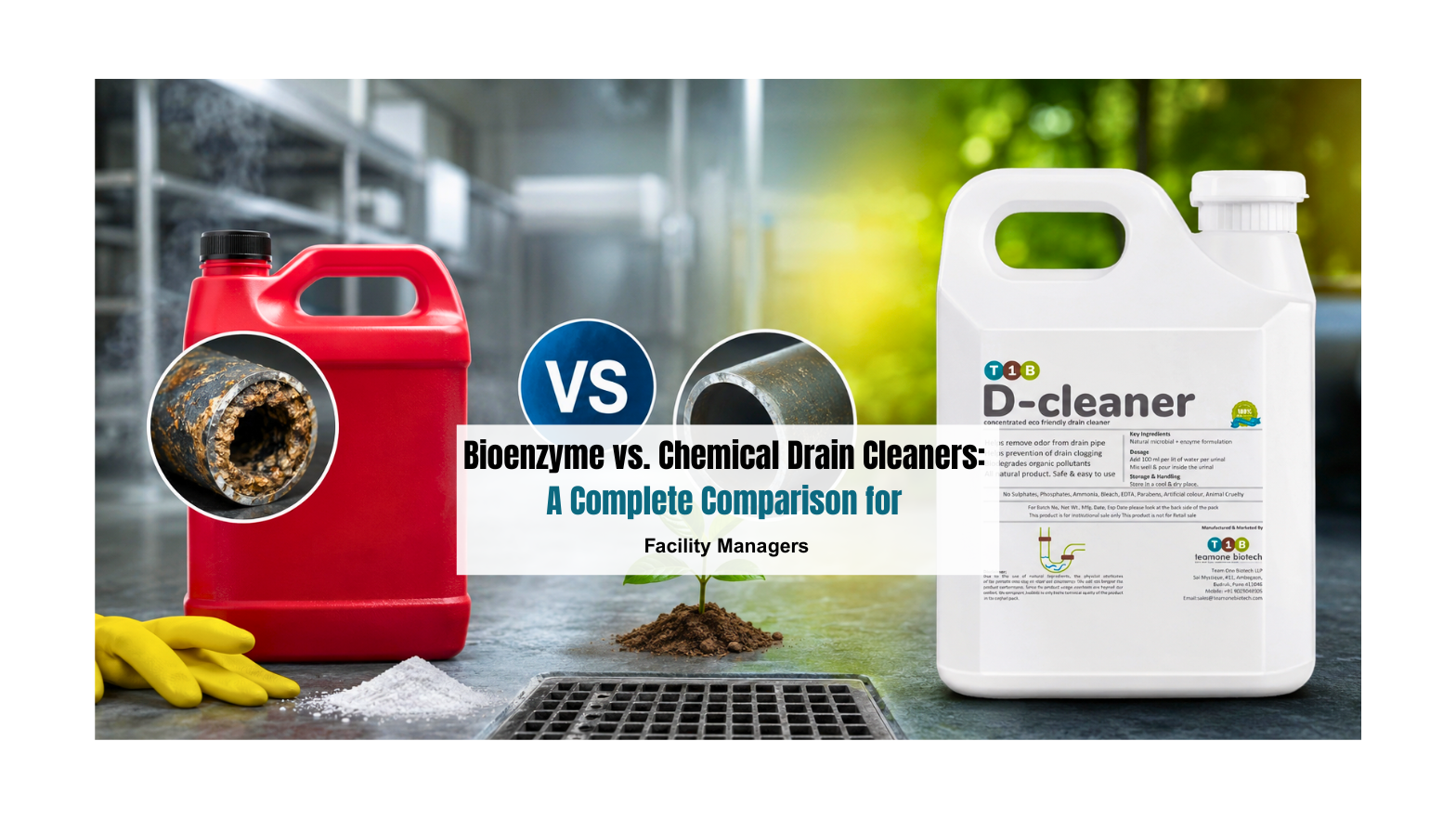
Bioenzyme vs. Chemical Drain Cleaners: A Complete Comparison for Facility Managers
It’s a Tuesday morning. Your hospital’s surgical wing is at full capacity. Or your school’s cafeteria is mid-service for 800 students. Or your corporate campus is hosting an investor walkthrough. And then, without warning, a drain line backs up.
The maintenance team reaches for the familiar blue bottle of chemical drain cleaner. Within minutes, the acrid smell drifts through the ventilation system. A nurse flags it. A teacher files a safety complaint. The facilities inbox lights up. You’ve solved one problem and created three more.
This is not a hypothetical. For operations directors and infrastructure heads managing complex, high-traffic plumbing networks across India, this scenario plays out with exhausting regularity. The real question isn’t just how to clear the blockage, it’s whether the solution you’re using is quietly compounding the very problem you’re trying to solve.
The debate around bio drain cleaner vs chemical approaches is no longer a fringe sustainability conversation. For facility managers navigating healthcare compliance, school safety regulations, municipal load restrictions, and increasingly stringent CPCB norms, it has become a core infrastructure decision.
The Chemical Illusion: Fast Results, Slow Damage
There’s a reason chemical drain cleaners remain the default in commercial settings. They work fast. Pour a concentrated acid or caustic alkali down a drain and the clog dissolves, often within minutes. For a facility manager under pressure, that speed feels like control.
But what facility plumbing maintenance professionals rarely see is the bill that arrives months later.
What harsh chemical cleaners actually do over time:
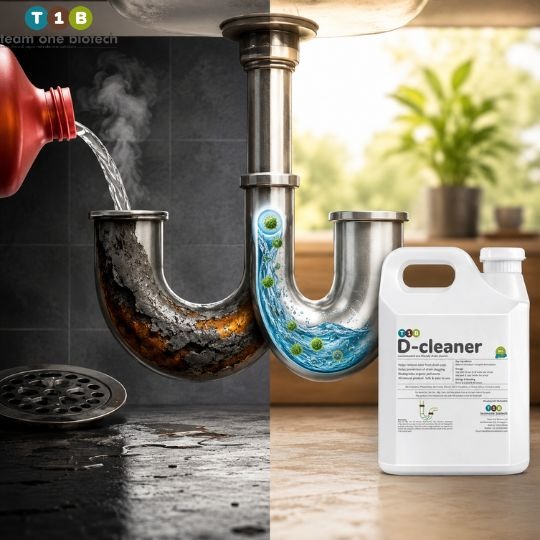
- Pipe degradation: Highly alkaline or acidic formulations attack the internal lining of older cast iron and PVC pipes alike. In buildings constructed more than a decade ago, common across Indian institutional infrastructure, repeated chemical use accelerates micro-fractures that are invisible until they cause a burst.
- Biofilm disruption without elimination: Chemical agents can strip the surface layer of organic buildup, but they rarely penetrate deep biofilm. What remains continues to accumulate, often faster, because the microbial balance within the pipe has been disrupted.
- Thermal and fume hazards: In enclosed mechanical rooms and drainage shafts typical of Indian hospitals and high-rise corporate campuses, the off-gassing from chemical cleaners can trigger HVAC safety shutdowns and create genuine occupational health liability.
- ETP interference: When chemical residues flush downstream into your facility’s Effluent Treatment Plant, they can temporarily neutralize the microbial colonies that your ETP depends on for biological treatment, undermining an expensive, compliance-critical system with a cheap maintenance shortcut.
The chemicals offer an illusion of resolution. The structural and regulatory costs accumulate in silence.
The Bioenzyme Paradigm: Maintenance That Works While You Sleep
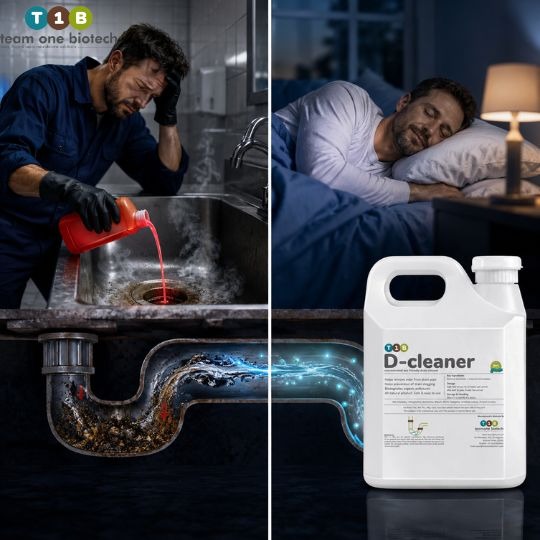
Enzymatic pipe cleaners and bio drain solutions operate on an entirely different logic. Rather than attacking organic matter with brute chemical force, they introduce concentrated microbial cultures and enzymes that digest fats, oils, grease (FOG), proteins, and cellulose at the molecular level.
Here’s how the process works in a commercial context:
Specific bacterial strains, typically lipase, protease, and amylase producers, are introduced into the drain system in liquid or granular form. These microbes colonize the pipe wall biofilm, continuously breaking down organic deposits as part of their metabolic cycle. Over a period of around 3 to 5 weeks of consistent application, a facility can expect to see a measurable reduction in blockage frequency and drain odour.
Note: These are general values and operational outcomes will vary based on the specific design, microbial load, and unique parameters of individual Effluent Treatment Plants (ETPs).
What makes this approach particularly suited to commercial drain maintenance in complex facilities is its cumulative nature. The microbial population doesn’t reset after each application, it builds. A drain network that has been on a consistent bioenzyme maintenance program for 2 to 3 months behaves fundamentally differently from one treated reactively with chemicals.
It’s the difference between having a maintenance system and having a maintenance crisis management system.
How This Plays Out Across Facility Verticals
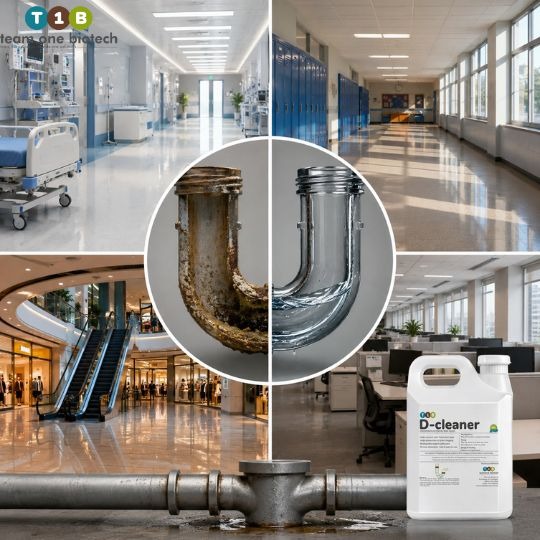
Hospitals and Healthcare Facilities
Healthcare environments present the highest-stakes intersection of plumbing performance and regulatory compliance. Drain systems in hospitals carry a uniquely hazardous mix: bodily fluids, pharmaceutical residues, surgical waste, and cleaning agent runoff, all moving through a network that must function without interruption.
Chemical cleaners in this context create compounding risks. Fume exposure in patient wards or sterile zones is not merely an inconvenience, it’s a compliance incident. More critically, the indiscriminate nature of strong chemicals means they don’t distinguish between harmful pathogens and the beneficial microbial colonies that help naturally suppress drain-borne hazards.
Eco-friendly bioremediation in healthcare settings offers a different model: targeted microbial cultures that can be selected for compatibility with the specific organic load profile of a hospital drain system. Properly deployed, they compete effectively against pathogenic organisms within the pipe environment, while posing no fume or chemical exposure risk to patients or staff.
Schools and Educational Institutions
In institutional settings serving children and adolescents, the calculus is straightforward: chemical exposure risk is unacceptable as a routine maintenance method. Yet the plumbing loads in Indian schools, particularly large residential schools and university campuses, are significant. Cafeteria grease traps, dormitory drain lines, and high-frequency washroom facilities all generate substantial FOG and organic load.
Bioenzyme solutions applied consistently to these systems address the load without introducing chemical hazards into environments where your exposure liability is at its highest. Over time, the reduction in emergency plumbing calls during academic sessions, when disruption is most costly, represents a tangible operational benefit alongside the safety case.
Malls, Corporate Campuses, and High-Traffic Commercial Hubs
This is where the institutional wastewater treatment challenge becomes genuinely complex. A large mall in a tier-one Indian city might see its food court drainage system handling load spikes during weekends and festivals that dwarf its weekday baseline. Corporate campuses with centralized kitchens face similar variability.
Indian operational conditions add specific layers of difficulty here. Monsoon-season plumbing backups, caused by a combination of elevated groundwater levels, municipal sewer surcharge, and intensified organic decomposition in warm, saturated conditions, can overwhelm drain networks that appear perfectly functional during dry months. Fluctuating municipal water quality affects the chemical behavior of both drain systems and treatment processes.
For facilities running their own Effluent Treatment Plants, the downstream implications of chemical drain cleaner use deserve particular attention. ETPs calibrated to handle specific influent chemistry can be significantly destabilized by periodic chemical flushes from building drainage. Bioenzyme-based maintenance, by contrast, is inherently compatible with biological treatment infrastructure, the microbial cultures in a well-managed drain system can actively support ETP performance rather than undermine it.
A facility managing significant daily wastewater volumes through its own ETP can expect, with consistent bioenzyme application across its drain network, to see improved influent quality reaching the treatment plant within a range of approximately 4 to 8 weeks of implementation.
Note: These are general values and operational outcomes will vary based on the specific design, microbial load, and unique parameters of individual Effluent Treatment Plants (ETPs).
Ready to stop managing plumbing emergencies and start preventing them? Request a custom facility audit from Team One Biotech’s technical team.
Head-to-Head: Bio Drain Cleaner vs Chemical
| Parameter | Chemical Drain Cleaners | Bioenzyme / Microbial Cleaners |
| Speed of Action | Immediate (hours) | Gradual (3–5 weeks for full biofilm colonization) |
| Structural Safety | Degrades pipe lining over repeated use | Non-corrosive; compatible with all pipe materials |
| Long-Term Cost Trend | Escalating (infrastructure damage, emergency calls) | Declining (preventive action reduces blockage frequency) |
| Fume / Safety Risk | Significant; HVAC and occupational hazard | None |
| ETP Compatibility | Disruptive to biological treatment processes | Supportive; enhances downstream microbial activity |
| Environmental Compliance | Risk of CPCB non-compliance in discharge | Aligned with bioremediation-positive regulatory direction |
| Maintenance Frequency | Reactive (applied at point of blockage) | Proactive (scheduled, low-dose, continuous) |
| Efficacy Against FOG | Surface-level dissolution only | Deep molecular digestion of fats, oils, and grease |
The ETP Connection: Why CPCB Compliance Makes This Decision Urgent
India’s regulatory environment around industrial and institutional wastewater is tightening. The Central Pollution Control Board’s guidelines on effluent quality increasingly scrutinize the inputs that reach treatment systems, not merely the output. For facilities operating their own ETPs or discharging to municipal treatment infrastructure, the chemical composition of drain cleaning agents is no longer a matter purely of internal maintenance preference.
Chemical drain cleaners that introduce high concentrations of chlorine compounds, strong acids, or persistent surfactants into a building’s wastewater stream can create compliance exposure at the point of ETP discharge testing. Bioenzyme-based maintenance, by design, introduces only biodegradable organic compounds and naturally occurring microbial populations, categories that CPCB’s framework for eco-friendly bioremediation actively supports.
For facility managers in sectors subject to environmental audit, hospitals, large commercial properties, manufacturing-adjacent campuses, this alignment is not a secondary consideration. It is increasingly a risk management requirement.
From Reactive Crisis to Proactive Infrastructure Strategy
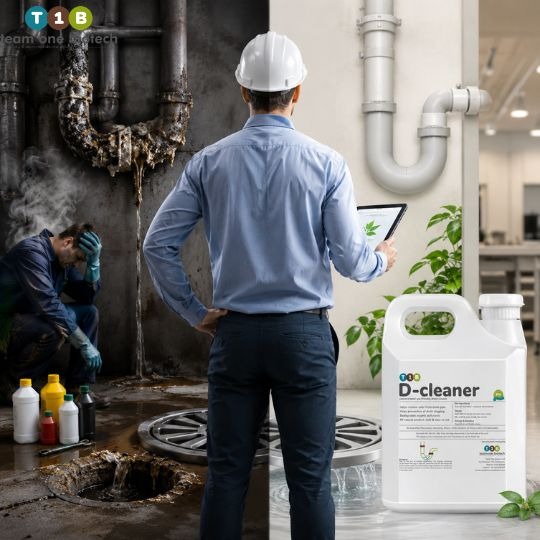
The facility managers who will navigate the next decade of Indian infrastructure complexity most effectively are those who stop treating plumbing as a problem to be solved when it breaks and start treating it as a system to be managed continuously.
Bioenzyme drain maintenance is not a premium product for sustainability-conscious buyers. It is a more intelligent operational framework, one that reduces emergency intervention costs, protects pipe infrastructure, keeps sensitive environments chemically safe, and positions your facility’s wastewater stream for regulatory compliance rather than periodic crisis.
The transition from chemical dependency to microbial maintenance does require a shift in scheduling logic: instead of reaching for a solution when a drain fails, you introduce a maintenance culture that prevents the failure from occurring. The return on that shift, in reduced downtime, reduced infrastructure repair, and reduced compliance risk, compounds over time in precisely the way that pipe damage from chemical cleaners does not.
Take the Next Step With Team One Biotech
Your facility has a unique plumbing load profile, a specific ETP configuration, and operational constraints that generic maintenance products cannot account for. Team One Biotech’s technical consultants work with facility managers across hospitals, educational institutions, corporate campuses, and municipal infrastructure to design bioenzyme maintenance programs calibrated to exactly those parameters.
Contact Team One Biotech today for a complimentary facility drain audit and a custom bioremediation maintenance plan built around your infrastructure, not a generic one-size-fits-all approach.
Looking to improve your ETP/STP efficiency with the right bioculture?
Talk to our experts at Team One Biotech for customised microbial solutions.
Contact: +91 8855050575
Email: sales@teamonebiotech.com
Visit: www.teamonebiotech.com
Discover More on YouTube – Watch our latest insights & innovations!-
Connect with Us on LinkedIn – Stay updated with expert content & trends!
