
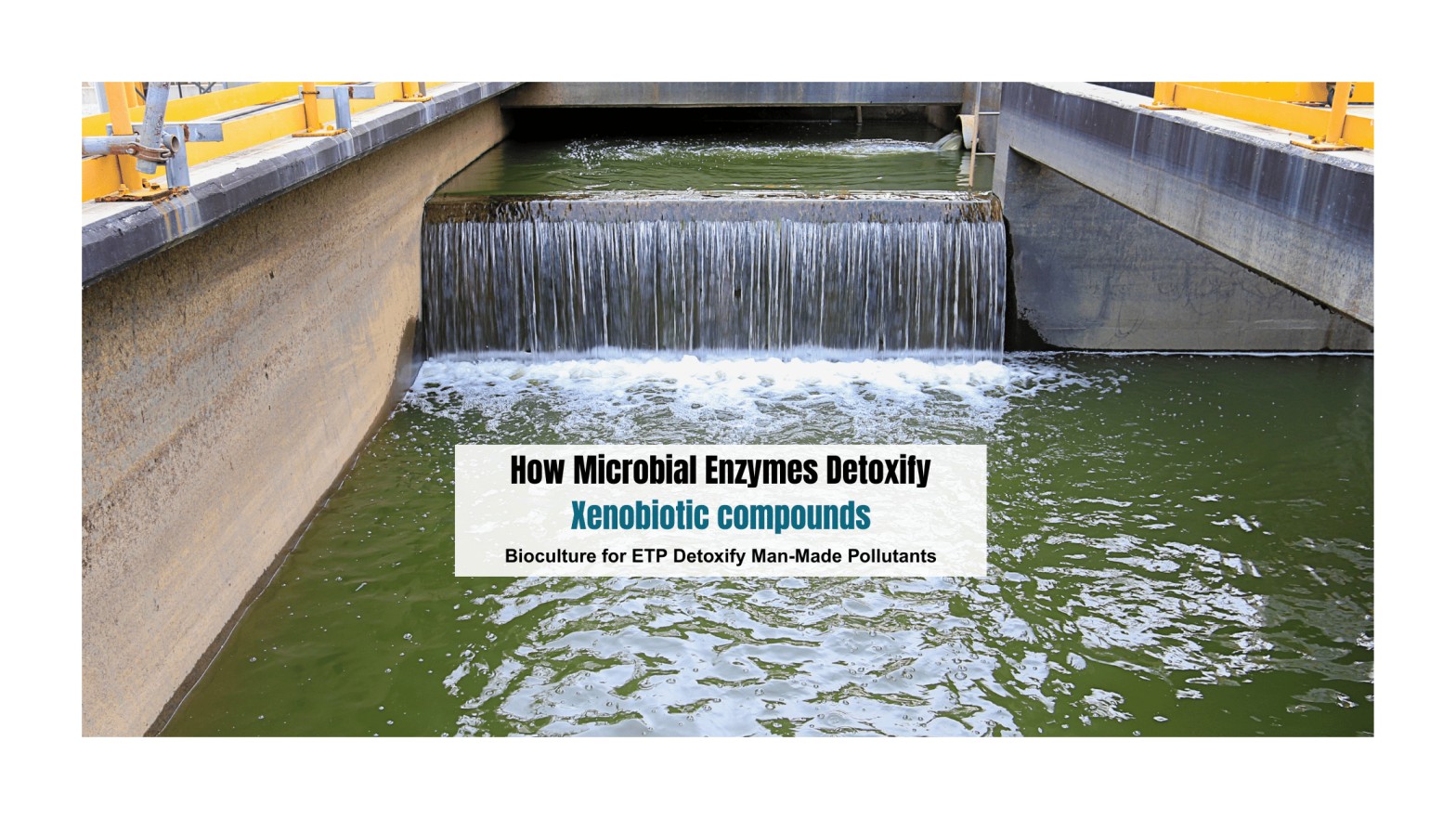
How Microbial Enzymes Detoxify Man-Made Pollutants
Biocultures for ETP- How Microbial Enzymes Detoxify Xenobiotic Compounds

Modern life depends on thousands of synthetic chemicals — plastics, pesticides, dyes, pharmaceuticals, fuels, and surfactants — that make living convenient but leave behind an uncomfortable legacy: xenobiotic compounds. These are man-made molecules that do not occur naturally and often resist degradation by normal biological pathways. They persist for decades, accumulate in ecosystems, and sometimes transform into even more toxic intermediates.

While conventional chemical and physical treatments can remove or immobilize some pollutants, they are energy-intensive and generate secondary waste. The sustainable alternative comes from nature itself — enzymes, the microscopic catalysts that drive every reaction inside living cells.

What Makes Xenobiotics So Stubborn

Xenobiotic molecules often contain:
• Halogenated groups (–Cl, –F, –Br) that make them chemically stable.
• Aromatic rings such as benzene that resist oxidation.
• Complex branching or polymeric chains that ordinary microbes can’t easily access.

Because of this structural complexity, the natural metabolic machinery of most microbes struggles to recognize these molecules as food.
Here’s where specialized microbial enzymes come into play — capable of attacking the unbreakable.

In industrial settings, especially in effluent treatment plants (ETPs), the accumulation of such persistent chemicals creates operational challenges. This is why many industries are now adopting biocultures for ETP systems to introduce pollutant-degrading microbes that can adapt to complex effluent loads.

How Enzymes Break the Unbreakable

Microbial enzymes act as molecular scalpels that cut and modify xenobiotic compounds into less toxic, more biodegradable forms. Key classes include:
Oxygenases and Monooxygenases – Insert oxygen into aromatic rings of hydrocarbons, initiating their breakdown (e.g., Pseudomonas oxygenases degrade benzene and toluene).
Peroxidases – Use hydrogen peroxide to oxidize phenols, dyes, and chlorinated pesticides.
Laccases – Multi-copper oxidases that transform phenolic and non-phenolic xenobiotics using atmospheric oxygen, with no harmful by-products.
Hydrolases and Esterases – Cleave ester and amide bonds in organophosphate pesticides, phthalates, and plastics.
Dehalogenases – Remove halogen atoms, converting recalcitrant chlorinated compounds like PCBs or trichloroethylene into simpler molecules.
Nitroreductases and Dehydrogenases – Detoxify nitroaromatics and explosives such as TNT by reduction and further mineralization.

These enzymatic steps either mineralize the contaminant completely into CO₂ and H₂O or transform it into intermediates that native microbes can assimilate.

When industries use biocultures for ETP, they are essentially introducing microbial communities capable of producing these enzymes naturally inside the aeration tank, equalization tank, or bioreactor. This ensures continuous in-situ enzyme production without requiring costly direct enzyme dosing.

Why Direct Enzyme Application Is Not Recommended

Although enzymes are highly efficient and environmentally friendly catalysts, they should not be administered directly into wastewater systems or soil environments. Free enzymes are unstable in real-world industrial conditions — they degrade quickly, get denatured by temperature, pH, or chemicals in the effluent, and lose activity within hours. They also lack the self-regenerating ability of microbes, meaning continuous dosing becomes impractical and extremely expensive. For sustainable bioremediation, enzymes must be produced in situ by living microbial communities that can multiply, adapt, and secrete fresh enzymes as required.

Why Enzyme-Based Bioremediation Matters
  1. Eco-friendly and specific – Enzymes target particular chemical bonds without producing toxic residues.
  2. Operate under mild conditions – They work at ambient temperature and pH, saving energy.
  3. Applicable to diverse pollutants – From pharmaceuticals and dyes to polyaromatic hydrocarbons and endocrine-disrupting compounds.
  4. Compatible with immobilization and reactors – Laccases, peroxidases, and hydrolases can be immobilized on carriers, enabling continuous treatment of wastewater streams.
  5. Synergy with microbes – Enzyme production in situ through microbial consortia sustains long-term remediation in soils, sediments, and bioreactors.

This is why biocultures for ETP are preferred — because living microbes multiply, adapt to effluent changes, and continuously secrete the required enzymes.

Biocultures for ETP: The Most Effective Way to Deliver Enzymes

In modern effluent treatment plants (ETPs), biocultures — specialized microbial consortia — are the safest and most effective way to introduce enzymes into the system. These microbes naturally produce a broad spectrum of enzymes such as oxygenases, hydrolases, laccases, and dehalogenases based on the pollutants present.

Biocultures:

• Maintain stable microbial populations
• Continuously regenerate and secrete fresh enzymes
• Break down complex industrial pollutants
• Reduce sludge generation
• Enhance COD/BOD removal
• Improve overall ETP stability and efficiency
• Reduce chemical dependency in biological treatment stages

For industries handling pharmaceuticals, chemicals, food processing waste, textiles, and dyes, biocultures for ETP have become an essential part of sustainable operations.

The Bigger Picture

Enzymes remind us that sustainability lies in mimicking nature’s chemistry rather than fighting it. They allow us to convert hazardous xenobiotics into harmless end-products without toxic by-products or energy-intensive treatment steps.

With the rising emphasis on zero-liquid-discharge (ZLD), operational efficiency, and cost control, adopting biocultures for ETP is no longer optional — it is a strategic environmental requirement for industries.

Looking for High-Performance Biocultures for Your ETP?

Team One Biotech provides premium microbial formulations designed for:

  • COD/BOD reduction

  • Sludge minimization

  • Colour & odour removal

  • Faster biological stabilisation

  • Enhanced ETP compliance

Our specialized enzyme-rich biocultures for ETP work across industries including pharmaceuticals, chemicals, textiles, food processing, dyes, FMCG, and more.

Industries today are also increasingly adopting biocultures for ETP not only for better pollutant degradation but also for their economic benefits. By improving microbial efficiency, reducing chemical usage, stabilizing biological reactions, and minimizing sludge handling expenses, biocultures significantly reduce overall treatment costs. To understand this in depth, you can explore how biocultures directly contribute to lowering operational and maintenance expenses in industrial wastewater systems here: How Biocultures Save Costs in Industrial Wastewater Treatment.

As one of the leading biotech companies in India and trusted bioremediation companies in India, Team One Biotech continues to deliver solutions that redefine sustainability across wastewater treatment, agriculture, aquaculture, and hygiene management.

Contact us at- +91 8855050575

Email: sales@teamonebiotech.com

Visit: www.teamonebiotech.com

Discover More on YouTube – Watch our latest insights & innovations!-

Connect with Us on LinkedIn – Stay updated with expert content & trends!

Bioremediation & Biocultures In Wastewater Treatment :Myths vs Truths
Bioremediation & Biocultures In Wastewater Treatment : Myths vs Truths
Introduction: Cutting Through the Noise

Bioremediation and microbial biocultures are transforming how industries manage wastewater. Yet, despite proven success in ETPs, STPs, and industrial wastewater systems, there are widespread misconceptions. To explore the right approach for your facility, Contact Us.

Too often, decision-makers expect overnight miracles or assume dosing is optional. These myths not only delay results but also undermine the effectiveness of biological solutions.

Let’s separate facts from fiction with some common myths about bioremediation.

  • Myth 1: “ Adding biocultures once will heal my system in one day.”
  • Truth: Bioremediation is a biological process, not an instant chemical reaction.

Microbes require time to acclimatize, multiply, and colonize the wastewater system.

Typically:

  • Heavy Dosing is done initially to build biomass quickly.
  • Visible results (Odour control, COD reduction) appear within days to weeks, depending on the load.
  • Stable long-term performance takes sustained dosing and monitoring.

Fact: Expecting overnight results ignores the science of microbial growth and can lead to disappointment.

  • Myth 2: “Wasting Sludge means losing valuable biomass”
  • Truth: Regular wasting is necessary to maintain healthy microbial populations.

In ETPs/STPs, biomass grows continuously. Without wasting:

  • Excess sludge accumulates, leading to poor oxygen transfer and bulking.
  • Old biomass becomes inactive, reducing treatment efficiency.
  • The system risks sludge carryover and poor settling.

Fact: Controlled wasting removes excess and unhealthy biomass, allowing fresh microbes to thrive.

  • Myth 3: “ Daily dosing isn’t needed in a continuous ETP flow.”
  • Truth: Continuous flow means continuous load-& microbes need continuous replenishment.
 
  • Wastewater inflow brings a fresh organic load every day.
  • Environmental shocks (pH, toxins, load fluctuations) can stress microbial populations.
  • Without daily dosing, microbial strength weakens, leading to consistent COD/BOD reduction.

Fact: Think of dosing like “feeding your system”— consistent inputs maintain consistent output.

  • Myth 4: “ Once microbes are added, they can survive forever.”
  • Truth: Microbes are living organisms, not permanent chemicals.
 
  • Microbes need optimal conditions (DO, pH, nutrients) to thrive.
  • Harsh conditions (shock loads, toxic chemicals, chlorine) kill microbial populations.
  • Even in healthy systems, microbial turnover requires regular replenishment.

Fact: Biocultures extend the life of your ETP/STP but cannot defy natural biological limits.

  • Myth 5: “ Higher dosing means faster results.”
  • Truth: Overdosing doesn’t accelerate bioremediation-it destabilizes it.


  • Microbial populations grow logarithmically when given the right environment.
  • Beyond a certain point, excess microbes compete for food and oxygen, leading to biomass stress.
  • Effective dosing is based on MLSS, influent load, and system design, not “more is better.”

Fact: Precision dosing ensures both performance and cost-effectiveness.

  • Myth 6: “Bioremediation only works for easy-to-degrade pollutants.”
  • Truth: Advanced bioculture consortia can also address oils, grease, and certain tough-to-degrade compounds.


  • Specialized strains degrade FOG (Fats, Oils & Grease).
  • Some formulations target ammonia, sulfides, and nitrates.
  • In combination with physical-chemical methods, microbes help reduce chemical dependency.

Fact: Bioremediation is versatile and can be customized for chemical, food & beverage, pharma, and municipal sectors.

  • Myth 6: “If my system is running fine, I don’t need biocultures.”
  • Truth: Wastewater loads and conditions are never constant.


  • Seasonal fluctuations, production cycles, or toxic shocks can disrupt treatment.
  • Biocultures act as a biological insurance policy, keeping the system resilient.
  • Even well-performing ETPs see improving sludge reduction, odor control, and compliance consistency.

Fact: Prevention is cheaper than a cure. Biocultures maintain stability in unpredictable environments.


The Real Takeaway – Bioremediation is Science, Not Magic

Bioremediation works – but only when applied with scientific understanding, consistent dosing, and proper system management.

At Team One Biotech, our solutions are designed for:

  • Gradual yet consistent performance improvement
  • Long-term compliance stability
  • Reduced operating costs and sludge volumes

By debunking myths and focusing on facts, industries can make informed choices and maximize returns from their wastewater systems.

 Explore More Solutions by Team One Biotech

Apart from biocultures for wastewater treatment, Team One Biotech also offers innovative and eco-friendly solutions across multiple sectors, including:

Plant Growth Promoters – microbial formulations for improved agricultural productivity

– Aquaculture Probiotics – supporting fish and shrimp health naturally

Bio Enzyme Floor Cleaner – eco-safe cleaning for homes and industries

Multipurpose Cleaner – powerful natural alternative to chemical cleaners

Septic Tank Cleaning Powder – maintaining septic efficiency and reducing odour

Probiotic Drain Cleaner – preventing clogs and ensuring hygienic drains

As one of the leading biotech companies in India and trusted bioremediation companies in India, Team One Biotech continues to deliver solutions that redefine sustainability across wastewater treatment, agriculture, aquaculture, and hygiene management.

Email: sales@teamonebiotech.com

Visit: www.teamonebiotech.com

Discover More on YouTube – Watch our latest insights & innovations!-

Connect with Us on LinkedIn – Stay updated with expert content & trends!

Ammoniacal Nitrogen In Wastewater Wastewater Treatment Methods
Ammoniacal Nitrogen in Wastewater: Challenges & Treatment Solutions
What is Ammoniacal Nitrogen?

Ammoniacal nitrogen (NH₄⁺-N) is a crucial parameter in wastewater treatment, representing ammonia (NH₃) and ammonium ions (NH₄⁺). It primarily originates from industrial effluents, municipal sewage, and agricultural runoff. High concentrations of ammoniacal nitrogen can be toxic to aquatic life, cause oxygen depletion in water bodies, and contribute to eutrophication and nitrate contamination. The need for efficient biocultures for ETP (Effluent Treatment Plants) is growing as industries seek sustainable wastewater solutions.

???? Visit: www.teamonebiotech.com/contact-us

nitrogen removal from wastewater

Sources of Ammoniacal Nitrogen in Wastewater
  • Industrial Wastewater – Fertilizer, textile processing, and chemical manufacturing industries discharge high levels of ammoniacal nitrogen.
  • Municipal Sewage – Organic matter decomposition, septic systems, and sludge digestion contribute to ammonia buildup.
  • Agricultural Runoff – Leaching of synthetic fertilizers, livestock waste, and manure management result in nitrogen contamination.
Environmental & Regulatory Concerns

Excess ammoniacal nitrogen leads to surface water pollution, affecting aquatic ecosystems and drinking water quality. Regulatory bodies such as the CPCB (India), USEPA (USA), and the EU Water Framework Directive have established strict discharge limits for ammonia levels to prevent aquatic toxicity. To comply with these regulations, industries are increasingly adopting biocultures for ETP to enhance wastewater treatment efficiency.

Ammoniacal Nitrogen Treatment Technologies
Biological Treatment
  • Nitrification & Denitrification – Utilizing specialized microbial cultures/biocultures, including bio cultures for wastewater treatment and bacteria cultures for effluent treatment plants, to convert ammonia into nitrogen gas.
  • Bioremediation Techniques – Custom bioculture for wastewater solutions improve ammonia removal efficiency in wastewater treatment plants.
  • Advanced Solutions – Customized bioculture formulations, enzymatic treatment, and membrane bioreactors (MBR) for efficient ammonia removal
Physico-Chemical Treatment
  • Air Stripping – Removes volatile ammonia by increasing pH and aeration.
  • Chemical Oxidation – Uses oxidizing agents like chlorine or ozone to convert ammonia to nitrogen gas.
  • Coagulation-Flocculation & Ion Exchange – Enhances ammonia removal through chemical precipitation and exchange processes.

wastewater treatment solutions

Advanced Solutions
  • Customized Bioculture Formulations – Tailored microbial solutions for effective ammoniacal nitrogen breakdown.
  • Enzymatic Treatment – Biotechnological advancements aid in ammonia degradation.
  • Membrane Bioreactors (MBR) – Advanced filtration systems for wastewater treatment plant optimization.
  • Aquaculture Probiotics – Beneficial bacterial strains improve water quality in aquaculture applications.
Conclusion

Controlling ammoniacal nitrogen in wastewater treatment plants is essential for environmental sustainability. Industries must adopt efficient treatment strategies such as biocultures for ETP, bio cultures for wastewater treatment, and eco-friendly alternatives to ensure regulatory compliance and reduce ecological impact. By leveraging innovative solutions, including bio cultures for ETP, industries can significantly improve wastewater treatment efficiency.

Are you looking for a reliable wastewater treatment solution?

???? Discover More on YouTube – Watch our latest insights & innovations!-
???? Connect with Us on LinkedIn – Stay updated with expert content & trends!

???? Contact us today to explore customized bioremediation strategies for your industry!
???? Email: sales@teamonebiotech.com
???? Visit: www.teamonebiotech.com/contact-us

Scan the code