

Case Study: Reducing Sludge Dewatering Costs by 40% with Microbial Bio-augmentation
The Cost No One Talks About in Your P&L
Every plant manager knows the obvious costs, power, raw materials, compliance audits. But there is one line item that quietly bleeds operational budgets dry, quarter after quarter: ETP sludge management.
In Indian textile mills, pharmaceutical units, distilleries, and chemical plants, sludge disposal is no longer just an inconvenience. It has become a significant and growing operational liability. Filter presses running at high electricity draw. Polymer and coagulant chemicals ordered in bulk every month. Third-party sludge haulers charging more with every trip. And despite all of it, the sludge keeps coming, wet, heavy, and expensive.
If your ETP sludge is consistently coming off the filter press at 85–95% moisture content, you are not just dealing with a dewatering problem. You are dealing with a biological treatment failure upstream. And the meter is running.
Why Indian ETPs Face a Uniquely Difficult Challenge
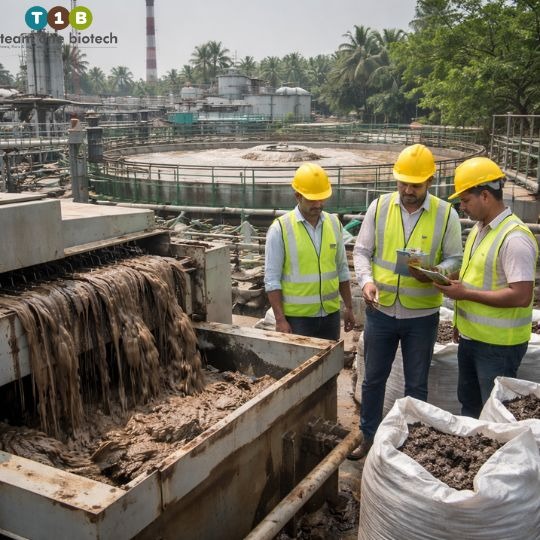
The problem is not simply poor equipment or undertrained operators. Indian industrial ETPs operate under a set of conditions that are genuinely difficult to manage:
- Highly fluctuating organic loads, Batch production cycles in pharma and distilleries create feast-or-famine conditions for biological systems, often destabilizing the microbial ecosystem in the aeration tank.
- Climatic variability, From a 12°C winter morning in Ludhiana to a 42°C summer afternoon in Surat, temperature swings stress microbial populations in ways that laboratory-designed systems rarely account for.
- Complex and inhibitory wastewater composition, High BOD, COD, TDS, and the presence of recalcitrant compounds in textile dye effluents or solvent-heavy pharmaceutical discharge actively suppress native microbial communities.
- CPCB and SPCB pressure, Discharge norms are tightening. Consent to Operate renewals now scrutinize sludge disposal records, TSDF utilization, and biological treatment efficiency with far greater intensity than even five years ago.
- Rising TSDF costs, With hazardous sludge disposal at authorized facilities becoming more expensive and logistics more complex, the cost per metric tonne of wet sludge keeps climbing.
The result: ETP operators pour more chemicals into a system that is biologically weak, produce more sludge than the system should generate, and then spend more money trying to dewater sludge that simply does not want to release its water.
The Case Study: A Large-Scale Industrial ETP Struggling to Break Even on Sludge Costs

The Facility
A mid-to-large industrial unit, operating a combined biological treatment system handling both aerobic and anaerobic process streams, was experiencing chronic sludge management issues. The facility ran a conventional activated sludge process followed by a secondary clarifier and a filter press dewatering unit. On paper, the system was adequate. In practice, it was consistently underperforming.
The Problem
The plant’s ETP team flagged several compounding issues over a period of months:
- Sludge moisture content stubbornly holding at 88–93%, despite optimal filter press cycle times and regular polymer dosing adjustments.
- Chemical coagulant consumption rising quarter-on-quarter with diminishing returns on cake dryness.
- Biological treatment zones showing poor VSS/TSS ratios, indicating a weak and unbalanced microbial community, too much inert biomass, not enough active degraders.
- Effluent quality intermittently failing BOD and COD discharge standards during peak load periods, attracting regulatory scrutiny.
- Sludge disposal volumes, and the associated TSDF costs, had increased substantially over the preceding financial year, making sludge management one of the top three operational cost centres in the ETP budget.
The root cause was clear upon detailed assessment: the biological treatment system was not breaking down complex organics efficiently. Instead of being mineralized within the system, organic matter was being carried forward into the sludge, adding to its mass and making it structurally resistant to mechanical dewatering. A filter press cannot fix what biology has failed to do.
The Solution: A Targeted Bio-augmentation Program
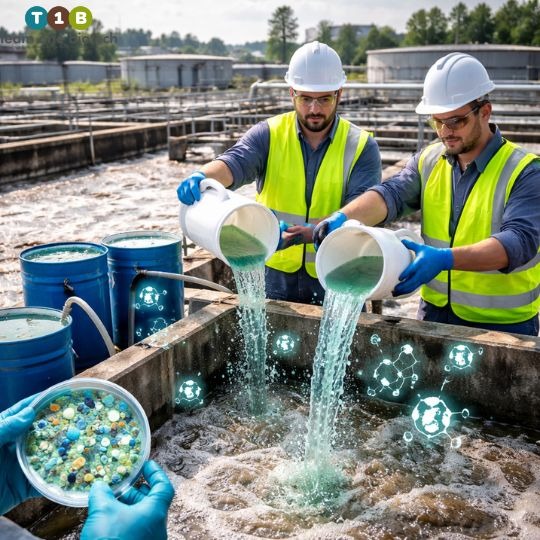
Rather than recommending capital expenditure on new equipment, the approach taken was fundamentally different, restore and reinforce the biological engine at the core of the ETP.
A customized microbial bio-augmentation program was designed and deployed across the facility’s biological treatment and anaerobic process zones. Here is what that involved:
Microbial Selection and Customization
Not all microbial consortia are equal. Generic, off-the-shelf products often fail in complex industrial wastewater because they are not matched to the specific substrate chemistry of the effluent. In this case, a site-specific microbial formulation was developed after wastewater characterization, targeting:
- High-efficiency heterotrophic bacteria capable of degrading complex COD fractions under variable load conditions
- Specialized hydrolytic organisms to break down long-chain polymeric organics in the sludge matrix itself
- Facultative anaerobes adapted to function effectively across the temperature and pH ranges observed at this facility
- Acid-phase and methanogenic bacteria for reinforcing the anaerobic process zone’s capacity to handle shock loads
Deployment Protocol
Bio-augmentation was not treated as a one-time addition. The protocol involved:
- Seeding the aeration tank and anaerobic digester with the tailored microbial consortium during a controlled inoculation phase
- Monitoring VSS activity, SVI (Sludge Volume Index), and F:M ratio on a weekly basis during the stabilization window
- Gradual reduction in chemical coagulant dosing as biological floc quality improved and the sludge’s natural dewatering characteristics strengthened
- Ongoing performance reviews tied to sludge cake moisture readings and monthly disposal volumes
Addressing India-Specific Challenges
Recognizing that seasonal temperature drops would periodically stress the newly augmented biomass, the program included cold-tolerant microbial strains in the formulation, organisms selected for functional stability at lower temperatures without losing hydrolytic activity. This is a critical design consideration that generic bio-augmentation products routinely ignore.
The Science Behind Better Dewaterability
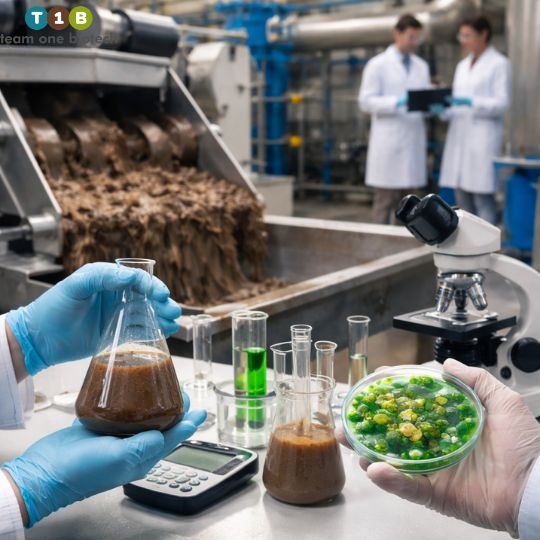
Understanding why bio-augmentation reduces sludge dewatering costs requires a brief look at what makes ETP sludge difficult to dewater in the first place.
Why Sludge Holds Water
Sludge dewaterability is not just a mechanical issue. It is a biological and physicochemical issue. The key factors are:
- Extracellular Polymeric Substances (EPS): Microbially-produced biopolymers that trap water molecules within the sludge floc structure. High EPS concentrations, common in stressed or overfed biological systems, make sludge sticky, voluminous, and resistant to pressing.
- Colloidal and bound water: A significant fraction of moisture in poorly conditioned sludge is chemically bound to organic particles, not free water that a press can expel.
- Poorly structured floc: Weak biological communities produce filamentous or dispersed floc with poor settling and compression characteristics, as opposed to the dense, compact floc formed by a healthy, well-balanced biomass.
What Bio-augmentation Changes
When specialized microorganisms in bioremediation are introduced and allowed to establish, several changes occur in the sludge matrix:
- EPS hydrolysis: Certain organisms within the consortium produce extracellular enzymes, particularly proteases, lipases, and glucanases, that actively degrade the EPS matrix, releasing bound water and reducing overall sludge volume.
- Enhanced organic mineralization: Complex organics that would otherwise persist in the sludge and contribute to its mass are broken down to carbon dioxide, water, and simple mineral compounds, reducing volatile solids content and sludge generation at the source.
- Improved floc architecture: A diverse, healthy microbial population produces well-structured floc with better compression characteristics, allowing filter presses to achieve significantly drier cake with less polymer input.
- Reduced endogenous decay residue: When biological treatment is highly efficient, less inorganic inert residue accumulates as waste biomass, reducing the non-compressible fraction in the sludge cake.
In simple terms: fix the biology, and the sludge takes care of itself.
The Results
Over a monitored period following full program deployment, the facility recorded the following improvements across its sludge treatment and biological treatment operations:
| Parameter | Observed Change |
| Sludge cake moisture content | Reduced from 88–93% to 72–78% range |
| Dewatering operating costs | 35–45% reduction |
| Chemical coagulant consumption | 20–30% reduction |
| Monthly sludge disposal volumes (wet weight) | 30–40% reduction |
| Filter press cycle efficiency | 15–25% improvement in throughput |
| Effluent BOD/COD compliance | Consistent pass during peak load periods |
The cumulative financial impact was substantial. A reduction in wet sludge volume of 30–40% directly translates to fewer TSDF trips, lower transport costs, and significantly reduced disposal fees, recurring savings that compound on a monthly basis.
The reduction in coagulant and polymer chemical spend provided additional operating cost relief, while improved filter press throughput reduced electricity consumption per tonne of sludge processed.
Note: The figures mentioned are general industry ranges based on specific case studies; actual results may vary depending on the unique characteristics and operational parameters of each individual ETP.
What This Means for Your ETP Budget
The financial logic is straightforward. If your plant generates, for example, 500 kg of wet sludge per day at 90% moisture content, a reduction to 75% moisture content does not just make the cake drier, it fundamentally reduces the mass you are paying to dispose of. That delta, multiplied across 300 operating days and priced at current TSDF disposal rates, is a number worth calculating.
Bio-augmentation is not a product you buy once and forget. It is a managed biological intervention, an ongoing program with monitoring, dose adjustment, and performance accountability built in. The cost of the program is, in virtually every well-executed case, a fraction of the savings it generates.
Is Your ETP a Candidate for Bio-augmentation?
The following indicators suggest your facility could benefit significantly from a structured microbial program:
- Filter press cake consistently above 78–80% moisture content
- Monthly chemical coagulant and polymer costs trending upward with no improvement in performance
- SVI above 150 mL/g, indicating poor sludge settling
- Effluent BOD/COD occasionally failing during high-load periods
- TSDF disposal costs representing more than 15–20% of your total ETP operating budget
- Biological treatment zones showing signs of bulking, foaming, or poor clarifier performance
If three or more of these apply to your plant, the problem is almost certainly upstream in your biology, not in your mechanical dewatering equipment.
Take the Next Step: Book a Sludge Audit
Team One Biotech’s technical team works directly with ETP operators and plant managers across Indian textile, pharma, distillery, and chemical sectors. Our process begins with a no-obligation Sludge Audit, a structured technical assessment of your current biological treatment performance, sludge characteristics, and dewatering efficiency.
The audit identifies exactly where your system is losing value and provides a quantified estimate of the cost reduction achievable through targeted bio-augmentation.
To schedule your Sludge Audit or speak directly with our technical team, contact Team One Biotech today.
Your sludge disposal costs are not a fixed expense. They are a recoverable loss, and the biology to recover them already exists.
Looking to improve your ETP/STP efficiency with the right bioculture?
Talk to our experts at Team One Biotech for customised microbial solutions.
Contact: +91 8855050575
Email: sales@teamonebiotech.com
Visit: www.teamonebiotech.com
Discover More on YouTube – Watch our latest insights & innovations!-
Connect with Us on LinkedIn – Stay updated with expert content & trends!