


Bio-fertilizers for Drip Irrigation: Benefits and Best Practices
Ramesh Patil had done everything right. Or so he thought.
The 48-year-old sugarcane farmer from Sangli district had invested heavily in drip irrigation five years ago, convinced it would solve his water problems and boost yields. He’d followed the advice of every fertilizer dealer in the market, pumping his fields with potassium nitrate, phosphoric acid, and urea through those precision emitters. His soil test reports showed adequate NPK levels. Yet, season after season, his yields plateaued and then began to decline.
The earth had become hard. Unresponsive. Dead.
What Ramesh didn’t know, what thousands of Indian farmers are only now discovering, is that he’d been feeding the plant while starving the soil. His drip system, that marvel of modern agriculture, had become a delivery mechanism for a slow poisoning. The chemical salts had built up. The soil pH had crashed. And most critically, the billions of microorganisms that once made his soil alive had simply disappeared.
This is the hard earth reality facing Indian agriculture today. But it’s also the doorway to a profound transformation, one that begins not with more chemicals, but with restoring the biological intelligence of our soils through bio-fertilizers in drip irrigation.
To understand how to implement these biological solutions in your own fields, read our full report: The Future of Indian Farming: A Guide to Bio-fertilizers and Soil Health.
The Silent Crisis in Indian Soils
Let’s speak plainly about what’s happening beneath our feet.
The Punjab breadbasket, which fed the Green Revolution, now suffers from such severe micronutrient deficiency and organic carbon depletion that wheat yields have stagnated for over a decade. In Maharashtra’s grape belt, soil salinity has rendered thousands of hectares marginal. Cotton farmers in Vidarbha pump more DAP every year while watching their input costs devour their profits and their soil structure collapse into powder.
The government’s Soil Health Card scheme has confirmed what traditional farmers always knew: healthy soil is living soil. Current data shows that over 60% of Indian agricultural soils are deficient in organic carbon, with levels below the critical 0.5% threshold. When organic matter dies, so does the soil’s capacity to hold water, cycle nutrients, or support plant immunity.
Chemical fertilizers deliver nutrients, yes, but they’re hardware without software. They don’t build soil structure. They don’t create nutrient banks. They don’t protect roots from pathogens or help crops withstand drought stress. They’re a transaction, not a relationship.
Bio-fertilizers, by contrast, are the soil’s software engineers.
Understanding the Science of Bio-Fertigation
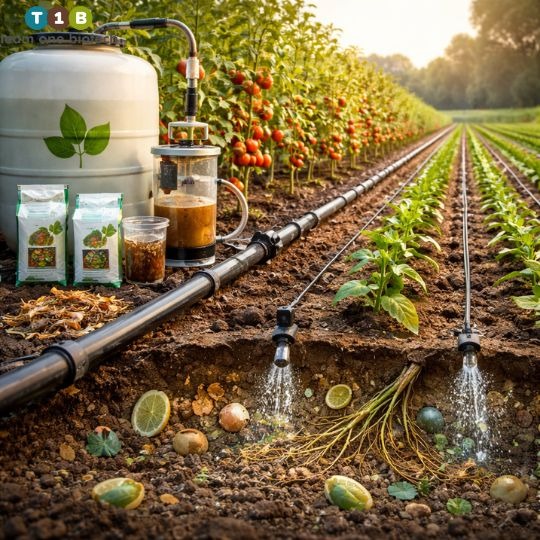
Fertigation, the practice of delivering fertilizers through irrigation systems, revolutionized precision agriculture. When you combine this precision with biological inputs rather than chemical ones, you create something entirely new: a living delivery system that rebuilds soil health while feeding crops.
Here’s how the science works:
Nitrogen Fixation Through the Drip Line
Liquid bio-fertilizers containing Azotobacter and Rhizobium species don’t just supply nitrogen, they colonize the root zone and manufacture it from atmospheric sources. When delivered through drip irrigation, these bacteria establish themselves in the exact zone where root activity is highest. In a properly managed system, these microbes can fix 20-30 kg of nitrogen per hectare per season, reducing chemical nitrogen dependence by up to 25%.
Phosphorus Solubilization at the Emitter Point
Phosphate-solubilizing bacteria (PSB) like Bacillus megaterium and Pseudomonas species work differently than DAP. They don’t add phosphorus, they unlock what’s already there. Indian soils often contain 300-500 kg of bound phosphorus per hectare that plants cannot access. PSB produce organic acids that release this locked phosphate, making it bioavailable exactly where the drip emitter creates that moist, active root zone.
The Potassium Connection
Potash-mobilizing bacteria work on the same principle, transforming insoluble potassium minerals in the soil into plant-available forms. This is particularly crucial for crops like pomegranate and grapes, which are heavy potassium feeders.
The beauty of bio-fertigation is precision meets biology. You’re not broadcasting microbes across a field and hoping they survive. You’re placing them, with water, directly into the active root zone where they can immediately begin their work.
The Technical Challenge: Making Biology Work in Drip Systems
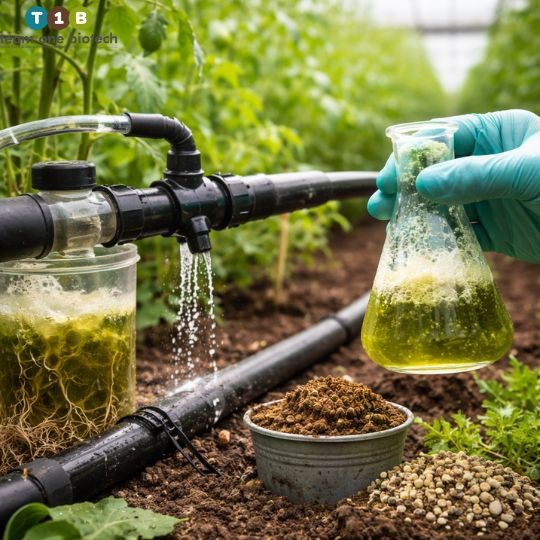
Here’s where many farmers stumble, and understandably so. Drip irrigation systems are engineered for liquid chemicals, inert, stable, predictable. Living organisms are none of these things. They need oxygen. They can clump. They can potentially clog those tiny emitter holes that cost thousands of rupees per acre to install.
But these challenges are entirely solvable with proper technique.
Filtration is Non-Negotiable
Your drip system should already have screen or disc filters for preventing sediment clogging. For bio-fertilizers, these same filters work, but you need to be more vigilant. Use filters in the 120-200 mesh range. After applying bio-fertilizers, flush the system with clean water for 10-15 minutes. This prevents any bacterial biomass from settling in the laterals overnight.
Quality liquid bio-fertilizers formulated for fertigation should have minimal suspended solids. If you’re seeing thick sludge or sediment in the bottle, that’s a red flag about manufacturing quality.
Timing Matters More Than You Think
Apply bio-fertilizers during the cooler parts of the day, early morning before 9 AM or late evening after 5 PM. This isn’t just folklore. UV radiation kills beneficial bacteria. High temperatures stress them. Applying during midday in the Indian summer is essentially sterilizing your product in the field.
Moreover, cooler temperatures mean the irrigation water itself is cooler, and these microorganisms are sensitive to thermal shock. Water temperature above 35°C significantly reduces bacterial survival.
The Farmer’s Manual: Best Practices for Bio-Fertigation
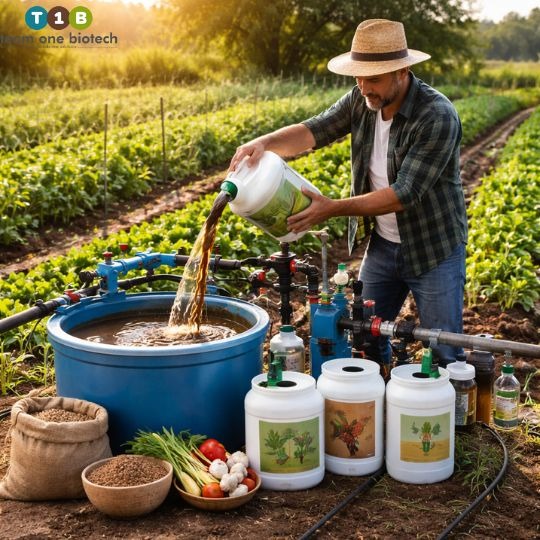
Let me give you a protocol that works, tested across thousands of acres from Nashik’s grape farms to Davangere’s cotton fields.
Pre-Application: The Jar Test
Before you inject any bio-fertilizer into your system, do this simple compatibility test. Take a clean glass jar. Add 100 ml of your irrigation water. Add the recommended dose of bio-fertilizer. If you’re using any other inputs, add them in sequence. Wait 30 minutes.
What you’re looking for: the solution should remain uniformly mixed without precipitation, flocculation, or phase separation. If you see particles settling or layers forming, you have a chemical incompatibility. Bio-fertilizers are generally incompatible with strongly acidic fertilizers (pH below 4) or heavy metal-containing compounds.
Application Protocol
Step 1: Irrigate First Run your drip system with plain water for 15-20 minutes. This primes the soil, creates uniform moisture, and ensures your emitters are functioning properly.
Step 2: Prepare the Bio-Fertilizer Solution In a clean container, mix the liquid bio-fertilizer with water at the manufacturer’s recommended dilution. For most products, this is 2-5 liters per acre diluted in 50-100 liters of water. Never mix concentrated bio-fertilizer directly into your fertilizer tank.
Step 3: Inject and Monitor Using your venturi system or fertilizer tank, inject the bio-fertilizer solution over 30-45 minutes. This slow injection ensures even distribution. Walk your field and check that all emitters are flowing uniformly.
Step 4: Flush the System This is the step farmers skip, and it’s costly. After bio-fertilizer injection, continue irrigation with clean water for another 15-20 minutes. This pushes the solution out of the laterals and into the root zone, preventing microbial buildup in the lines.
Storage Discipline
Liquid bio-fertilizers are living products with shelf lives. Store them in a cool, shaded location, never in direct sunlight or in a tin shed where summer temperatures exceed 40°C. Most products remain viable for 12-18 months if stored properly, but check expiration dates. A dead bio-fertilizer is just expensive water.
Frequency and Dosage
For crops like sugarcane and cotton with 5-6 month growth cycles, apply bio-fertilizers through drip every 20-30 days during active growth phases. For perennials like pomegranate and grapes, monthly applications during the growing season yield best results. The key is consistency, you’re building a microbial community, not delivering a one-time nutrient hit.
Chemical Fertigation vs. Bio-Fertigation: The Real Comparison
| Parameter | Chemical Fertigation | Bio-Fertigation |
| Nutrient Delivery | Immediate, direct | Gradual, continuous through microbial activity |
| Soil Impact | Increases salinity, reduces pH, depletes organic matter | Improves structure, increases organic carbon, balances pH |
| Cost Over Time | Escalating (resistance, degradation) | Decreasing (builds soil fertility) |
| Water Requirement | High (leaching needed) | Lower (improved moisture retention) |
| Crop Immunity | None | Enhanced through root colonization |
| Compatibility Issues | Acidic products can corrode | Minimal if pH managed |
| Residual Effect | None | Microbial populations persist season-to-season |
| Environmental Impact | Groundwater contamination, emissions | Regenerative, carbon-sequestering |
This table tells a story. Chemical fertigation is a sprint that exhausts the runner. Bio-fertigation is training that builds endurance.
The Bioremediation Dimension: Healing Damaged Soils
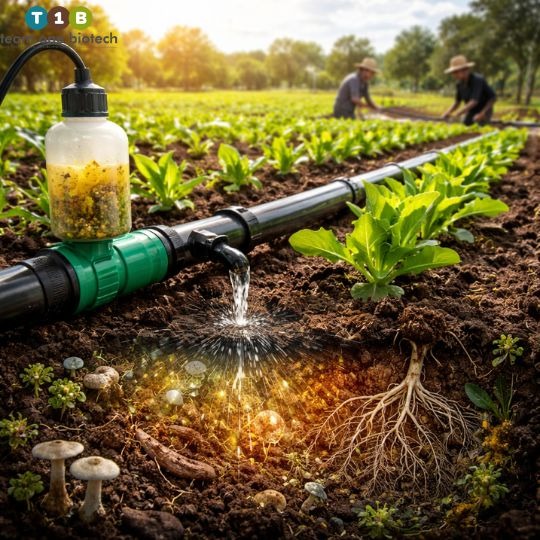
Here’s where we need to talk about soils that are already compromised, and there are millions of hectares in this category across India.
Bioremediation is the use of living organisms to restore degraded environments. In agriculture, it means using specific microbial consortia to reverse chemical damage, break down pesticide residues, and rebuild soil organic matter.
Consider a cotton field in Yavatmal that’s received heavy applications of chemical fertilizers and pesticides for 20 years. The soil is compacted, acidic, and biologically depleted. You can’t fix this overnight with compost or organic matter alone, you need microbial intervention to restart the biological processes that make soil healthy.
This is where specialized bio-fertilizers go beyond simple nutrient provision. Products containing diverse microbial communities, nitrogen fixers, phosphate solubilizers, potash mobilizers, and cellulolytic bacteria, work together to:
- Break down accumulated chemical residues
- Restore soil pH through organic acid production
- Rebuild soil structure through bacterial exopolysaccharides
- Restart nutrient cycling that has been dormant
Think of it as rebooting the soil’s operating system. You’re not just adding inputs, you’re restoring function.
The beauty of delivering these bioremediation agents through drip irrigation is precision. You can target specific problem areas. You can monitor recovery through root zone sampling. And because you’re delivering regularly with irrigation, you maintain consistent microbial populations rather than relying on a single broadcast application that degrades over time.
Why This Matters Now: The Economic and Ecological Imperative
Let’s return to Ramesh Patil, our sugarcane farmer. After learning about bio-fertigation, he made a simple calculation.
His annual chemical fertilizer bill through drip: ₹45,000 per acre. His yield: 85 tons per acre, declining. His soil: degraded, requiring increasing inputs each year.
He switched to an integrated approach, 60% of his previous chemical fertilizers plus regular bio-fertilizer applications. First season cost: ₹38,000 per acre. Yield: 87 tons. Soil organic carbon: increased from 0.42% to 0.51% (measured via Soil Health Card).
Second season: ₹35,000 per acre. Yield: 92 tons. Water requirement: reduced by 12% due to improved soil moisture retention.
Third season: ₹32,000 per acre. Yield: 95 tons. Disease pressure: noticeably reduced.
The economics work because biology compounds. Chemical inputs deplete and require more. Biological inputs build and require less.
Moving Forward: Your Soil’s Future Starts Today
The transition to bio-fertigation isn’t about abandoning modern agriculture, it’s about upgrading it. Your drip system isn’t the problem; it’s the solution delivery mechanism. The question is: what are you delivering?
Indian farming stands at an inflection point. We can continue down the path of increasing chemical dependence, declining soil health, and marginal economics. Or we can recognize that the most sophisticated agricultural technology isn’t in a factory, it’s in the soil, waiting to be awakened.
Bio-fertilizers through drip irrigation represent the convergence of precision agriculture and biological intelligence. They’re not a return to the past, but a step into a more sophisticated future where we work with nature’s systems rather than against them.
Your soil is not dead. It’s dormant. And every time you run that drip line, you have a choice: suppress or support, deplete or restore, extract or regenerate.
Ready to transform your soil from hard earth to living ecosystem? Team One Biotech specializes in bioremediation and soil health solutions designed specifically for Indian farming conditions. Our liquid bio-fertilizer range is engineered for drip irrigation systems, combining nitrogen fixers, phosphate solubilizers, and potassium mobilizers in formulations that won’t clog your emitters or compromise your investment. Visit our website or contact our agronomy team for a customized soil restoration plan. Because healthy soil isn’t just about this season’s yield, it’s about the next generation’s inheritance.
Looking to improve your ETP/STP efficiency with the right bioculture?
Talk to our experts at Team One Biotech for customised microbial solutions.
Contact: +91 8855050575
Email: sales@teamonebiotech.com
Visit: www.teamonebiotech.com
Discover More on YouTube – Watch our latest insights & innovations!-
Connect with Us on LinkedIn – Stay updated with expert content & trends!