
Increasing Crop Resilience Against Drought and Heat Stress Using Microbes
The loo winds swept across the wheat fields of Bathinda in April 2024, carrying with them temperatures that touched 47°C. Harjit Singh watched his crop wilt despite having applied the recommended doses of urea and DAP. His tubewell ran dry by mid-May. That season, he lost 40% of his expected yield.
Harjit’s story is not isolated. Across Punjab, Haryana, Madhya Pradesh, and Maharashtra, farmers are confronting a harsh new reality: the fertilizers that once promised abundance are now powerless against the twin crises of erratic rainfall and relentless heat. The 2025 monsoon arrived three weeks late in parts of Vidarbha. When it did come, it brought flooding, not relief. Between these extremes, the soil, exhausted from decades of chemical dependency, has lost its ability to buffer crops against stress.
Restoring microbial life starts with a shift in management. Learn how to rebuild your soil’s resilience in our comprehensive guide: The Future of Indian Farming: A Guide to Bio-fertilizers and Soil Health.
This is not a problem that can be solved with another bag of NPK. The solution lies beneath our feet, in the billions of microorganisms that once made Indian soils among the most fertile on earth. Restoring that microbial life is not just about yields. It is about survival.
The Hidden Crisis Beneath Indian Farms
Walk into any agricultural supply store in rural India, and the shelves tell a story: stacks of urea, DAP, potash, and an ever-growing array of pesticides. For fifty years, this chemical-intensive model delivered results. But the soil has a memory, and it is now demanding payment.
Consider the numbers. Groundwater tables in Punjab have dropped by over 20 meters in the past two decades. Coastal regions in Gujarat and Andhra Pradesh battle increasing soil salinity as seawater intrusion worsens. In the black cotton soils of Maharashtra, organic carbon content has fallen below 0.5%, a threshold below which soil is considered biologically dead.
The problem is structural. Chemical fertilizers provide nutrients, but they do nothing to build soil structure or water-holding capacity. Repeated applications have disrupted the soil’s natural pH balance, killed beneficial microbes, and left behind residues that actually inhibit plant growth under stress conditions. When a heatwave strikes or rains fail, these soils have no resilience. They crack, harden, and release whatever moisture they held within hours.
This is where the conversation must shift. The question is no longer “how much fertilizer should I apply?” but rather “how do I rebuild my soil’s ability to protect my crops when nature turns hostile?”
The Invisible Shield: How Microbes Build Crop Resilience

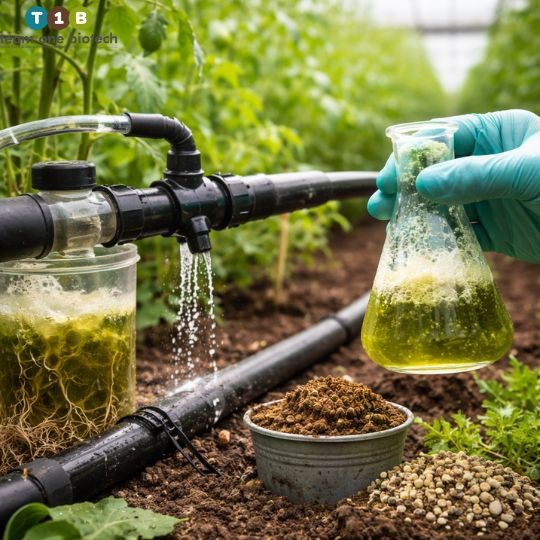
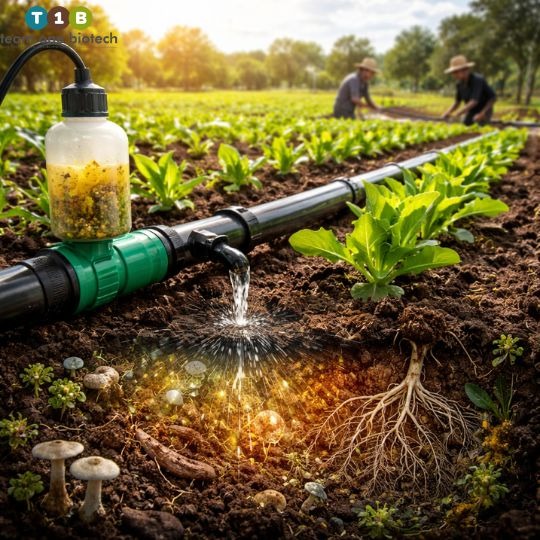
Soil is not merely a growing medium. It is a living ecosystem, home to bacteria, fungi, protozoa, and countless other organisms that form symbiotic relationships with plant roots. When these relationships are intact, crops can withstand stress that would otherwise be catastrophic.
At the heart of this system are Plant Growth-Promoting Rhizobacteria (PGPR) and mycorrhizal fungi. These microbes do not just feed the plant, they fundamentally alter how the plant responds to environmental stress.
What PGPR do during drought:
- Produce ACC-deaminase enzymes that break down ethylene, the plant’s stress hormone
- Synthesize osmolytes (compounds like proline and glycine betaine) that help plant cells maintain water balance
- Secrete exopolysaccharides (EPS) that bind soil particles together, improving water retention
- Enhance root branching and depth, allowing plants to access moisture from deeper soil layers
What mycorrhizal fungi contribute:
- Extend root systems through fungal networks that can reach water sources up to 100 times farther than roots alone
- Increase phosphorus uptake even in water-stressed conditions
- Form protective sheaths around roots that reduce water loss
- Break down organic matter, releasing nutrients slowly over time
The difference is measurable. Studies conducted on wheat in water-stressed conditions in Haryana showed that crops treated with PGPR maintained 65% higher relative water content in leaves compared to chemical-only treatments. In tomato crops subjected to 42°C heat stress in Karnataka, mycorrhizal inoculation reduced leaf wilting by 50% and maintained photosynthetic efficiency.
This is not theoretical. This is biology doing what chemistry cannot, preparing plants for uncertainty.
The Mechanics of Microbial Resilience

Understanding how microbes confer stress tolerance requires looking at what happens at the cellular level when a plant faces extreme heat or water scarcity.
When temperatures exceed 40°C, plants produce ethylene, a hormone that triggers premature aging, leaf abscission, and flower drop. PGPR bacteria containing ACC-deaminase cleave the ethylene precursor (ACC) before it can be converted into the stress hormone. The result: plants stay greener longer, retain flowers, and continue photosynthesis even under thermal stress.
During drought, plant cells lose turgor pressure and collapse. Microbes counter this by inducing the production of compatible solutes, organic compounds that stabilize proteins and cell membranes. Proline, for instance, acts like an internal antifreeze, protecting cellular machinery even as external water becomes scarce. Crops inoculated with proline-producing bacteria show significantly lower membrane damage and maintain higher stomatal conductivity.
Perhaps most importantly, microbial activity rebuilds soil architecture. Exopolysaccharides secreted by beneficial bacteria act as a biological glue, binding clay, silt, and organic matter into stable aggregates. These aggregates create pore spaces that hold water like a sponge while still allowing excess moisture to drain. In field trials across drought-prone regions of Rajasthan, soils treated with microbial consortia retained 30% more water at field capacity compared to untreated controls.
The heat tolerance mechanism is equally elegant. Certain thermotolerant bacteria produce heat shock proteins (HSPs) that transfer to plant roots. These proteins help stabilize enzymes and cell membranes, essentially teaching the plant to function at temperatures that would otherwise denature its critical proteins.
Bioremediation: Healing Soil Before Rebuilding It
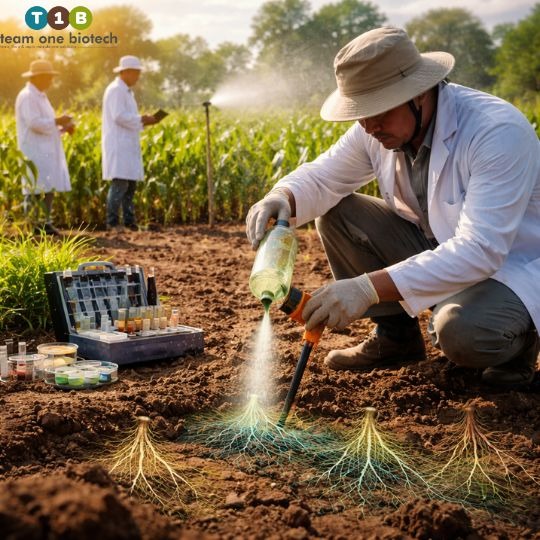
Here is where Team One Biotech’s expertise becomes essential. Introducing beneficial microbes into chemically saturated soil is like planting seeds in concrete. The soil must first be detoxified.
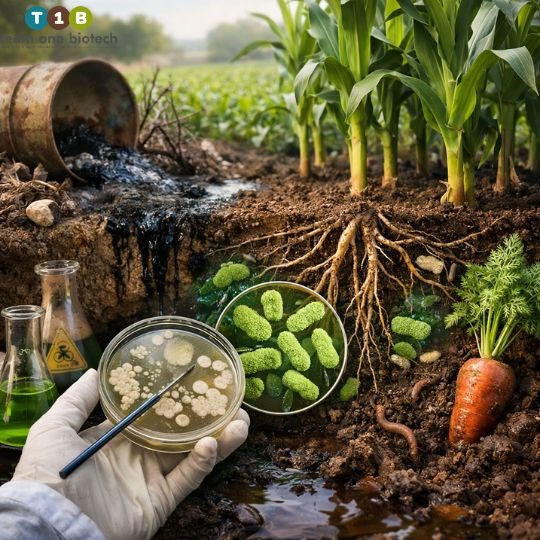
Bioremediation addresses the legacy of chemical agriculture by using specialized microorganisms to break down pesticide residues, heavy metals, and excess salts that have accumulated over decades. This is not a cosmetic fix. It is a restoration of the soil’s biological capacity.
In coastal Andhra Pradesh, where soil salinity has made large tracts unviable for traditional crops, bioremediation protocols using halotolerant bacteria have reduced electrical conductivity (EC) levels by up to 40% within two cropping seasons. In Punjab fields contaminated with lindane and chlorpyrifos residues from decades of pesticide use, targeted microbial consortia degraded these compounds, allowing subsequent bio-fertilizer applications to establish successfully.
The principle is simple: you cannot expect beneficial microbes to colonize hostile environments. Bioremediation creates the conditions for biological regeneration. It is the foundation upon which microbial crop resilience is built.
Team One Biotech approaches this systematically. Soil testing identifies specific contaminants and deficiencies. Custom microbial formulations target those issues. Over time, the native microbial population rebounds, creating a self-sustaining system where beneficial organisms proliferate naturally.
This is not a one-season intervention. It is a multi-year commitment to soil health that pays dividends in drought resistance, heat tolerance, and ultimately, stable yields regardless of weather extremes.
Practical Steps for Indian Farmers: Transitioning to Bio-Integrated Systems

The shift from chemical dependency to biological resilience does not happen overnight, nor does it require abandoning conventional inputs entirely, at least not initially. The goal is integration, not replacement.
Year One: Assessment and Foundation
- Conduct comprehensive soil testing including microbial biomass, organic carbon, and contaminant screening
- Apply bioremediation formulations to address chemical residues and pH imbalances
- Reduce chemical fertilizer input by 25%, replacing with microbial seed treatments and soil inoculants
- Focus on PGPR formulations that contain ACC-deaminase producing strains
Year Two: Expansion
- Introduce mycorrhizal fungi alongside bacterial inoculants
- Incorporate organic amendments (vermicompost, farm yard manure) to feed the growing microbial population
- Reduce chemical inputs by another 25%
- Monitor water retention capacity and crop stress indicators
Year Three: Optimization
- Aim for 50% reduction in chemical fertilizers while maintaining or exceeding previous yield levels
- Implement cover cropping during off-seasons to maintain microbial activity
- Use bio-fertilizers as the primary nutrient source with chemicals only as targeted supplements
Critical practices throughout:
- Avoid broad-spectrum fungicides that kill beneficial microbes along with pathogens
- Maintain soil moisture during establishment phase through drip irrigation or mulching
- Test soil microbial counts annually to track biological recovery
Farmers in Jalgaon, Maharashtra, following this protocol reported 35% lower irrigation requirements by the third year while maintaining comparable cotton yields despite two consecutive low-rainfall seasons. The soil’s improved structure and active microbial community created a buffer against climatic variability that chemicals alone could never provide.
A Living Future for Indian Agriculture
The Second Green Revolution will not be written in fertilizer bags. It will be measured in the invisible life beneath our feet, the bacteria that teach plants to conserve water, the fungi that extend roots into untapped reserves, the enzymes that neutralize stress before it can damage yields.
Team One Biotech’s work in bioremediation and bio-solutions represents more than products. It is a recognition that Indian agriculture needs healing before it can become resilient. The degraded soils of Punjab, the saline fields of Gujarat, the heat-stressed farms of Vidarbha, these are not lost causes. They are ecosystems waiting to be reawakened.
Microbial crop resilience is not about returning to pre-modern farming. It is about applying cutting-edge biological science to restore the natural mechanisms that made Indian soils legendary. When PGPR reduces ethylene stress, when mycorrhizae extend water access, when bioremediation clears decades of chemical burden, we are not romanticizing tradition. We are deploying precision biology to solve modern problems.
The farmers who adopt these systems will not do so because of sentiment. They will do so because when the loo winds blow at 47°C, when the monsoon fails for the third year running, their crops will still stand. Their soil will still hold water. Their families will still eat.
Ready to transform your farm’s resilience against climate extremes? Connect with Team One Biotech’s agronomy team for a customized soil health assessment and microbial solution plan tailored to your region’s specific challenges. Because sustainable yields begin with living soil.
Looking to improve your ETP/STP efficiency with the right bioculture?
Talk to our experts at Team One Biotech for customised microbial solutions.
Contact: +91 8855050575
Email: sales@teamonebiotech.com
Visit: www.teamonebiotech.com
Discover More on YouTube – Watch our latest insights & innovations!-
Connect with Us on LinkedIn – Stay updated with expert content & trends!