
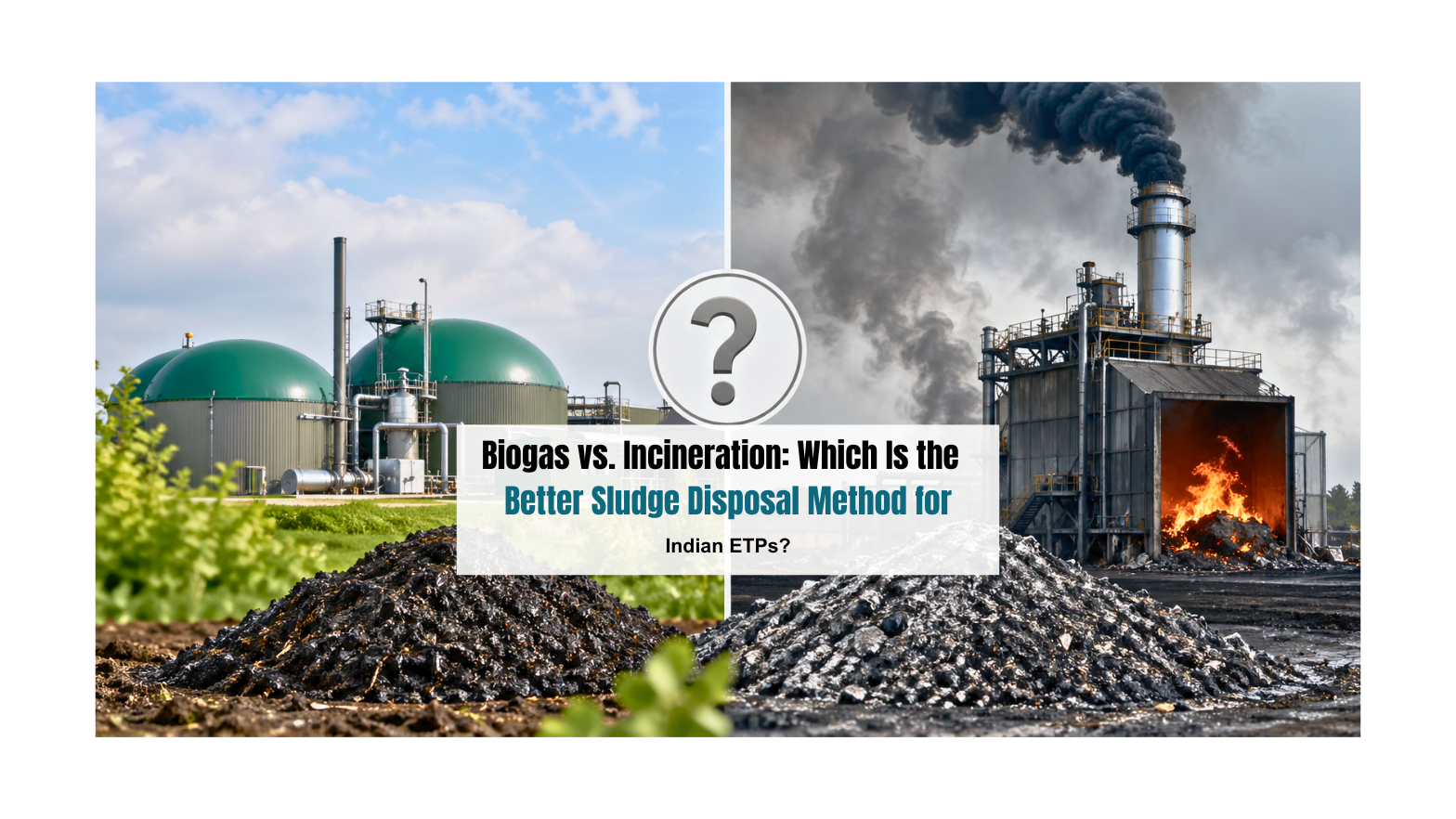
Biogas vs. Incineration: Which Is the Better Sludge Disposal Method for Indian ETPs?
Every ETP operator in India knows the feeling. The sludge pits are filling up faster than budgets can handle, the transporter just hiked his rates again, and the latest CPCB circular is sitting on the desk waiting to ruin the morning. Industrial sludge disposal has quietly become one of the most expensive and legally precarious problems in Indian manufacturing, and the traditional answer of “just haul it away” is running out of road.
Between tightening Hazardous Waste Management Rules, mounting pressure from State Pollution Control Boards, and the sheer logistics of managing high-moisture sludge in a land-scarce country, ETP operators are being pushed, often urgently, toward more sustainable, closed-loop disposal strategies. Two technologies are consistently at the center of that conversation: anaerobic digestion for biogas recovery and thermal incineration. Both promise volume reduction and regulatory compliance. But they deliver very different outcomes when you look at costs, carbon footprints, operational demands, and long-term value.
This is not a theoretical comparison. This is a ground-level evaluation for the conditions that actually exist in Indian ETPs.
The Sludge Crisis Quietly Reshaping Indian Industry
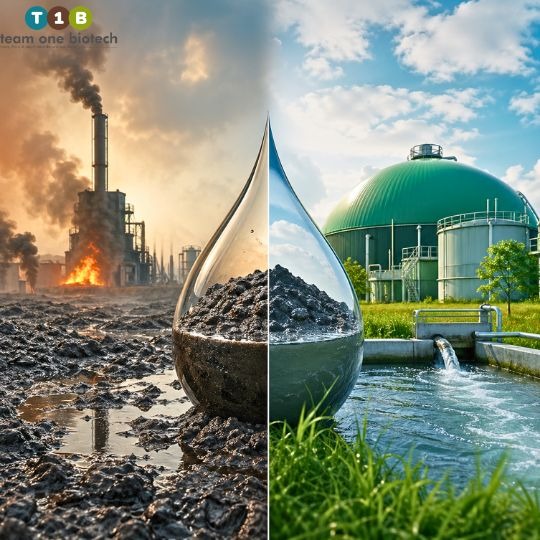
India’s industrial expansion has been a remarkable story, but it has produced an equally remarkable volume of wet, chemically complex sludge. Textile clusters in Surat and Tiruppur, pharmaceutical corridors in Hyderabad and Ahmedabad, food processing belts in Punjab and Maharashtra, and tanneries in Vellore are all dealing with the same compounding problem: sludge generation is outpacing responsible disposal capacity.
The regulatory environment has changed fundamentally. The Hazardous Waste (Management, Handling and Transboundary Movement) Rules have become significantly more stringent. CPCB’s prescribed standards for landfill co-disposal and the increasing scrutiny on common treatment, storage, and disposal facilities (TSDFs) mean that the days of offloading sludge responsibility to a third-party contractor and forgetting about it are largely over.
Meanwhile, the Government of India’s “Waste to Wealth” mission under the Office of the Principal Scientific Adviser has created a formal policy framework encouraging industries to recover energy and materials from waste streams. Industrial sludge, long treated as a pure liability, is now recognized as a potential resource, if the right technology is applied.
This is the context in which the biogas versus incineration debate becomes genuinely important.
Understanding Your Two Primary Options

Biogas (Anaerobic Digestion): The Biological Route
Anaerobic digestion is the process of breaking down organic matter in the absence of oxygen using microbial communities. When applied to ETP sludge, the output is twofold: biogas (primarily methane, with a composition that typically ranges between 55% and 70% methane depending on feedstock quality) and digestate, a stabilized, nutrient-containing residue.
Why India’s conditions favor this technology:
India’s tropical and subtropical climate is a natural advantage for anaerobic digestion. Mesophilic digestion, the most commonly deployed mode, performs optimally in the temperature range that much of India maintains for the majority of the year without additional heating input. This translates directly into lower energy costs for maintaining digester temperature, which is one of the more significant OPEX items in colder climates.
Indian ETP sludge, particularly from food processing, dairy, distillery, and pharmaceutical sectors, tends to carry a high organic load. This is precisely the profile that anaerobic systems digest most efficiently. High volatile solids content means more biogas yield per unit of sludge processed.
Energy recovery and financial value:
The biogas generated can be used to run generators for captive power consumption, fuel boilers replacing furnace oil or LPG, or be upgraded to compressed biomethane for vehicle fuel. Across typical Indian ETP configurations, energy recovery from sludge biogas can fall between 30% and 50% of the theoretical energy equivalent, though this varies significantly by sludge composition and system design.
Industries that successfully close this loop report reductions in grid power consumption and fuel procurement costs that meaningfully improve their operational economics over a three-to-seven-year horizon.
The role of bioremediation in enhancing digestion:
This is where Team One Biotech’s core expertise becomes directly relevant. Raw ETP sludge often contains inhibitory compounds, residual disinfectants, heavy metals at trace concentrations, recalcitrant organics, that suppress the microbial populations responsible for digestion. Bioremediation solutions, specifically the application of specialized microbial consortia prior to or within the digestion stage, can measurably enhance volatile solids destruction rates and improve biogas yields. Pre-treatment with targeted bacterial inoculants has been shown across multiple case studies to reduce digestion cycle times and improve process stability in variable-feed industrial environments.
The digestate question:
The solid fraction remaining after digestion, the digestate, retains nutrients, primarily nitrogen and phosphorus. Depending on the industry and the regulatory classification of the sludge, this digestate may be eligible for use as a soil amendment, which represents an additional avoided cost compared to hazardous waste disposal. Not all sludge qualifies, and a site-specific characterization is essential before assuming this pathway.
Limitations to acknowledge:
Anaerobic digestion is not a fit for every sludge type. Sludge with very high inorganic content, significant heavy metal contamination (as in metal finishing or electroplating ETPs), or very low organic loading will produce marginal biogas yields. The technology also requires operator training, consistent monitoring, and a tolerance for biological variability.
Incineration: The Thermal Route
High-temperature incineration oxidizes sludge completely, destroying organic compounds and pathogens and reducing mass volume dramatically. For hazardous or highly toxic sludge profiles that cannot be biologically treated, it is often the only compliant option.
Where incineration makes clear sense:
- Sludge from industries with persistent organic pollutants (POPs) or high halogenated compound content
- Mixed hazardous waste streams where biological activity would be suppressed or unsafe
- Situations demanding extremely rapid volume reduction where land is critically constrained
The economics are challenging:
Incinerators designed for sludge, particularly those meeting the emission norms specified under the Environment Protection Act and CPCB’s guidelines for hazardous waste incineration, are capital-intensive assets. CAPEX for a compliant industrial incinerator can range across a wide band depending on throughput capacity and pollution control equipment specifications. The OPEX picture is similarly demanding: auxiliary fuel is almost always required to sustain combustion temperatures when sludge moisture is high (which is the norm in Indian ETPs), and this represents a recurring operational cost that does not diminish over time.
Air quality and regulatory exposure:
India’s regulatory framework for incinerator emissions covers particulate matter, sulphur dioxide, nitrogen oxides, hydrogen chloride, heavy metals, and dioxins/furans. Compliance with these norms requires significant investment in air pollution control equipment, wet scrubbers, bag filters, secondary combustion chambers. Operating outside these norms creates substantial legal and reputational risk. This is not a theoretical concern; SPCB enforcement actions against non-compliant incinerators have been documented across multiple states.
Energy recovery is possible but limited:
Waste heat recovery from incineration is technically feasible and practiced at larger installations. However, energy recovery rates for wet sludge incineration are generally lower than those achievable through anaerobic digestion of equivalent organic-rich feedstocks, primarily because significant energy input is consumed in evaporating moisture before combustion can become self-sustaining.
Operational Factors: What Actually Matters on the Ground

| Factor | Biogas (AD) | Incineration |
| Space requirement | Moderate (digesters can be underground or covered) | Higher (combustion chamber, flue gas treatment, ash handling) |
| Operating expertise | Microbiology and process monitoring | High-temperature thermal operations, emission compliance |
| Sludge moisture sensitivity | Performs well with high-moisture sludge | High moisture requires auxiliary fuel, increasing OPEX |
| Residue management | Digestate (potentially reusable) | Ash (requires classified disposal) |
| CPCB compliance complexity | Moderate | High (continuous emission monitoring required) |
For smaller and mid-sized ETPs, which constitute the majority of the Indian industrial base, the operational footprint and expertise requirement for incineration can be prohibitive without shared facility arrangements.
Economic Outlook: Thinking in Ranges, Not Promises
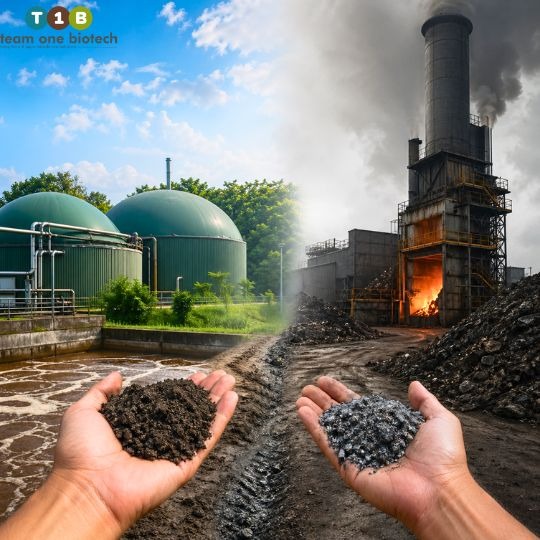
Responsible analysis resists the temptation to quote specific payback figures without knowing site conditions. That said, general patterns are observable:
Biogas systems at industrial ETPs with suitable organic sludge profiles have demonstrated payback periods that typically fall somewhere between four and eight years when energy savings, avoided disposal costs, and potential digestate value are modeled together. The range is wide because it depends enormously on current fuel prices, sludge volume, organic content, and whether the biogas is used for power, heat, or vehicle fuel.
Incineration as a standalone investment rarely generates positive financial returns in the traditional sense, it is a compliance cost management tool. The economic case rests on avoided liability, regulatory assurance, and the value of destroying material that cannot be treated any other way.
If your sludge profile is suitable for anaerobic digestion, the economic and environmental case for biogas over incineration is, in most Indian scenarios, substantially stronger.
Making the Right Decision for Your ETP
There is no universal answer, and any consultant or vendor who tells you otherwise is selling rather than advising. The right sludge disposal method is determined by sludge characterization, regulatory classification, existing infrastructure, available capital, and operational capacity.
What is clear is that Indian ETP operators who treat this decision as purely a compliance exercise will continue to face rising costs and tightening pressure. Those who approach it as a resource management decision have the opportunity to recover energy, reduce liability, and align with the direction that Indian environmental policy is clearly moving.
If you are at the point of evaluating sludge disposal options for your facility, the most valuable first step is a detailed site audit, one that characterizes your sludge properly, maps your regulatory obligations, and models realistic performance ranges for technologies applicable to your specific context.
Team One Biotech’s team of bioremediation and ETP specialists conducts exactly this kind of site-specific evaluation. If you would like a ground-level assessment of whether biogas recovery, enhanced biological treatment, or a hybrid approach fits your operation, reach out for an initial consultation. The conversation costs nothing; the wrong technology decision costs significantly more.
Disclaimer
All numerical ranges, performance estimates, payback period references, energy recovery figures, and operational comparisons presented in this article are general indicative estimates drawn from broad industry experience and publicly available studies. Actual results will vary, often significantly, based on individual ETP sludge characteristics, facility design, feedstock variability, equipment specifications, local regulatory requirements, energy tariff structures, and site-specific operational factors. No figures in this article should be treated as performance guarantees or used as the basis for investment decisions without a detailed, site-specific technical and financial assessment conducted by qualified professionals.
Looking to improve your ETP/STP efficiency with the right bioculture?
Talk to our experts at Team One Biotech for customised microbial solutions.
Contact: +91 8855050575
Email: sales@teamonebiotech.com
Visit: www.teamonebiotech.com
Discover More on YouTube – Watch our latest insights & innovations!-
Connect with Us on LinkedIn – Stay updated with expert content & trends!