
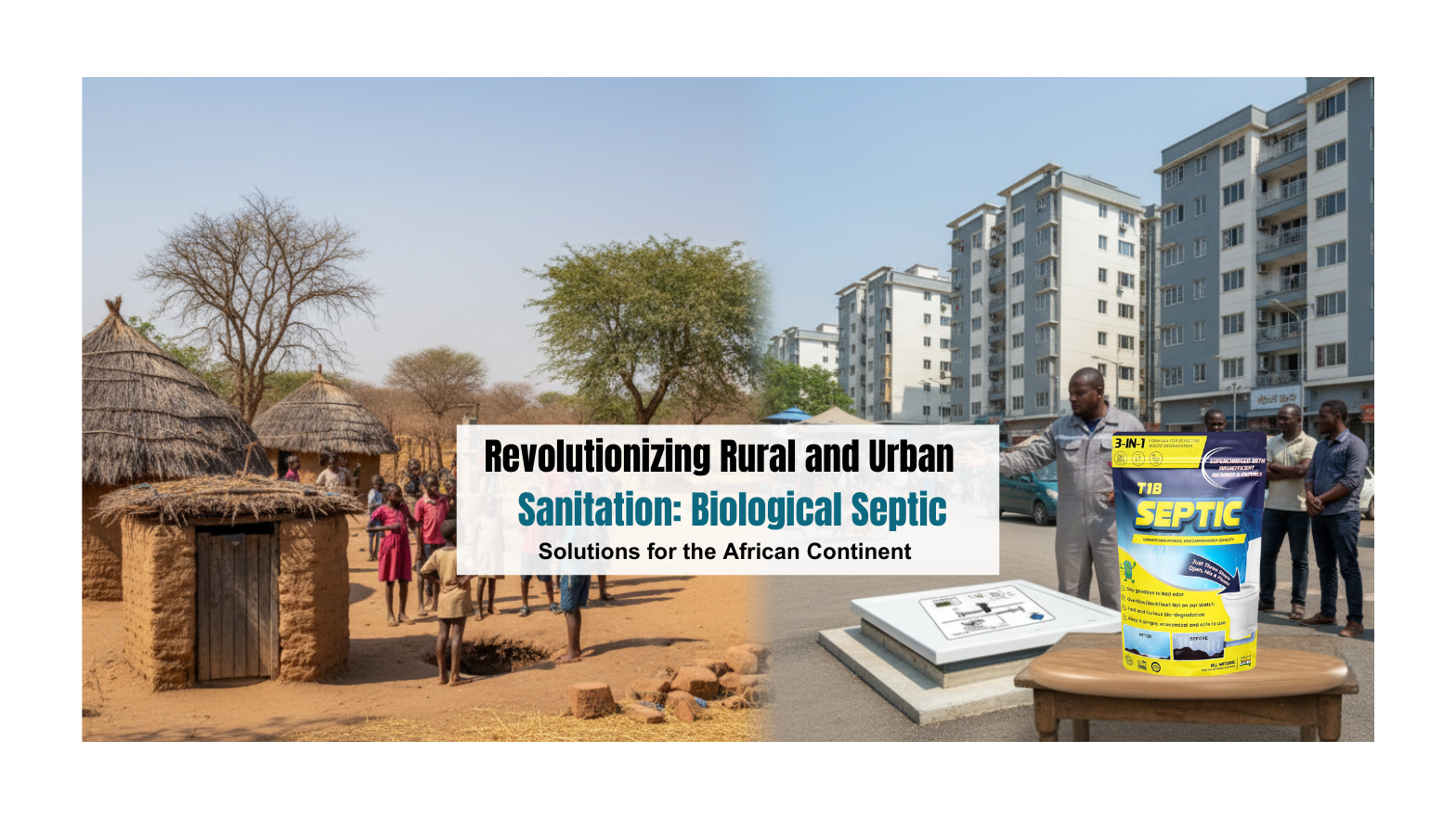
Revolutionizing Rural and Urban Sanitation: Biological Septic Solutions for the African Continent
The Human Cost of Broken Sanitation
In the outskirts of Lagos, a mother walks three kilometers every morning to fetch water from a communal borehole. The pit latrine behind her home is nearly full. The smell has become unbearable during the rainy season, and her youngest child developed diarrhea last month. The local honey-sucker truck charges 15,000 Naira per visit, more than her weekly income. So the pit overflows. Untreated fecal matter seeps into the shallow aquifer beneath her neighborhood, contaminating the very borehole she depends on.
This isn’t an isolated tragedy. It’s the daily reality for over 400 million people across Sub-Saharan Africa who lack access to safely managed sanitation services.
When we talk about sanitation infrastructure, we’re not discussing abstract engineering problems. We’re talking about human dignity. The right to raise children without the constant threat of cholera outbreaks. The ability to attend school without debilitating intestinal parasites that stunt cognitive development. The fundamental expectation that waste management shouldn’t cost a month’s wages.
The sanitation crisis kills. The World Health Organization estimates that inadequate sanitation causes approximately 280,000 diarrheal deaths annually in Africa alone. Groundwater contamination from poorly maintained septic systems creates a vicious cycle: communities without centralized sewerage rely on groundwater for drinking, yet that same groundwater becomes polluted by their own waste disposal methods.
Traditional solutions have failed these communities repeatedly. The promise of massive sewer infrastructure projects remains perpetually five years away, while populations continue to grow exponentially. Vacuum pumping services can’t keep pace with demand, and even when available, they’re economically inaccessible to the majority who need them most.
Biological septic solutions represent more than just another technology, they represent a paradigm shift in how we think about decentralized sanitation be it Ghana / Nigeria / Cameroon/ Burkina Faso/ RD Congo /Equotorial Guinea/ Botswana /Togo / Ivory Coast or across the African continent.
Understanding the Sanitation Infrastructure Gap
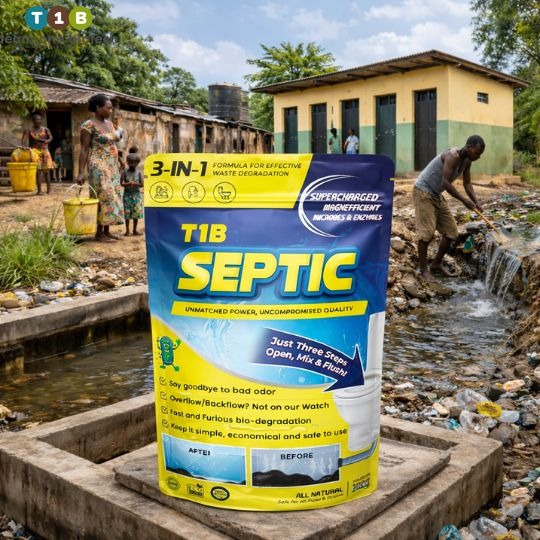
Why Traditional Systems Don’t Work in African Contexts
The conventional wisdom imported from developed nations assumes sanitation equals centralized sewerage. Build treatment plants. Lay underground pipe networks. Pump waste to centralized facilities. This model works excellently in cities like London or Tokyo, where decades of infrastructure investment created comprehensive coverage.
African cities and rural areas face fundamentally different challenges.
Population density patterns in African urban centers differ dramatically from Western cities. Informal settlements spring up faster than municipal planning can accommodate. Nairobi’s Kibera settlement houses over 250,000 people on just 2.5 square kilometers, yet no formal sewer lines reach these residents. Extending conventional infrastructure into such areas requires demolishing and relocating entire communities, a political and humanitarian impossibility.
Capital costs for centralized sewerage are staggering. A 2019 World Bank analysis estimated that achieving universal sanitation coverage across Sub-Saharan Africa using conventional infrastructure would require approximately $13 billion annually for the next 15 years. Most municipal budgets can barely maintain existing roads and water supply networks, let alone fund massive new underground pipe systems.
Topographical realities complicate matters further. Unlike flat European cities where gravity-fed sewers work efficiently, African urban landscapes often feature dramatic elevation changes. Pumping stations become necessary. Maintenance costs multiply. Systems designed for temperate climates fail under the stress of tropical downpours that overwhelm drainage capacity within hours.
The Honey-Sucker Dilemma
Across South Africa, Nigeria, and Kenya, the vacuum truck industry, colloquially known as “honey-suckers”, represents the primary method of managing pit latrines and septic tanks. These trucks pump out accumulated sludge and theoretically transport it to treatment facilities.
The economic math simply doesn’t work for most households.
A single vacuum truck can service perhaps 15-20 properties daily, depending on distances and road conditions. In cities where millions rely on pit latrines, the supply-demand imbalance keeps prices artificially high. For a family earning $3-5 daily, a $50-80 pumping fee represents catastrophic expense. The result? People delay pumping until overflows create public health emergencies.
Even when municipalities subsidize vacuum truck services, logistical challenges persist. Roads in informal settlements often can’t accommodate large trucks. During rainy seasons, muddy access routes become impassable. The trucks themselves require regular maintenance and fuel, costs that municipal budgets struggle to sustain.
And where does the pumped waste actually go? Studies in Kampala, Uganda, found that less than 30% of collected fecal sludge reaches treatment plants. The remainder gets dumped illegally in drainage channels, open fields, or directly into water bodies. The expensive pumping operation merely relocates the contamination problem rather than solving it.
Decentralized Sanitation: The Only Scalable Path Forward
International development experts increasingly recognize that decentralized approaches, where waste is treated on-site or very nearby rather than transported long distances, offer the only realistic pathway to universal sanitation coverage.
The United Nations Sustainable Development Goal 6 explicitly calls for “adequate and equitable sanitation” by 2030, acknowledging that solutions must be adapted to local contexts rather than imposed from outside. Decentralized sanitation fits African realities because it works with existing infrastructure, pit latrines, septic tanks, and small-scale treatment systems, rather than requiring wholesale replacement.
The challenge becomes: how do you make decentralized systems actually function safely and sustainably? This is precisely where biotechnology enters the equation.
The Indian Parallel: Lessons from Swachh Bharat Mission
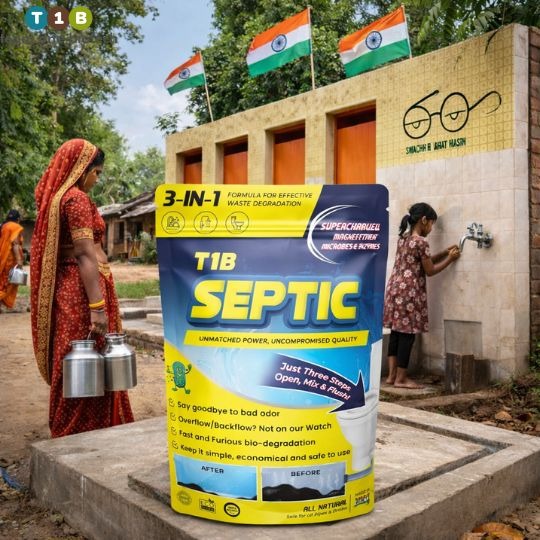
India faced an almost identical sanitation crisis until recently. Before 2014, over 500 million Indians practiced open defecation. Pit latrines and septic tanks served hundreds of millions more, yet maintenance remained sporadic and vacuum pumping infrastructure couldn’t keep pace with demand.
The Swachh Bharat Mission (Clean India Mission), launched in October 2014, aimed to eliminate open defecation and improve solid waste management across the entire nation. The scale of ambition was staggering: constructing over 100 million toilets in five years.
But construction alone doesn’t solve sanitation. Those toilets connected to septic tanks and pit latrines that still required regular maintenance. India’s tropical and subtropical climate, high population density, and limited centralized sewerage in rural areas mirrored the challenges currently facing Sub-Saharan Africa.
Indian biotechnology firms, including Team One Biotech, recognized that sustainable sanitation required more than concrete and pipes. It required transforming how those decentralized systems functioned biologically. The development of specialized microbial cultures capable of accelerating waste decomposition became a game-changer.
Municipalities across India began integrating biological septic tank treatments into their sanitation programs. Rather than relying solely on expensive vacuum trucks, communities could extend the intervals between pumping by 2-3 times. Odor complaints plummeted. Groundwater testing showed reduced contamination levels. Most critically, the cost per household dropped dramatically.
Translating Success to African Contexts
The parallels between India’s 2014 situation and Sub-Saharan Africa’s current reality are striking:
- Climate similarity: Tropical and subtropical zones dominate both regions, creating identical temperature and moisture conditions that affect bacterial activity in septic systems
- Infrastructure gaps: Centralized sewerage serves only a small percentage of the population in both contexts
- Economic constraints: Household incomes in many African nations align closely with rural Indian income levels
- Population density: Both regions face challenges of managing sanitation in densely populated informal settlements
Team One Biotech’s experience solving India’s septic tank challenges over the past decade positions the company uniquely to address African sanitation needs. The microbial formulations that proved effective from Kerala to Punjab are equally suited to environments from Mombasa to Johannesburg.
The Biotechnology Solution: How T1B Products Work
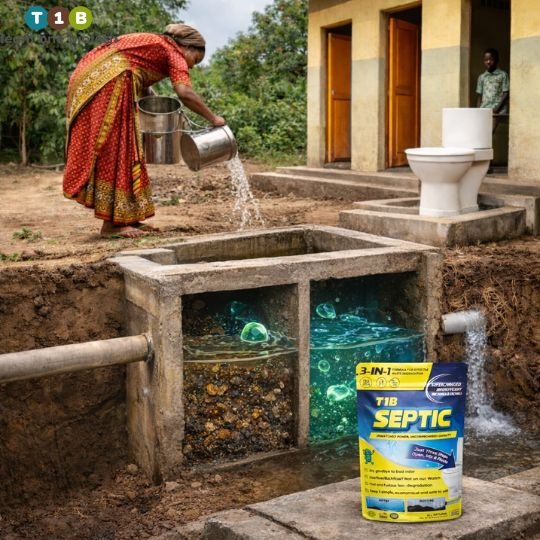
Understanding the Science of Bioremediation
At its core, a septic tank or pit latrine should function as an anaerobic digestion system. Beneficial bacteria break down organic waste, converting complex proteins, fats, and carbohydrates into simpler compounds. When this process works efficiently, solid waste volume decreases significantly, harmful pathogens die off, and the system maintains equilibrium.
The problem? Natural bacterial populations in human waste aren’t optimized for rapid, complete decomposition. They work slowly. They’re sensitive to pH fluctuations, toxic chemicals from cleaning products, and temperature variations. In overloaded systems, they simply can’t keep pace with incoming waste, leading to accumulation, overflow, and system failure.
Biological septic treatments introduce concentrated populations of specifically selected microorganisms that dramatically accelerate decomposition.
T1B Drain O Zyme: Engineering Superior Microbes
Team One Biotech’s Drain O Zyme formula represents years of research into microbial selection and optimization. The product contains multiple bacterial strains chosen for complementary capabilities:
- Cellulolytic bacteria break down toilet paper and vegetable matter rapidly
- Proteolytic bacteria specialize in protein degradation, essential for processing fecal matter efficiently
- Lipolytic bacteria target fats and oils, common culprits in drain blockages
- Amylolytic bacteria handle starch breakdown
The key innovation lies not just in selecting these strains, but in cultivating robust populations that survive harsh environments. Drain O Zyme bacteria demonstrate pH tolerance from 4.5 to 9.5, temperature stability from 10°C to 55°C, rapid reproduction rates, and pathogen competition capabilities.
Septic Safe Cultures: Targeted Pit Latrine Performance
While Drain O Zyme serves general septic tank applications, T1B’s Septic Safe formulations target the unique challenges of pit latrines, the predominant sanitation infrastructure across rural Africa.
Septic Safe cultures address specific challenges:
Odor elimination: Specialized bacteria rapidly metabolize volatile sulfur compounds responsible for the characteristic pit latrine smell. Within 48-72 hours of application, communities report dramatic odor reduction.
Volume reduction: By accelerating decomposition, Septic Safe cultures can reduce solid waste volume by 40-60% within a month. This extends the functional life of pit latrines by years.
Pathogen suppression: Introduced bacterial populations compete with pathogens for resources, significantly reducing disease transmission risk.
Sludge liquefaction: The cultures produce enzymes that break down compacted sludge layers, transforming solid masses into liquid that percolates into surrounding soil naturally.
Climate-Optimized Performance: The African Advantage
Standard enzyme and bacteria products developed for North American or European markets often fail in African conditions because they’re optimized for temperate climates. In Lagos during dry season, daytime temperatures routinely hit 35°C. Inside a pit latrine with black plastic cover absorbing solar radiation, internal temperatures can reach 45-50°C.
Most commercial bacterial cultures begin dying off above 40°C. Team One Biotech’s formulations underwent extensive testing across India’s diverse climate zones, from Rajasthan’s 48°C summers to monsoon-soaked regions. The company selected thermophilic and thermotolerant bacterial strains that not only survive but thrive in high-temperature environments.
For African applications, this means consistent performance year-round, lower required concentrations, and extended shelf life in warm warehouse conditions.
Economic Impact and Business Models
Cost Comparison: Traditional vs. Biological Treatment
For municipalities and households alike, economics drives sanitation decisions.
Traditional vacuum pumping:
- Average cost per pumping: $50-$150
- Frequency required: Every 6-18 months
- Annual cost range: $40-$300 per household
Biological treatment program:
- Product cost: $8-$15 per monthly treatment
- Annual cost range: $32-$180 per household
- Pumping frequency: Reduced to once every 2-4 years
- Total annual cost including occasional pumping: $45-$210 per household
A mid-sized African city with 50,000 septic tanks currently spending $4-6 million annually on pumping operations could reduce that to $2-3 million while actually improving public health outcomes.
The White Label Opportunity for Local Entrepreneurs
Team One Biotech recognizes that sustainable solutions require local ownership and cultural adaptation. The company actively seeks partnerships with African NGOs, government contractors, and private sanitation firms to distribute products under locally-branded labels.
This white labeling model creates multiple advantages:
Economic empowerment: Local distributors build businesses around products with proven demand, creating employment and keeping revenue within communities.
Cultural trust: Consumers often prefer purchasing from familiar local brands rather than unknown international companies.
Customized messaging: Local partners understand regional languages, cultural sensitivities, and communication channels.
Regulatory navigation: Each African nation maintains different import, labeling, and health product regulations. Local partners handle this complexity.
The business model works simply: Team One Biotech manufactures bulk product in India, handles international shipping logistics to African ports, and delivers containers to local partners. Those partners then repackage under their own brand labels, set pricing appropriate for their markets, and distribute through existing networks.
Government Contractor Partnerships
For companies bidding on municipal sanitation contracts, incorporating biological treatments provides a competitive advantage. Team One Biotech offers dedicated support for government contractors:
- Technical documentation for tender submissions
- Training programs for municipal workers
- Bulk supply agreements with guaranteed availability
- Co-branding options where appropriate
Cities that integrated T1B products into sanitation infrastructure reported 35-50% reductions in vacuum truck operational costs, 60-75% decreases in overflow incidents, and significant improvements in water quality testing.
Trust, Verification, and International Logistics
Alibaba Gold Supplier Verification
In international trade, trust represents the foundational challenge. Team One Biotech addresses this through Alibaba’s Gold Supplier program and Trade Assurance system.
Gold Supplier status requires companies to pass third-party verification of business licensing, manufacturing facility inspections, export compliance, and financial stability.
Trade Assurance offers financial protection for international transactions:
- Funds are held in escrow until delivery confirmation
- Quality disputes are mediated by Alibaba with potential for full refunds
- Shipping delays are documented and may trigger compensation
- Product specifications are contractually guaranteed
Shipping and Logistics Capabilities
Team One Biotech maintains established relationships with freight forwarders experienced in shipments to major African ports: Mombasa, Lagos, Durban, and Dar es Salaam. The company handles export documentation, container optimization, and port clearance support.
Typical shipping timeframes from Indian ports to Africa range from 18-35 days. T1B maintains buffer stock to ensure consistent supply for ongoing contracts.
Quality Assurance and Testing
Team One Biotech provides:
- Certificate of Analysis with every shipment
- Sample provision for small-scale trials
- Third-party lab testing results
- Application support via email and video call
Environmental Sustainability and Climate Considerations
Groundwater Protection
The African Water Vision 2025 identified groundwater contamination as one of the continent’s most serious environmental challenges. Approximately 75% of Africa’s population depends on groundwater for drinking and agriculture.
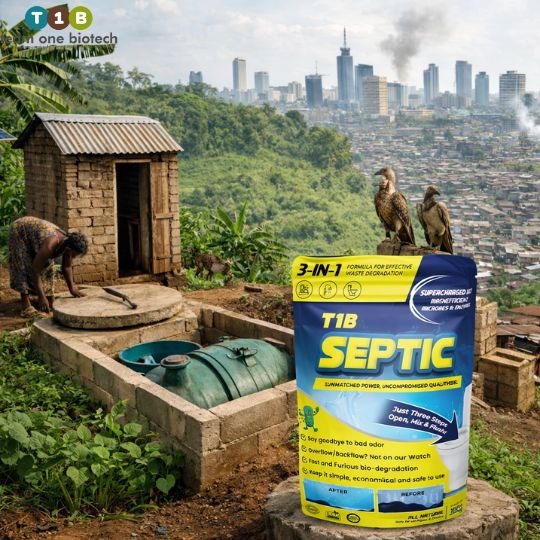
Biological septic treatments contribute to groundwater protection through pathogen reduction (80-90% reductions in fecal coliform counts), nutrient stabilization, and volume reduction.
Carbon Footprint Reduction
Biological treatments reduce emissions compared to traditional pumping. For a city with 50,000 septic systems, reducing pumping frequency from annual to every three years eliminates approximately 100,000 truck-kilometers yearly, equivalent to preventing 35-50 tons of CO2 emissions annually.
Water Scarcity Adaptation
Biological treatments suit water-scarce environments because they work in dry sanitation systems, require minimal water for application, and can be adapted to handle combined blackwater and greywater systems.
The Path Forward: Building Sanitation Security
Africa stands at a critical juncture. Rapid urbanization continues unabated. Climate change intensifies water scarcity. Population growth stresses already inadequate sanitation infrastructure. Yet conventional approaches remain far beyond most nations’ fiscal capacity.
Decentralized sanitation supported by biological treatment technology offers a viable alternative pathway. The Indian experience demonstrates this approach works at scale. Over half a billion people now have access to improved sanitation that simply didn’t exist a decade ago. Biological treatments played a crucial role in making that transformation sustainable and affordable.
African nations needn’t reinvent solutions. The technology exists. The business models are proven. The partnerships are available.
Team One Biotech brings a decade of expertise solving sanitation challenges in conditions almost identical to those across Sub-Saharan Africa. The company’s products aren’t experimental, they’re field-proven solutions currently protecting groundwater and improving health for millions.
For NGOs committed to community health, for government contractors seeking cost-effective sanitation solutions, for municipalities struggling with inadequate budgets, biological septic treatments represent an actionable intervention available today.
The sanitation crisis is solvable. The tools exist. The question is whether decision-makers will embrace proven solutions or continue waiting for perfect infrastructure that may never arrive.
Partner With Team One Biotech
Team One Biotech welcomes inquiries from African NGOs, government sanitation contractors, private waste management firms, and distributors interested in white-label partnerships. The company offers verified manufacturing credentials through Alibaba Gold Supplier status, Trade Assurance protection, technical support, flexible partnership models, and comprehensive documentation for regulatory approvals.
Visit Team One Biotech’s verified Alibaba profile to explore product specifications, request samples, and begin partnership discussions that can bring proven sanitation solutions to communities across Africa.
The future of African sanitation doesn’t require waiting for massive infrastructure projects. It requires deploying effective solutions available today. Biological septic treatments represent that solution, scalable, affordable, and ready for immediate implementation.
Let’s build sanitation security together.
Looking to improve your ETP/STP efficiency with the right bioculture?
Talk to our experts at Team One Biotech for customised microbial solutions.
Contact: +91 8855050575
Email: sales@teamonebiotech.com
Visit: www.teamonebiotech.com
Discover More on YouTube – Watch our latest insights & innovations!-
Connect with Us on LinkedIn – Stay updated with expert content & trends!
