
Bio-fertilizers for Drip Irrigation: Benefits and Best Practices

Ramesh Patil had done everything right. Or so he thought.

The 48-year-old sugarcane farmer from Sangli district had invested heavily in drip irrigation five years ago, convinced it would solve his water problems and boost yields. He’d followed the advice of every fertilizer dealer in the market, pumping his fields with potassium nitrate, phosphoric acid, and urea through those precision emitters. His soil test reports showed adequate NPK levels. Yet, season after season, his yields plateaued and then began to decline.

The earth had become hard. Unresponsive. Dead.

What Ramesh didn’t know, what thousands of Indian farmers are only now discovering, is that he’d been feeding the plant while starving the soil. His drip system, that marvel of modern agriculture, had become a delivery mechanism for a slow poisoning. The chemical salts had built up. The soil pH had crashed. And most critically, the billions of microorganisms that once made his soil alive had simply disappeared.

This is the hard earth reality facing Indian agriculture today. But it’s also the doorway to a profound transformation, one that begins not with more chemicals, but with restoring the biological intelligence of our soils through bio-fertilizers in drip irrigation.

To understand how to implement these biological solutions in your own fields, read our full report: The Future of Indian Farming: A Guide to Bio-fertilizers and Soil Health.

The Silent Crisis in Indian Soils

Let’s speak plainly about what’s happening beneath our feet.

The Punjab breadbasket, which fed the Green Revolution, now suffers from such severe micronutrient deficiency and organic carbon depletion that wheat yields have stagnated for over a decade. In Maharashtra’s grape belt, soil salinity has rendered thousands of hectares marginal. Cotton farmers in Vidarbha pump more DAP every year while watching their input costs devour their profits and their soil structure collapse into powder.

The government’s Soil Health Card scheme has confirmed what traditional farmers always knew: healthy soil is living soil. Current data shows that over 60% of Indian agricultural soils are deficient in organic carbon, with levels below the critical 0.5% threshold. When organic matter dies, so does the soil’s capacity to hold water, cycle nutrients, or support plant immunity.

Chemical fertilizers deliver nutrients, yes, but they’re hardware without software. They don’t build soil structure. They don’t create nutrient banks. They don’t protect roots from pathogens or help crops withstand drought stress. They’re a transaction, not a relationship.

Bio-fertilizers, by contrast, are the soil’s software engineers.

Understanding the Science of Bio-Fertigation

Understanding the Science of Bio-Fertigation

Fertigation, the practice of delivering fertilizers through irrigation systems, revolutionized precision agriculture. When you combine this precision with biological inputs rather than chemical ones, you create something entirely new: a living delivery system that rebuilds soil health while feeding crops.

Here’s how the science works:

Nitrogen Fixation Through the Drip Line

Liquid bio-fertilizers containing Azotobacter and Rhizobium species don’t just supply nitrogen, they colonize the root zone and manufacture it from atmospheric sources. When delivered through drip irrigation, these bacteria establish themselves in the exact zone where root activity is highest. In a properly managed system, these microbes can fix 20-30 kg of nitrogen per hectare per season, reducing chemical nitrogen dependence by up to 25%.

Phosphorus Solubilization at the Emitter Point

Phosphate-solubilizing bacteria (PSB) like Bacillus megaterium and Pseudomonas species work differently than DAP. They don’t add phosphorus, they unlock what’s already there. Indian soils often contain 300-500 kg of bound phosphorus per hectare that plants cannot access. PSB produce organic acids that release this locked phosphate, making it bioavailable exactly where the drip emitter creates that moist, active root zone.

The Potassium Connection

Potash-mobilizing bacteria work on the same principle, transforming insoluble potassium minerals in the soil into plant-available forms. This is particularly crucial for crops like pomegranate and grapes, which are heavy potassium feeders.

The beauty of bio-fertigation is precision meets biology. You’re not broadcasting microbes across a field and hoping they survive. You’re placing them, with water, directly into the active root zone where they can immediately begin their work.

The Technical Challenge: Making Biology Work in Drip Systems
The Technical Challenge: Making Biology Work in Drip Systems

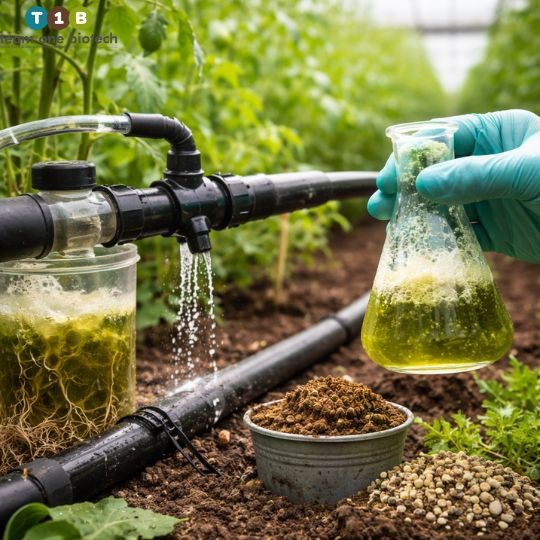
Here’s where many farmers stumble, and understandably so. Drip irrigation systems are engineered for liquid chemicals, inert, stable, predictable. Living organisms are none of these things. They need oxygen. They can clump. They can potentially clog those tiny emitter holes that cost thousands of rupees per acre to install.

But these challenges are entirely solvable with proper technique.

Filtration is Non-Negotiable

Your drip system should already have screen or disc filters for preventing sediment clogging. For bio-fertilizers, these same filters work, but you need to be more vigilant. Use filters in the 120-200 mesh range. After applying bio-fertilizers, flush the system with clean water for 10-15 minutes. This prevents any bacterial biomass from settling in the laterals overnight.

Quality liquid bio-fertilizers formulated for fertigation should have minimal suspended solids. If you’re seeing thick sludge or sediment in the bottle, that’s a red flag about manufacturing quality.

Timing Matters More Than You Think

Apply bio-fertilizers during the cooler parts of the day, early morning before 9 AM or late evening after 5 PM. This isn’t just folklore. UV radiation kills beneficial bacteria. High temperatures stress them. Applying during midday in the Indian summer is essentially sterilizing your product in the field.

Moreover, cooler temperatures mean the irrigation water itself is cooler, and these microorganisms are sensitive to thermal shock. Water temperature above 35°C significantly reduces bacterial survival.

The Farmer’s Manual: Best Practices for Bio-Fertigation
The Farmer's Manual: Best Practices for Bio-Fertigation

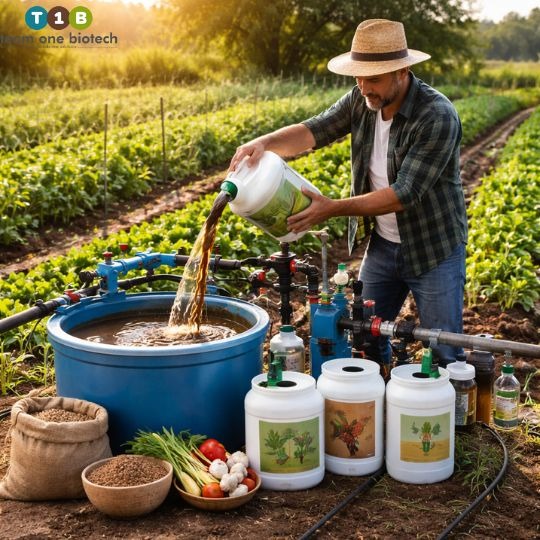
Let me give you a protocol that works, tested across thousands of acres from Nashik’s grape farms to Davangere’s cotton fields.

Pre-Application: The Jar Test

Before you inject any bio-fertilizer into your system, do this simple compatibility test. Take a clean glass jar. Add 100 ml of your irrigation water. Add the recommended dose of bio-fertilizer. If you’re using any other inputs, add them in sequence. Wait 30 minutes.

What you’re looking for: the solution should remain uniformly mixed without precipitation, flocculation, or phase separation. If you see particles settling or layers forming, you have a chemical incompatibility. Bio-fertilizers are generally incompatible with strongly acidic fertilizers (pH below 4) or heavy metal-containing compounds.

Application Protocol

Step 1: Irrigate First Run your drip system with plain water for 15-20 minutes. This primes the soil, creates uniform moisture, and ensures your emitters are functioning properly.

Step 2: Prepare the Bio-Fertilizer Solution In a clean container, mix the liquid bio-fertilizer with water at the manufacturer’s recommended dilution. For most products, this is 2-5 liters per acre diluted in 50-100 liters of water. Never mix concentrated bio-fertilizer directly into your fertilizer tank.

Step 3: Inject and Monitor Using your venturi system or fertilizer tank, inject the bio-fertilizer solution over 30-45 minutes. This slow injection ensures even distribution. Walk your field and check that all emitters are flowing uniformly.

Step 4: Flush the System This is the step farmers skip, and it’s costly. After bio-fertilizer injection, continue irrigation with clean water for another 15-20 minutes. This pushes the solution out of the laterals and into the root zone, preventing microbial buildup in the lines.

Storage Discipline

Liquid bio-fertilizers are living products with shelf lives. Store them in a cool, shaded location, never in direct sunlight or in a tin shed where summer temperatures exceed 40°C. Most products remain viable for 12-18 months if stored properly, but check expiration dates. A dead bio-fertilizer is just expensive water.

Frequency and Dosage

For crops like sugarcane and cotton with 5-6 month growth cycles, apply bio-fertilizers through drip every 20-30 days during active growth phases. For perennials like pomegranate and grapes, monthly applications during the growing season yield best results. The key is consistency, you’re building a microbial community, not delivering a one-time nutrient hit.

Chemical Fertigation vs. Bio-Fertigation: The Real Comparison

ParameterChemical FertigationBio-Fertigation
Nutrient DeliveryImmediate, directGradual, continuous through microbial activity
Soil ImpactIncreases salinity, reduces pH, depletes organic matterImproves structure, increases organic carbon, balances pH
Cost Over TimeEscalating (resistance, degradation)Decreasing (builds soil fertility)
Water RequirementHigh (leaching needed)Lower (improved moisture retention)
Crop ImmunityNoneEnhanced through root colonization
Compatibility IssuesAcidic products can corrodeMinimal if pH managed
Residual EffectNoneMicrobial populations persist season-to-season
Environmental ImpactGroundwater contamination, emissionsRegenerative, carbon-sequestering

This table tells a story. Chemical fertigation is a sprint that exhausts the runner. Bio-fertigation is training that builds endurance.

The Bioremediation Dimension: Healing Damaged Soils
The Bioremediation Dimension: Healing Damaged Soils

Here’s where we need to talk about soils that are already compromised, and there are millions of hectares in this category across India.

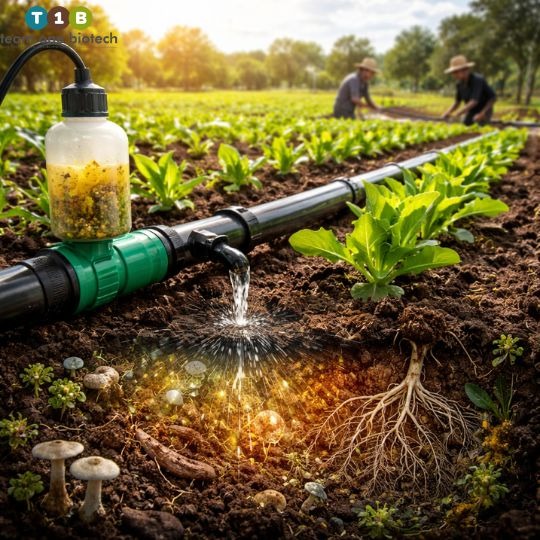
Bioremediation is the use of living organisms to restore degraded environments. In agriculture, it means using specific microbial consortia to reverse chemical damage, break down pesticide residues, and rebuild soil organic matter.

Consider a cotton field in Yavatmal that’s received heavy applications of chemical fertilizers and pesticides for 20 years. The soil is compacted, acidic, and biologically depleted. You can’t fix this overnight with compost or organic matter alone, you need microbial intervention to restart the biological processes that make soil healthy.

This is where specialized bio-fertilizers go beyond simple nutrient provision. Products containing diverse microbial communities, nitrogen fixers, phosphate solubilizers, potash mobilizers, and cellulolytic bacteria, work together to:

  • Break down accumulated chemical residues
  • Restore soil pH through organic acid production
  • Rebuild soil structure through bacterial exopolysaccharides
  • Restart nutrient cycling that has been dormant

Think of it as rebooting the soil’s operating system. You’re not just adding inputs, you’re restoring function.

The beauty of delivering these bioremediation agents through drip irrigation is precision. You can target specific problem areas. You can monitor recovery through root zone sampling. And because you’re delivering regularly with irrigation, you maintain consistent microbial populations rather than relying on a single broadcast application that degrades over time.

Why This Matters Now: The Economic and Ecological Imperative

Let’s return to Ramesh Patil, our sugarcane farmer. After learning about bio-fertigation, he made a simple calculation.

His annual chemical fertilizer bill through drip: ₹45,000 per acre. His yield: 85 tons per acre, declining. His soil: degraded, requiring increasing inputs each year.

He switched to an integrated approach, 60% of his previous chemical fertilizers plus regular bio-fertilizer applications. First season cost: ₹38,000 per acre. Yield: 87 tons. Soil organic carbon: increased from 0.42% to 0.51% (measured via Soil Health Card).

Second season: ₹35,000 per acre. Yield: 92 tons. Water requirement: reduced by 12% due to improved soil moisture retention.

Third season: ₹32,000 per acre. Yield: 95 tons. Disease pressure: noticeably reduced.

The economics work because biology compounds. Chemical inputs deplete and require more. Biological inputs build and require less.

Moving Forward: Your Soil’s Future Starts Today

The transition to bio-fertigation isn’t about abandoning modern agriculture, it’s about upgrading it. Your drip system isn’t the problem; it’s the solution delivery mechanism. The question is: what are you delivering?

Indian farming stands at an inflection point. We can continue down the path of increasing chemical dependence, declining soil health, and marginal economics. Or we can recognize that the most sophisticated agricultural technology isn’t in a factory, it’s in the soil, waiting to be awakened.

Bio-fertilizers through drip irrigation represent the convergence of precision agriculture and biological intelligence. They’re not a return to the past, but a step into a more sophisticated future where we work with nature’s systems rather than against them.

Your soil is not dead. It’s dormant. And every time you run that drip line, you have a choice: suppress or support, deplete or restore, extract or regenerate.

Ready to transform your soil from hard earth to living ecosystem? Team One Biotech specializes in bioremediation and soil health solutions designed specifically for Indian farming conditions. Our liquid bio-fertilizer range is engineered for drip irrigation systems, combining nitrogen fixers, phosphate solubilizers, and potassium mobilizers in formulations that won’t clog your emitters or compromise your investment. Visit our website or contact our agronomy team for a customized soil restoration plan. Because healthy soil isn’t just about this season’s yield, it’s about the next generation’s inheritance.

Looking to improve your ETP/STP efficiency with the right bioculture?
Talk to our experts at Team One Biotech for customised microbial solutions.

Contact+91 8855050575

Email:  sales@teamonebiotech.com

Visit: www.teamonebiotech.com

Discover More on YouTube – Watch our latest insights & innovations!-

Connect with Us on LinkedIn – Stay updated with expert content & trends!

The Future of Indian Farming: A Guide to Bio-fertilizers and Soil Health

The monsoon clouds gathered over Punjab in 1970, bringing with them not just water, but the promise of transformation. The Green Revolution was sweeping across India’s farmlands, turning a nation that once pleaded for grain shipments into a self-sufficient agricultural powerhouse. Farmers watched in awe as their yields doubled, then tripled. Chemical fertilizers became synonymous with progress, and every season, the appetite for nitrogen, phosphorus, and potassium grew stronger.

Yet today, Ramesh Singh, a third-generation farmer from Ludhiana, stands in his wheat field with furrowed brows. His grandfather’s stories of effortless harvests feel like folklore. Despite applying more urea than ever before, his yields have plateaued. His input costs have skyrocketed by forty-seven percent in just five years, while his profit margins continue their relentless decline. The soil beneath his feet, once dark and crumbly, now feels compacted and lifeless.

Ramesh’s story is not unique. It echoes across the Deccan plateau, where black cotton soil has lost much of its organic carbon. It resonates in the North-Eastern states, where acidic soils struggle to sustain traditional crop cycles. It reverberates through the salt-encrusted fields of Haryana, where decades of intensive irrigation and chemical inputs have left the land exhausted, almost hostile.

This is the silent crisis facing Indian agriculture, a crisis not of production alone, but of sustainability. The very revolution that fed millions has inadvertently created “tired” soil, and with it, the slow erosion of rural livelihoods. But within this challenge lies an extraordinary opportunity: the biological renaissance of Indian farming through bio-fertilizers and soil health restoration.

Chemical Saturation Crisis in Indian Soil

Chemical Saturation Crisis in Indian Soil

The statistics paint a sobering picture. India’s fertilizer consumption has increased from approximately 2.8 million tonnes in 1970 to over 60 million tonnes today. Yet, our average crop yields remain significantly below global standards. What went wrong?

The answer lies in what agronomists call the “NPK imbalance”, an over-dependence on nitrogen, phosphorus, and potassium at the expense of micronutrients, organic matter, and beneficial soil biology.

The Three Pillars of Soil Degradation

Chemical Overload: Continuous application of synthetic fertilizers has altered the fundamental chemistry of our soils. In Punjab and Haryana, the epicenters of the Green Revolution, soil testing reveals alarming trends. Zinc deficiency affects nearly seventy percent of sampled fields. Sulphur and boron levels have dropped precipitously. Meanwhile, the soil’s natural pH balance has shifted, creating conditions where nutrients become “locked” in the soil, unavailable to plant roots despite their physical presence.

Biological Collapse: Healthy soil is not merely dirt, it is a living ecosystem. Each gram of vibrant agricultural soil contains millions of bacteria, thousands of fungi, and countless other microorganisms. These organisms form symbiotic relationships with crops, enhancing nutrient uptake, protecting against pathogens, and improving soil structure. Chemical saturation has decimated these microbial communities. The earthworms that once aerated the soil have vanished from many fields. The mycorrhizal fungi that extended root systems through microscopic networks have been poisoned into near-extinction.

Physical Deterioration: Organic carbon content, the foundation of soil health, has plummeted. Surveys indicate that soils across the Deccan plateau contain less than 0.3 percent organic carbon, far below the minimum threshold of 0.5 percent required for sustainable agriculture. Without organic matter, soil loses its structure. It cannot retain moisture during dry spells or drain effectively during heavy monsoons. Compaction becomes inevitable, creating hard pans that roots cannot penetrate and water cannot infiltrate.

Regional Manifestations of Soil Distress

Punjab and Haryana: The breadbaskets of India face acute salinity and alkalinity challenges. Decades of flood irrigation combined with inadequate drainage have pushed salts to the surface. Fields that once produced twenty-five quintals of wheat per hectare now struggle to reach fifteen. Farmers spend lakhs on remediation, often with limited success.

North-Eastern States: Natural soil acidity, exacerbated by high rainfall and leaching, creates unique challenges. Aluminium toxicity becomes a genuine threat to crops. Traditional shifting cultivation patterns, disrupted by population pressure and land consolidation, no longer allow soils the recovery time they require.

Deccan Plateau: Black cotton soils, rich in clay content but depleted in organic carbon, exhibit severe cracking during summer months and waterlogging during the monsoon. The loss of organic matter means these soils cannot buffer against climatic extremes. Crop failures during both Kharif and Rabi seasons have become increasingly common.

Bio-fertilizers: Nature’s Answer to Soil Exhaustion

Bio-fertilizers represent a fundamental reimagining of agricultural inputs. Rather than forcing nutrients into depleted soil through chemical intervention, bio-fertilizers work with nature’s own mechanisms to restore soil vitality and enhance nutrient availability.

At their essence, bio-fertilizers are living microbial inoculants containing beneficial bacteria, fungi, and other microorganisms. These microscopic allies perform functions that chemical fertilizers simply cannot replicate.

The Science Behind Microbial Soil Inoculants

Nitrogen Fixation: Certain bacteria, most notably Rhizobium, Azotobacter, and Azospirillum, possess the remarkable ability to convert atmospheric nitrogen into plant-available forms. A well-inoculated legume crop can fix up to eighty kilograms of nitrogen per hectare naturally, reducing or even eliminating the need for urea applications.

Phosphate Solubilization: Phosphorus, despite being abundantly present in most Indian soils, remains largely unavailable to plants. It forms insoluble compounds with calcium, iron, and aluminium. Phosphate-solubilizing bacteria and fungi secrete organic acids that break these bonds, liberating phosphorus for plant uptake. This biological mechanism can unlock existing soil reserves, making expensive phosphatic fertilizers partially redundant.

Potassium Mobilization: Similarly, potassium-mobilizing bacteria can release locked potassium from mineral structures in the soil. They produce acids and chelating substances that weatherize potassium-bearing minerals, making this essential macronutrient accessible to growing crops.

Growth Hormone Production: Many beneficial microorganisms synthesize plant growth hormones, auxins, gibberellins, and cytokinins, that stimulate root development, enhance flowering, and improve stress tolerance. These natural regulators create more robust plants without synthetic interventions.

Team One Biotech’s Bioremediation Expertise

Team One Biotech has positioned itself at the forefront of India’s bioremediation revolution. Understanding that each region’s soil challenges require tailored solutions, the company develops microbial consortia specifically adapted to Indian conditions.

Their approach goes beyond simple inoculant production. Team One Biotech employs rigorous soil testing protocols to identify deficiencies, then formulates custom bio-fertilizer blends that address specific nutritional gaps and biological deficits. Their Innovative Bio-Products for Sustainable Agriculture incorporate indigenous microbial strains, naturally adapted to India’s diverse climatic zones and soil types.

What distinguishes Team One Biotech is their commitment to soil health restoration as a holistic practice. They recognize that bio-fertilizers work optimally not in isolation, but as part of an integrated soil management strategy that includes organic amendments, crop rotation, and judicious use of chemical inputs when necessary.

The Multidimensional Benefits of Bio-fertilizers for Indian Agriculture

Transitioning to bio-fertilizers is not merely an environmental choice, it represents sound economic strategy and agronomic wisdom.

Long-term Yield Stability

Chemical fertilizers provide immediate nutrient availability, creating impressive short-term results. However, this approach is fundamentally extractive. It mines the soil’s existing biological and physical capital without replenishing it.

Bio-fertilizers operate differently. They build soil health incrementally, creating conditions for sustained productivity. Research conducted across multiple Indian agricultural universities demonstrates that farms incorporating bio-fertilizers show consistent yield improvements over five to seven year periods. More significantly, these yields prove resilient during stress conditions, droughts, pest outbreaks, or disease pressure, that devastate conventionally managed fields.

The mechanism is straightforward: healthier soil produces healthier plants. Plants with robust root systems, access to balanced nutrition, and natural disease resistance simply perform better across varied conditions. They require fewer rescue interventions, less supplementary irrigation, and reduced pesticide applications.

Cost Reduction and Economic Viability

The economics of bio-fertilizers become compelling when examined over complete crop cycles rather than single seasons.

Consider a typical wheat farmer in Uttar Pradesh. Traditional chemical inputs, urea, DAP, potash, micronutrients, might cost eighteen to twenty thousand rupees per hectare. Bio-fertilizers, combined with reduced chemical applications, can decrease these costs by thirty to forty percent within three growing seasons.

The savings compound. As soil health improves, the efficiency of all inputs increases. Plants extract more nutrition from existing soil reserves. Water retention improves, reducing irrigation requirements and associated electricity costs. Pest and disease incidence often decreases, lowering pesticide expenditure.

For small and marginal farmers, those operating on holdings of less than two hectares, these savings represent the difference between subsistence and prosperity. They free up capital for family needs, education, and farm improvements.

Climate Resilience and Environmental Sustainability

Indian agriculture faces unprecedented climatic uncertainty. Erratic monsoons, extended dry spells, unseasonal temperature fluctuations, these phenomena demand adaptive farming systems.

Bio-fertilizers contribute to climate resilience through multiple pathways. Improved soil organic carbon enhances water retention, helping crops survive dry periods. Better soil structure facilitates drainage during heavy rainfall, preventing waterlogging and root diseases. Enhanced microbial activity creates more stable soil aggregates that resist erosion.

From an environmental perspective, bio-fertilizers address several critical concerns. They reduce nitrous oxide emissions associated with excessive nitrogen fertilization. They minimize phosphorus runoff that causes eutrophication of water bodies. They restore biodiversity to agricultural landscapes, supporting beneficial insects, birds, and soil fauna.

This environmental stewardship is not abstract altruism, it is practical self-interest. Healthy ecosystems provide free services: pollination, natural pest control, nutrient cycling, and water filtration. Degraded ecosystems demand costly external inputs to maintain even minimal productivity.

Enhanced Nutritional Quality of Produce

An often-overlooked benefit of bio-fertilizer-based agriculture is the superior nutritional quality of harvested produce. Crops grown in biologically active, balanced soils accumulate higher levels of essential minerals, vitamins, and beneficial phytochemicals.

This quality premium is increasingly recognized in urban markets. Consumers actively seek produce grown with minimal chemical inputs. For farmers positioned to access these markets, bio-fertilizers create opportunities for value addition and premium pricing.

Practical Implementation: Your Transition Roadmap from Chemical Dependence to Integrated Soil Management

Shifting from conventional to bio-fertilizer-based farming requires methodical planning. This is not an overnight transformation, but a strategic evolution spanning multiple growing seasons.

Phase One: Assessment and Foundation (Months 1-3)

Comprehensive Soil Testing: Begin with professional soil analysis that measures not just NPK levels, but organic carbon content, microbial activity, pH, electrical conductivity, and micronutrient status. Team One Biotech offers diagnostic services specifically designed for Indian soil conditions.

Baseline Documentation: Record current input costs, yield levels, and crop quality parameters. This baseline data will demonstrate the impact of your transition objectively.

Education and Training: Engage with bio-fertilizer manufacturers, agricultural universities, and progressive farmer groups. Understanding the science behind biological inputs builds confidence and prevents costly mistakes.

Phase Two: Gradual Integration (Season 1-2)

Partial Substitution Strategy: Do not eliminate chemical fertilizers entirely in your first season. Instead, reduce chemical NPK applications by twenty-five to thirty percent while introducing bio-fertilizers. This conservative approach minimizes risk while allowing soil microbiomes to establish.

Targeted Bio-fertilizer Application: Select appropriate microbial inoculants for your specific crops:

  • For Legumes (pulses, groundnut): Rhizobium inoculants for nitrogen fixation
  • For Cereals (wheat, rice, maize): Azospirillum and Azotobacter for nitrogen support, plus phosphate-solubilizing bacteria
  • For Vegetables and Cash Crops: Comprehensive microbial consortia including mycorrhizal fungi for enhanced nutrient uptake

Organic Matter Addition: Incorporate composted farmyard manure, green manures, or crop residues. Bio-fertilizers work optimally when adequate organic substrate is available for microbial colonization.

Phase Three: Optimization and Expansion (Season 3-5)

Progressive Chemical Reduction: As soil health indicators improve, increased earthworm populations, better soil structure, enhanced organic carbon, reduce chemical inputs further. Many farmers achieve fifty to sixty percent reduction by the third season.

Diversification of Microbial Inputs: Expand beyond basic NPK-focused inoculants. Incorporate bio-pesticides and bio-fungicides that provide crop protection through microbial antagonism rather than chemical toxicity.

Crop Rotation and Intercropping: Biological soil management synergizes beautifully with traditional wisdom about crop diversity. Rotating between cereals, legumes, and oilseeds maintains balanced nutrient extraction and supports diverse microbial communities.

Phase Four: Mastery and Advocacy (Season 6+)

Fine-tuning Protocols: By this stage, you understand your soil’s specific responses. Customize bio-fertilizer applications based on crop growth stages, seasonal variations, and observed deficiencies.

Economic Analysis: Calculate your total savings, yield improvements, and quality premiums. Most farmers report that bio-fertilizer systems become economically superior to conventional approaches by the fifth or sixth season.

Community Leadership: Share your experiences with neighboring farmers. The transformation of Indian agriculture will occur farm by farm, village by village, through demonstration and peer influence.

Practical Application Techniques

Seed Treatment: Mix bio-fertilizer powder with water to create a slurry. Coat seeds thoroughly and air-dry in shade before sowing. This ensures microbial colonization from the moment of germination.

Soil Application: Mix bio-fertilizers with compost or well-decomposed farmyard manure. Broadcast before final land preparation, ensuring incorporation into the root zone.

Seedling Root Dip: For transplanted crops like rice, tomato, or chili, dip seedling roots in bio-fertilizer solution before transplanting. This gives plants a microbial boost during the vulnerable establishment phase.

Drip Irrigation Integration: Many liquid bio-fertilizers can be delivered through drip systems, ensuring even distribution and efficient utilization.

Addressing Common Concerns and Misconceptions

“Bio-fertilizers Cannot Match Chemical Yields”

This concern stems from comparing immediate, single-season responses. Chemical fertilizers do provide faster nutrient availability. However, bio-fertilizers build yield potential over time. Multi-season studies consistently show equivalent or superior yields once soil biology is fully established. Additionally, bio-fertilizer systems demonstrate greater stability, their yields remain consistent across varying climatic conditions.

“Bio-fertilizers Are Too Expensive”

Quality bio-fertilizers require modest investment, typically two to four thousand rupees per hectare for comprehensive microbial inoculants. When factored against reduced chemical fertilizer costs, improved resource efficiency, and better produce quality, the economics favor biological approaches within two to three crop cycles.

“The Technology Is Complicated”

Bio-fertilizer application is actually simpler than managing complex chemical fertilization schedules. Manufacturers like Team One Biotech provide clear protocols tailored to specific crops and regions. The learning curve is gentle, and results build confidence quickly.

“My Soil Is Too Degraded”

Severely degraded soils do require patient restoration, but they respond dramatically to biological interventions. The worse your starting point, the more impressive your improvements will be. Degraded soils are not dead, they are dormant ecosystems waiting for revival.

The Broader Context: Bio-fertilizers in India’s Agricultural Policy Landscape

The Government of India has recognized the critical importance of soil health restoration. The Soil Health Card scheme, Paramparagat Krishi Vikas Yojana, and various state-level programs provide subsidies and support for organic and biological inputs.

National Biofertilizer Development Centers work continuously to develop improved microbial strains and delivery systems. Agricultural universities conduct extensive field trials demonstrating bio-fertilizer efficacy under diverse conditions. This institutional support creates an enabling environment for farmers willing to embrace sustainable farming practices.

Furthermore, certification programs for organic produce, India Organic, PGS-India, open premium market opportunities for farmers using bio-fertilizers as part of certified organic production systems. Urban consumers increasingly demand produce grown with minimal chemical inputs, creating economic incentives beyond environmental considerations.

Looking Forward: The Bio-Revolution Is Here

The transformation of Indian agriculture through bio-fertilizers and bioremediation is not a distant aspiration, it is happening now, on thousands of progressive farms across the country. From the rice paddies of West Bengal to the cotton fields of Gujarat, from the sugarcane belts of Maharashtra to the spice gardens of Kerala, farmers are rediscovering the power of working with nature rather than against it.

This biological renaissance does not require abandoning scientific progress. It represents the maturation of agricultural science, moving beyond crude chemical interventions toward sophisticated management of living systems. It combines traditional wisdom about soil fertility with cutting-edge microbiology. It honors the Green Revolution’s achievements while correcting its excesses.

For companies like Team One Biotech, the mission is clear: democratize access to world-class bioremediation technologies, making them available and affordable to farmers across India’s vast agricultural landscape. Through rigorous research, quality production, and genuine farmer partnerships, they are building the infrastructure for sustainable agricultural prosperity.

The tired soils of Punjab can be revitalized. The acidic fields of Assam can regain productivity. The degraded black cotton soils of the Deccan can rebuild their organic carbon reserves. This restoration will not happen through government mandates or corporate diktat, it will emerge from individual farmers making informed choices, season after season, gradually rebuilding the biological wealth beneath their feet.

Join the Bio-Revolution: Your Soil, Your Legacy

Ramesh Singh, the Ludhiana farmer we met at the beginning of this journey, made a decision three years ago. Faced with declining yields and escalating costs, he attended a farmer training program on bio-fertilizers. Skeptical but desperate, he implemented bio-fertilizer applications on just two acres, a trial plot while continuing conventional management on his remaining land.

The first season showed modest improvements. The second season revealed striking differences, his bio-fertilizer plots withstood a mid-season dry spell that severely stressed his conventional fields. By the third season, the transformation was undeniable. His trial plots yielded eighteen percent more wheat, his input costs had dropped by thirty-two percent, and the soil, the very soil he had thought was permanently exhausted, showed visible revival. Earthworms reappeared. The soil held moisture better. It smelled different, alive, rich, fertile.

Today, Ramesh has transitioned his entire farm to integrated biological management. He serves as a resource person for his village, demonstrating techniques and sharing his economic results with curious neighbors. More importantly, he speaks with renewed hope about his children’s future in farming, something he could not imagine just five years ago.

Your soil tells a story. It remembers the care or neglect of previous seasons. It responds to every intervention, chemical or biological, with consequences that ripple forward through time. The question facing Indian agriculture is simple yet profound: what story will your soil tell five years from now? Will it speak of continued degradation and declining fertility, or will it testify to renewal and restoration?

The tools for transformation are available. The science is proven. The economics are compelling. The support systems are in place. What remains is the will to begin, not tomorrow, not next season, but now.

The future of Indian farming is not about returning to pre-industrial techniques. It is about moving forward to post-industrial wisdom, integrating the best of traditional knowledge with contemporary scientific understanding. Bio-fertilizers and soil health restoration represent this synthesis. They offer a pathway toward agricultural systems that nourish both people and planet, that generate prosperity while rebuilding natural capital, that feed current generations without compromising the inheritance of those yet to come.

The bio-revolution awaits. Your soil awaits. The choice, ultimately, is yours.

Transform your soil. Transform your farm. Transform your future.

Looking to improve your ETP/STP efficiency with the right bioculture?
Talk to our experts at Team One Biotech for customised microbial solutions.

Contact+91 8855050575

Email:  sales@teamonebiotech.com

Visit: www.teamonebiotech.com

Discover More on YouTube – Watch our latest insights & innovations!-

Connect with Us on LinkedIn – Stay updated with expert content & trends!

Scan the code