

Anaerobic Digestion in STP/ETP: Turning Waste into Wealth
Every month, industrial facilities across India receive electricity bills that eat into already-thin operating margins. Simultaneously, their ETP and STP units are quietly generating tonnes of organic sludge that must be dewatered, transported, and disposed of at significant cost. What if both problems shared the same solution? What if that sludge, widely treated as a liability, was actually an untapped energy asset sitting beneath your feet?
This is not a theoretical proposition. It is the commercial reality of anaerobic digestion (AD), a biological process that is reshaping how forward-thinking plant operators and sustainability managers in India look at wastewater treatment. The question is no longer whether AD works. The question is how long your facility can afford to ignore it.
What Is Anaerobic Digestion and Why Does It Matter to Indian Industry?
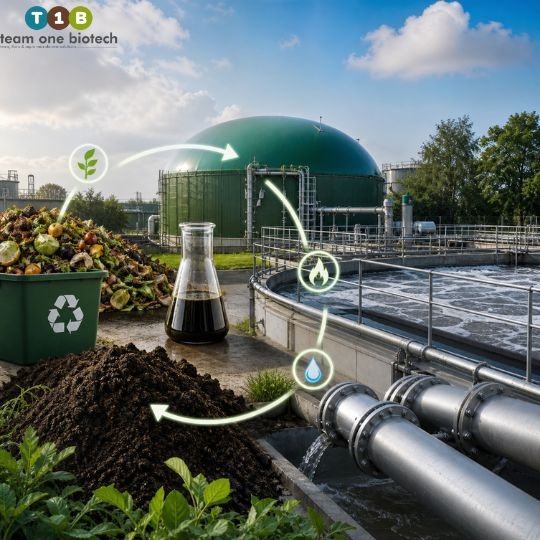
The anaerobic digestion process is a series of microbial reactions that break down organic matter in the complete absence of oxygen, producing two commercially valuable outputs: biogas (primarily methane) and digestate (a nutrient-rich residue usable as fertilizer or soil conditioner).
In the Indian industrial context, this process carries outsized significance. Sectors such as distilleries, dairy processing, paper and pulp, pharmaceuticals, food and beverage, and municipal sewage treatment are all operating under tightening CPCB and SPCB compliance mandates. These regulations are not softening. The Central Pollution Control Board’s evolving discharge norms and the push toward Zero Liquid Discharge (ZLD) compliance are forcing plant operators to rethink sludge management from the ground up.
Meanwhile, the cost of grid electricity continues to climb, and industrial consumers in states like Maharashtra, Gujarat, Tamil Nadu, and Uttar Pradesh are acutely aware of how energy expenditure affects their cost per unit of production. Anaerobic digestion offers a pathway to reduce both the environmental liability of sludge and the financial burden of purchased energy, simultaneously.
The Four Biological Stages of the Anaerobic Digestion Process
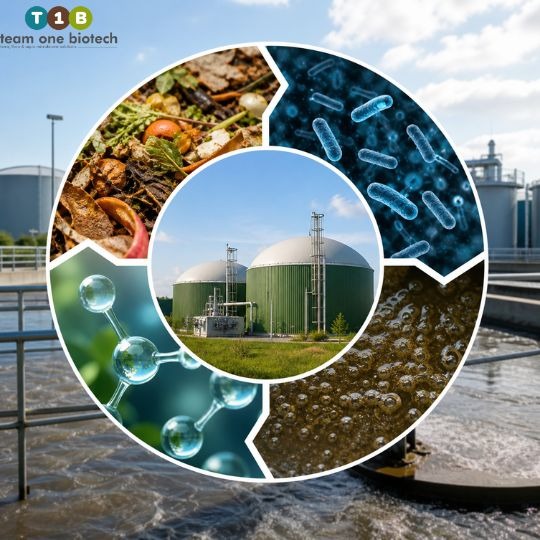
Understanding how AD works at a microbial level is critical for operators who want to optimize performance rather than simply install a reactor and hope for results. The process unfolds in four distinct, interdependent stages.
Stage 1: Hydrolysis
The process begins with hydrolysis, where complex organic polymers including carbohydrates, proteins, and lipids are broken down into simpler soluble compounds such as sugars, amino acids, and fatty acids. Specialized hydrolytic bacteria secrete extracellular enzymes to catalyze this breakdown.
This stage is often the rate-limiting step in systems treating high-solid or complex industrial effluents. Indian textile or pharmaceutical ETPs, for instance, frequently encounter effluents with recalcitrant organics that resist rapid hydrolysis, making microbial selection and inoculation at this stage critically important.
Stage 2: Acidogenesis
The soluble products from hydrolysis are then fermented by acidogenic bacteria into volatile fatty acids (VFAs), alcohols, carbon dioxide, and hydrogen. This is the fastest stage in the sequence and produces an acidic intermediate environment.
Operational challenges arise when acidogenesis outpaces the subsequent stages, causing VFA accumulation and a drop in pH that can inhibit or completely crash the system. Managing this balance is one of the most common pain points in Indian industrial AD installations, particularly in distilleries and food processing plants where organic loads fluctuate significantly with production cycles.
Stage 3: Acetogenesis
Acetogenic bacteria convert the VFAs and alcohols from the previous stage into acetic acid, hydrogen, and carbon dioxide, the direct precursors for methane generation. This stage operates in close syntrophic partnership with methanogens. The relationship is exquisitely sensitive to hydrogen partial pressure, and any operational disruption, whether from toxic influent, sudden organic overload, or temperature variation, can break this partnership and suppress biogas output.
Stage 4: Methanogenesis
This is the stage that generates wealth. Methanogenic archaea, the most environmentally sensitive microorganisms in the entire consortium, convert acetic acid and hydrogen into methane (CH4) and carbon dioxide (CO2). The methane fraction in the resulting biogas typically ranges between 55% and 75%, depending on the substrate composition and reactor conditions.
Methanogens are slow-growing, obligate anaerobes. They are extraordinarily sensitive to oxygen intrusion, pH swings, ammonia toxicity, and the presence of heavy metals, all of which are common challenges in mixed industrial effluents across Indian manufacturing sectors.
This is precisely why microbial consortium quality is not an afterthought. It is the foundation of AD performance.
At Team One Biotech, our proprietary microbial cultures for Anaerobic Digestion are developed and tested specifically for the organic profiles common in Indian industrial wastewater. Whether your ETP is treating distillery spent wash, dairy whey permeate, or paper mill effluent, the right biological inoculant can dramatically accelerate startup, stabilize performance, and push biogas yields to the upper end of achievable ranges.
Consult with Team One Biotech today for a free biological assessment of your ETP/STP influent.
Turning the Process into Profit: The Three Pillars of Wealth Generation
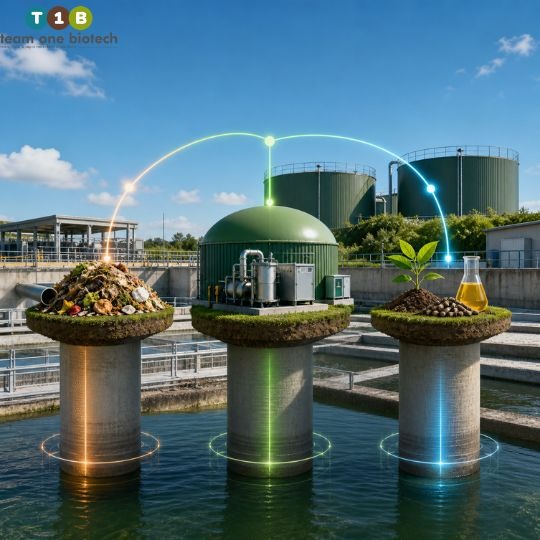
Pillar 1: Biogas Recovery and Energy Independence
The most immediate and quantifiable financial return from AD is the recovery of combustible biogas. This gas can be used directly in boilers to replace furnace oil or natural gas, fed into gas engines for combined heat and power (CHP) generation, or, in larger installations, upgraded to compressed biomethane for vehicle fuel or grid injection under the Sustainable Alternative Towards Affordable Transportation (SATAT) scheme.
For medium to large ETPs treating high-strength organic effluent, the energy recovered through biogas can offset a meaningful share of total plant energy consumption. The exact offset depends heavily on influent COD concentration, flow volume, reactor design, and operational consistency. Systems with stable, high-COD inputs and well-managed microbial populations consistently outperform those operating reactively.
The SATAT initiative, promoted by the Ministry of Petroleum and Natural Gas, provides Indian industry with a structured offtake channel for surplus biomethane, creating a genuine revenue stream from what was previously a waste output.
Pillar 2: Reduction in Sludge Handling and Disposal Costs
In conventional aerobic treatment, sludge generation is high and the costs associated with its dewatering, transportation, and disposal can constitute a substantial portion of the ETP operating budget. Anaerobic digestion significantly reduces volatile solids in the sludge stream, resulting in a lower sludge volume requiring final disposal.
The digestate that remains after AD is stabilized, odor-reduced, and in many cases suitable for agricultural land application as a soil amendment, subject to applicable state SPCB norms. This alone can convert a recurring disposal cost into a potential revenue stream or at minimum eliminate a logistics burden that many plant managers underestimate.
Pillar 3: Carbon Credits and ESG Positioning
India’s voluntary carbon market is maturing, and regulatory frameworks around carbon credits are gaining traction. Biogas plants that displace fossil fuels are eligible to generate Verified Carbon Units (VCUs) under recognized methodologies. For industries with aggressive ESG targets or those supplying to multinational buyers with Scope 3 emission requirements, this adds a non-trivial financial and reputational layer of value to an AD investment.
More immediately, demonstrating active energy recovery from wastewater is a powerful narrative for sustainability reporting, green financing applications, and environmental compliance submissions to state pollution control boards.
Addressing Real-World Challenges in Indian AD Installations
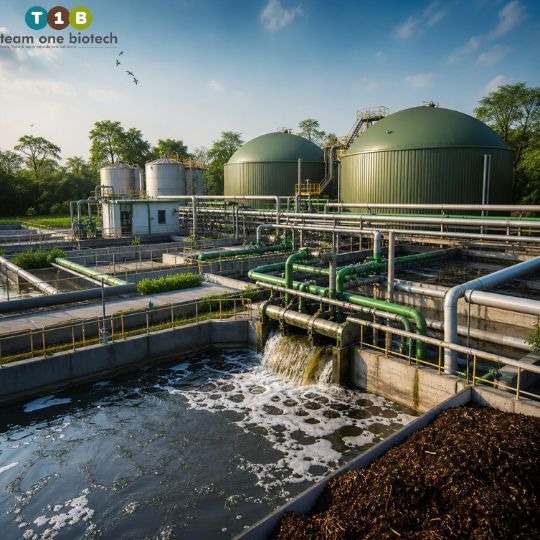
Indian industrial AD systems face a set of challenges that are distinct from those encountered in European or North American installations.
Fluctuating Organic Loads: Seasonal production variations in agro-based industries create wide swings in influent COD and flow, which stress microbial populations adapted to stable conditions. Robust biological seeding and real-time monitoring are essential buffers against this variability.
Temperature Variability: Unlike temperate climates, certain Indian regions experience extreme seasonal temperatures. Mesophilic AD reactors operating in the range of 30 degrees Celsius to 38 degrees Celsius generally perform well across most Indian geographies, but insulation and heating strategies remain important in northern states during winter months.
Inhibitory Compounds: Effluents from pharmaceutical, chemical, and textile sectors frequently contain compounds that are toxic to methanogens at certain concentrations. Pretreatment strategies and the use of inhibitor-tolerant microbial strains are essential in such applications.
Startup and Seeding: Many AD installations in India underperform not because of poor design but because of inadequate or mismatched biological inoculation during startup. A reactor seeded with the wrong microbial community or insufficient biomass will take months to reach design performance, costing operators in both lost biogas and treatment inconsistency.
Team One Biotech’s specialized bio-cultures for anaerobic systems are engineered to address precisely these conditions. Contact us for a plant-specific microbial consortium recommendation and startup protocol.
From Linear Waste to Circular Economy: The Strategic Shift
The traditional model of industrial wastewater management is fundamentally linear. Waste is generated, treated at cost, and discharged or disposed of. Every rupee spent on treatment is a pure operating expense with no return.
Anaerobic digestion fundamentally disrupts this logic. It inserts a value recovery loop into the treatment chain, converting an expense center into a partial revenue center. Organic waste becomes biogas. Biogas becomes electricity or fuel. Digestate becomes soil amendment. Carbon displacement becomes credits. A facility that once paid to manage its waste now extracts value from it at multiple points.
This is the circular economy in industrial practice, and it is not aspirational language. It is an engineering and financial architecture that Indian industry is increasingly positioned to adopt, given the regulatory tailwinds, energy pricing pressures, and the availability of proven biological solutions.
The shift requires commitment at the management level, technical expertise at the operational level, and the right biological foundation at the microbial level.
Team One Biotech works alongside plant engineers and sustainability teams to design, seed, and optimize anaerobic digestion systems tailored to your specific wastewater profile. Schedule a plant audit with our technical team and take the first step from waste liability to energy asset.
Disclaimer: All numerical values, performance metrics, percentage ranges, and yield estimates referenced in this article are general indicative figures based on published literature and industry experience. Actual biogas yields, COD reduction efficiencies, sludge reduction rates, and energy outputs will vary significantly depending on site-specific influent characteristics, reactor design, hydraulic and solid retention times, temperature conditions, microbial population health, and operational management practices. These figures should not be used for detailed engineering design or financial projections without a site-specific technical assessment.
Looking to improve your ETP/STP efficiency with the right bioculture?
Talk to our experts at Team One Biotech for customised microbial solutions.
Contact: +91 8855050575
Email: sales@teamonebiotech.com
Visit: www.teamonebiotech.com
Discover More on YouTube – Watch our latest insights & innovations!-
Connect with Us on LinkedIn – Stay updated with expert content & trends!