
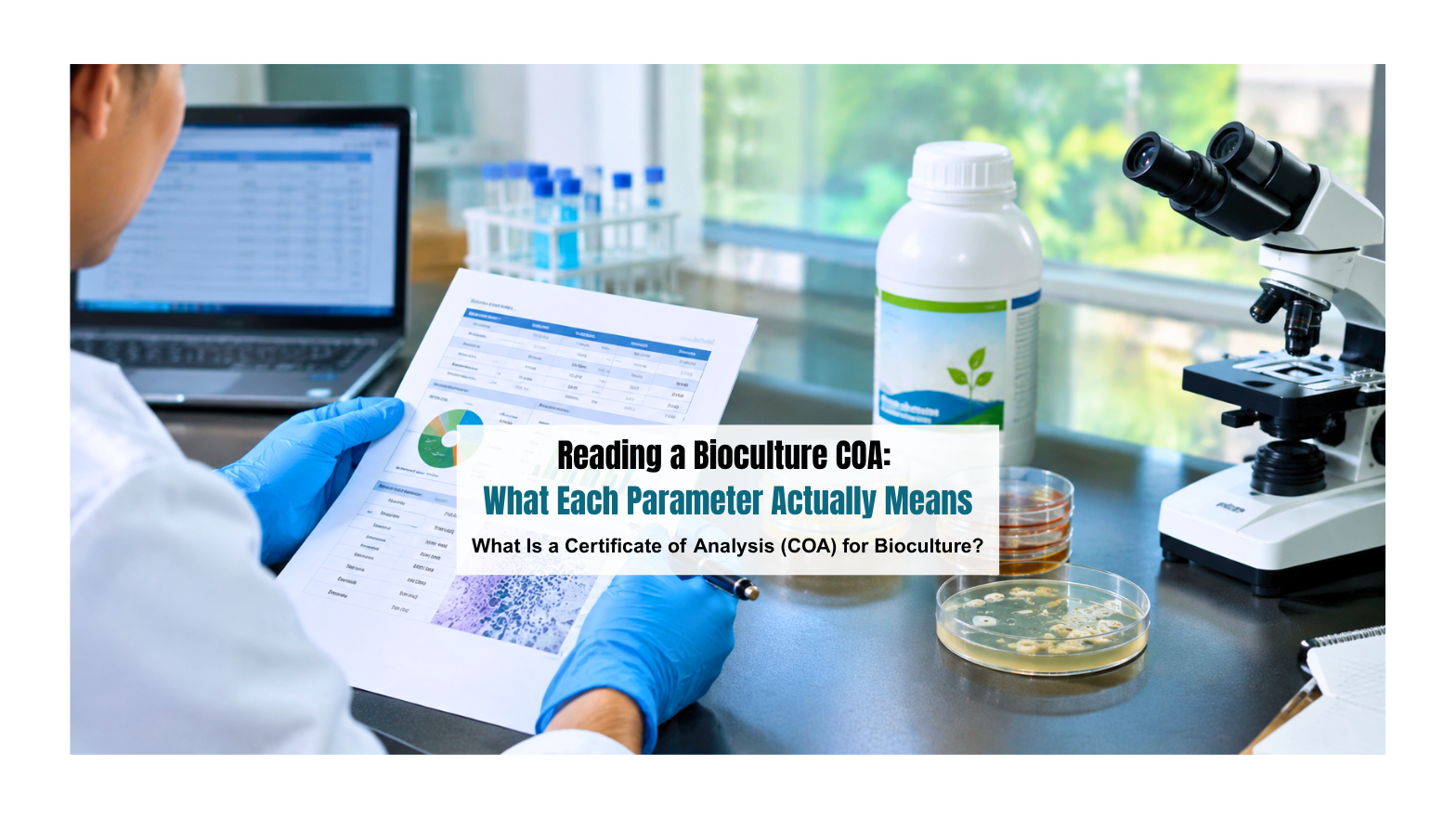

Reading a Bioculture COA: What Each Parameter Actually Means
Why Most COAs Are Misread, And What It’s Costing Your Plant
Most plant operators have experienced this: a bioculture product arrives, the COA is attached, and everyone nods at the numbers, but quietly, no one is entirely sure what they are actually looking at. The lot number gets recorded. The document gets filed. And the product gets dosed into the system based largely on trust, trust that the vendor’s numbers are accurate, trust that someone else in the chain has verified them, trust that it will simply work.
That trust is sometimes well-placed. Often, it is not.
Vendors regularly present bioculture COA documents in dense, column-heavy formats that prioritize the appearance of rigor over actual readability. Parameters are listed without context. Units are inconsistent. Reference ranges are missing. And because most procurement teams are not staffed with microbiologists, the document gets treated as a formality rather than the critical verification tool it was designed to be.
The cost of this gap is real. A bioculture product with degraded viable counts will underperform in your biological treatment stage. Inadequate BOD and COD reduction follows. Discharge parameters begin to drift. And when your effluent fails to meet CPCB or SPCB norms, the penalty lands on your facility, not on the vendor who supplied a product you never properly verified.
The certificate of analysis bioculture suppliers provide is your first line of defense in that chain. Most people are not reading it correctly. This blog changes that. Parameter by parameter, here is exactly what a bioculture COA is telling you, and what it means for your plant.
What Is a Certificate of Analysis (COA) for Bioculture?

A bioculture COA is a vendor-issued document that certifies a specific batch of microbial product has been tested and meets defined quality standards before it leaves the manufacturing facility. That distinction, batch-specific, tested before dispatch, is what separates a genuine COA from marketing literature.
A COA is not a product brochure. It is not a standard specification sheet that applies to every unit ever produced under a given product name. A real certificate of analysis bioculture document will reference a specific lot number, a specific testing date, and results that correspond to that exact batch, because microbial products are living systems, and quality can vary between production runs.
A responsible manufacturer tests every batch independently. They do not issue a blanket COA generated from historical data and applied across months of production. If a supplier cannot show you a lot-specific COA for the batch you are actually receiving, not a sample document, not a reference file, but the one tied to your shipment, that is the first signal to probe further.
When evaluating a new bioculture vendor, always request the COA for the specific batch being supplied. If they hesitate, that hesitation is information.
The Core Parameters in a Bioculture COA, Explained

COA formats differ between manufacturers in layout, terminology, and depth of testing. However, across responsible bioremediation product suppliers, the following parameters appear consistently. These are the ones that determine whether a product will perform, or quietly fail, inside your ETP or STP.
1. Viable Cell Count / Spore Count (CFU/g or CFU/mL)
CFU stands for Colony Forming Units, a measure of how many living, active microbial units are present per gram or per milliliter of the product. When a bioculture COA lists CFU/g or CFU/mL, it is telling you the biological density of what you are about to dose into your system. Higher numbers are not automatically better, but a number that falls significantly below the product’s stated specification is always a problem.
This is the parameter that most directly predicts treatment performance. A product with a lower-than-specified viable count will underperform in your biological treatment stage. The microbial population you are introducing into the reactor will be insufficient to establish the colony density needed for effective BOD and COD breakdown. You may dose correctly by volume and still see degraded performance, because the product itself delivered fewer active organisms than it claimed.
Viable cell count is also the parameter most sensitive to mishandling. It degrades with exposure to heat, moisture, UV light, and time. A product that was produced with excellent CFU values but stored incorrectly, whether during transit, at a distributor’s warehouse, or at your own facility, can arrive with counts substantially lower than what the COA recorded at the time of manufacture. This is why the manufacturing date and storage conditions on the COA matter as much as the CFU figure itself.
Acceptable ranges for ETP-grade biocultures span a broad spectrum depending on organism type, product formulation, and treatment application. Aerobic and anaerobic strains have different benchmarks. Granular, powder, and liquid formulations are not directly comparable on a per-unit basis. The meaningful check is not a universal threshold, it is whether the value on the COA aligns with the specification sheet for that specific product. When it does not, the mismatch requires an explanation before the product is accepted.
2. pH Stability / pH Range
The pH parameter on a bioculture COA tells you the range within which the microbial population in that product remains active, viable, and capable of performing its treatment function. Read carefully, this is distinct from the pH of the product itself, which refers to the formulation’s acidity or alkalinity as a physical characteristic. What matters operationally is the pH window within which those organisms actually work.
This matters more than most operators account for. Biological treatment systems at ETPs do not always hold a stable pH. Industrial influent, particularly from textile, food processing, chemical, or pharmaceutical operations, can introduce significant pH variation into the equalization or aeration stage. If your operating pH drifts outside the range stated on the COA, the microbial culture you have dosed will not perform as expected. This holds regardless of the CFU count. A product with excellent viable counts applied in the wrong pH environment is a wasted investment.
Many biological system failures in ETPs are attributed to poor product quality when the actual cause is a pH mismatch. The culture was fine. The conditions were not. Catching this before dosing, by cross-referencing the COA’s pH range with your system’s actual operating data, prevents troubleshooting exercises that could have been avoided at the procurement stage. Your ETP bioculture parameters must align with your effluent reality, and the COA gives you the data to make that check.
3. Moisture Content
Moisture content is a parameter that primarily applies to powder and granular bioculture formulations, and it is frequently underweighted in the COA review process. It should not be.
In dry microbial products, moisture is the primary accelerant of biological degradation. When moisture content exceeds the manufacturer’s stated threshold, whether during production, storage, or transit, it creates conditions that accelerate microbial death, trigger premature spore germination, and cause the product to clump or cake. A product with elevated moisture content may still visually resemble the original specification. It may smell the same. But its viable count will have declined, often substantially, and dosing will become inconsistent because the product no longer disperses uniformly.
Moisture content on the COA is therefore a direct indicator of how well the product has been handled before it reached your facility. A value within spec suggests the cold chain and storage protocols have been maintained. A value outside spec suggests intervention, whether during manufacturing, warehousing, or the last-mile logistics, that the product has experienced conditions it was not designed to withstand.
Before you even reference the COA, examine the product physically on receipt. Powder products that are clumped, discolored, or unusually hard are showing you moisture compromise before any lab value confirms it. The COA gives you the documented baseline. The physical inspection tells you what happened after that document was issued.
Acceptable moisture content thresholds differ across formulations and should always be verified against the manufacturer’s specification sheet.
4. Enzyme Activity
Not all bioculture COAs include enzyme activity data. Those that do are providing significantly more insight into how a product will perform in the reactor, not just how many organisms are present, but what those organisms are capable of doing.
Enzyme activity in this context refers to the capacity of the microbial culture to produce extracellular enzymes, proteases, lipases, amylases, cellulases, that break down specific categories of organic compounds in wastewater. These are the enzymes that do the actual degradation work on complex pollutants before or alongside microbial assimilation. A bioculture product selected for an industrial ETP treating food processing effluent, for instance, should demonstrate meaningful lipase and amylase activity. A product selected for pharmaceutical wastewater treatment has different enzyme requirements entirely.
The reason this matters specifically for COA review is that CFU count and enzyme activity are not always correlated. A product with an acceptable viable count can still display low enzyme activity, either because the strains present are not producing the enzymes required for your specific influent composition, or because enzyme activity has declined due to suboptimal storage conditions. In that scenario, the product may colonize your bioreactor adequately but fail to degrade the target pollutants at the rate your discharge parameters require.
For operators managing ETPs with complex organic loads, food processing, pharmaceuticals, textiles, tanneries, enzyme activity data on the COA is not optional detail. It is a primary performance indicator. Where a supplier does not include it, asking for supporting biodegradation performance data for your specific effluent type is a reasonable and appropriate request.
5. Shelf Life and Manufacturing Date
Shelf life on a bioculture COA is not a conservative estimate. It is the specific window within which the manufacturer guarantees the stated viable count will hold, provided the product is stored exactly as specified. Once that window closes, the guarantee does not exist. The product may still contain active organisms. It may even perform adequately. But you are operating outside the validated specification, and if system performance degrades, you have limited recourse.
This is a parameter where procurement timing creates real operational risk. Teams that purchase bioculture products in bulk to reduce per-unit cost sometimes hold inventory beyond its active window. A product that arrives with six months of shelf life remaining but sits in a stores room for four of those months before dosing begins leaves a narrow margin, and that margin assumes storage conditions have been maintained perfectly throughout. If temperature fluctuations or humidity excursions have occurred, the effective remaining potency may already be below specification even within the stated shelf life.
Every COA review for a bioculture product should include three simultaneous checks: manufacturing date, expiry or shelf life, and current date. Build lead time into your procurement planning so that products are dosed well within their active window, not in the final weeks of it. And cross-reference the storage conditions printed on the COA, temperature range, humidity limits, light exposure requirements, against where and how you actually store materials at your facility.
Bioculture shelf life is a compliance consideration as much as it is a quality one. If your biological system underperforms because the culture was past its active window, your discharge data suffers, and regulatory bodies are not interested in supply chain explanations.
6. Absence of Pathogens / Contaminant Screen
A COA from a responsible manufacturer will include documented confirmation that the product has been screened for pathogenic organisms, commonly Salmonella species, pathogenic strains of E. coli, and other regulated contaminants relevant to the product’s application context. This is typically expressed as an absence result: tested and not detected within a defined sampling quantity.
Most operators reading a bioculture COA focus heavily on CFU count and skip past the pathogen screen, treating it as a technical formality rather than a meaningful parameter. This is a mistake, and the consequences are more serious than many realize.
A contaminated microbial culture introduced into a biological treatment system does not simply fail to work. It can actively disrupt the existing microbial community in your reactor, the established biomass that has been conditioned over time to your specific influent. Pathogenic or competitive organisms introduced alongside the intended culture can suppress beneficial populations, alter the balance of the biological stage, and in severe cases cause a system crash that takes weeks to recover. That recovery period is your compliance exposure. Effluent quality during a crashed biological system is unlikely to meet your CPCB or SPCB discharge norms.
The regulatory framework does not distinguish between a system failure caused by operator error and one caused by a compromised input product. Your effluent quality is your responsibility. A clean pathogen screen on the COA is part of the documented due diligence that demonstrates you verified the inputs your system received.
How to Use the COA Before Every Purchase, A Quick Checklist

Before approving any bioculture purchase or accepting a delivery, the following checks should be completed against the COA provided:
- Confirm the COA references the specific batch or lot number being supplied, not a generic document
- Verify the manufacturing date and expiry are clearly stated and that current inventory timing keeps dosing within the active shelf life window
- Compare the CFU/g or CFU/mL value against the product’s own specification sheet, not against a general benchmark
- Confirm the pH range stated on the COA is compatible with your ETP’s actual operating pH
- Check that moisture content falls within the manufacturer’s stated limit for that formulation
- Review enzyme activity data if your effluent contains complex organic compounds, and request supporting performance data if this is absent
- Confirm the pathogen absence screen is documented and covers relevant organisms
- For first-time vendors, request third-party lab validation of the stated values before full-scale procurement
If a vendor cannot supply a COA that addresses every item on this list, that is a specification gap that requires resolution before the product is accepted into your facility.
Why This Matters Beyond Product Quality, The Compliance Dimension

The connection between a bioculture COA and regulatory compliance is direct, even if it is rarely framed that way in procurement conversations. When a biological treatment system fails, because viable counts were below specification, because pH conditions were mismatched, because moisture had compromised the product, because a contaminated culture crashed the reactor, the downstream consequence is effluent that exceeds your permitted discharge limits. That exceedance triggers CPCB or SPCB review. And in that review, the origin of the failure is irrelevant to the enforcing authority.
Plant operators are responsible for their discharge quality. Regulatory bodies do not accept vendor failure as a mitigating factor in non-compliance proceedings. The penalties, operational shutdowns, and reputational damage that follow a discharge violation land entirely on the facility.
This is the regulatory reality that makes the COA more than a technical document. Treated correctly, it is a documented verification trail, evidence that before dosing any microbial product into your treatment system, your team confirmed the biological input met specification across every critical parameter. That trail demonstrates due diligence. It protects you operationally and positions you to respond to regulatory scrutiny with documented decisions rather than verbal explanations.
Experienced plant managers do not treat the COA as fine print. They treat it as a procurement gatekeeping document, the checkpoint between a supplier’s claim and their system’s performance.
Read the COA Like Your Compliance Depends on It. Because It Does.
A bioculture COA is not supporting documentation. It is the technical specification that determines whether your investment in wastewater treatment microbial products will produce the results your system needs, or create the problems your operations cannot afford.
The parameters covered in this guide, viable cell count and CFU values, pH stability range, moisture content, enzyme activity, shelf life and manufacturing date, and pathogen absence testing, are not bureaucratic line items. Each one maps directly to a failure mode in a biological treatment system. Each one connects to an effluent quality outcome. And each one is something you now have the context to evaluate before the product is dosed, not after performance degrades.
Microbial product quality is verifiable before purchase. The COA is how you verify it. Use it that way.
At Team One Biotech, every batch dispatched comes with a fully documented, lot-specific certificate of analysis covering all critical ETP bioculture parameters, because we believe your plant deserves more than a number on a page. Reach out to our technical team today to request a product COA or to discuss your ETP’s microbial treatment requirements.
Looking to improve your ETP/STP efficiency with the right bioculture?
Talk to our experts at Team One Biotech for customised microbial solutions.
Contact: +91 8855050575
Email: sales@teamonebiotech.com
Visit: www.teamonebiotech.com
Discover More on YouTube – Watch our latest insights & innovations!-
Connect with Us on LinkedIn – Stay updated with expert content & trends!