


What is PGPR (Plant Growth Promoting Rhizobacteria) and Why Your Crops Need It?
There is a conversation happening in farmhouses across Punjab, Haryana, and the Deccan plateau that rarely reaches urban India. It is not about market prices or monsoon delays. It is about exhaustion, the exhaustion of soil that has been asked to produce without pause for over five decades.
An elderly farmer in Bathinda told me last monsoon season that his grandfather’s fields once required only farmyard manure and the wisdom of crop rotation. Today, even with three bags of DAP per acre, his wheat yield plateaus at 45 quintals, the same output his father achieved in 1995 with half the chemical inputs. The land, he said, has become “addicted but never satisfied.”
This is not poetic exaggeration. This is the documented reality of Indian soil health in 2026. The Green Revolution, which saved millions from hunger, came with a hidden invoice. Continuous cropping of rice-wheat systems, reliance on high-analysis NPK fertilizers, and the abandonment of organic amendments have created what soil scientists call “biological desertification.” Soil Organic Carbon levels in the Indo-Gangetic plains have crashed from approximately 1% in the 1960s to a dangerously low 0.3% in many intensive cropping zones. The microbiome, the invisible workforce of billions of bacteria, fungi, and actinomycetes, has been decimated.
The NPK ratio tells the story in numbers. The ideal fertilizer application ratio is 4:2:1 (Nitrogen:Phosphorus:Potassium). In 2026, India’s average application ratio has distorted to 7.7:3.1:1. We are force-feeding nitrogen while creating phosphorus and potassium imbalances. Worse, over 60% of applied phosphorus becomes “locked” in soil through chemical fixation, unavailable to plants despite its presence.
To learn how to implement these biological corrections on your own land, explore our comprehensive resource: The Future of Indian Farming: A Guide to Bio-fertilizers and Soil Health.
This is where Plant Growth Promoting Rhizobacteria emerges not as a trendy agricultural fad, but as a biological correction to a systemic crisis.
For the Time-Pressed Farmer:
- PGPR biofertilizers India are beneficial bacteria that colonize plant roots, fixing nitrogen and solubilizing phosphates naturally
- Indian soils have degraded from 1% to 0.3% Soil Organic Carbon in major grain belts, creating a biological crisis
- PGPR microbial consortiums offer nitrogen fixation, phosphate solubilization, heavy metal detoxification, and stress resistance
- Traditional chemical NPK ratios have shifted from the ideal 4:2:1 to an alarming 7.7:3.1:1, causing nutrient imbalances
- Bioremediation in agriculture using PGPR can restore soil health while reducing input costs by 30-40% over three seasons
- Team One Biotech solutions combine decades of bioremediation expertise with India-specific microbial formulations
Defining the Hero: What Exactly is PGPR?

Plant Growth Promoting Rhizobacteria are naturally occurring soil bacteria that establish symbiotic or associative relationships with plant roots. They colonize the rhizosphere, the narrow zone of soil directly influenced by root secretions and associated soil microorganisms. Think of the rhizosphere as the plant’s gut. Just as your digestive system relies on beneficial bacteria to break down food and synthesize vitamins, plants depend on rhizosphere microbes to mobilize nutrients, defend against pathogens, and regulate stress responses.
PGPR species include genera such as Azotobacter, Azospirillum, Bacillus, Pseudomonas, Rhizobium, and Paenibacillus. These are not genetically modified organisms. They are indigenous soil inhabitants that modern agriculture has inadvertently suppressed through chemical intensity. Sustainable farming solutions now focus on reintroducing these microbial allies through carefully formulated bio-fertilizers.
The difference between chemical fertilizers and PGPR biofertilizers is fundamental. Chemical fertilizers supply nutrients directly, often in excess, creating dependency and environmental runoff. PGPR biofertilizers restore the soil’s biological capacity to mobilize, cycle, and protect nutrients. They teach the soil to feed itself again.
The 4 Pillars of PGPR Power

1. Nitrogen Fixation: The Atmospheric Harvest
Certain PGPR strains possess the enzymatic machinery to convert atmospheric nitrogen into ammonia through biological nitrogen fixation. Bacteria like Azotobacter and Azospirillum can provide 20-40 kg of nitrogen per hectare per season. For leguminous crops, Rhizobium species form root nodules, fixing up to 100-200 kg N per hectare.
This is nitrogen that costs nothing, produces no greenhouse gases, and requires no fossil fuel synthesis. In a country where urea subsidies strain government budgets and farmer purchasing power alike, biological nitrogen fixation represents economic and ecological liberation.
2. Phosphate Solubilization: Unlocking the Frozen Bank
Indian soils contain vast reserves of phosphorus, but 95% of it is locked in insoluble mineral forms that plant roots cannot access. PGPR species like Bacillus megaterium and Pseudomonas fluorescens secrete organic acids (gluconic acid, citric acid) and phosphatase enzymes that dissolve these mineral phosphates, converting them into plant-available forms.
This is not hypothetical. Field trials across Maharashtra and Andhra Pradesh have demonstrated that phosphate-solubilizing bacteria can reduce the need for DAP by 25-30% while maintaining or improving yields. The phosphorus was always there. It simply needed the right biological mediator.
3. Siderophore Production: The Iron Cavalry
Iron is the fourth most abundant element in soil, yet plants frequently suffer iron deficiency because available iron oxidizes into insoluble ferric forms. PGPR produce siderophores, organic compounds that chelate (grab) iron and transport it to plant roots. This mechanism also competitively starves pathogenic fungi and bacteria of iron, acting as a biological defense system.
4. Phytohormone Regulation: The Stress Resistance Shield
PGPR synthesize plant hormones including indole-3-acetic acid (IAA), cytokinins, and gibberellins. These hormones enhance root architecture, improve water uptake efficiency, and activate stress tolerance pathways. During drought, salinity, or temperature stress, conditions increasingly common in India’s changing climate, PGPR-inoculated crops show measurably higher resilience.
Research from Tamil Nadu Agricultural University documented that cotton plants treated with PGPR microbial consortiums maintained 22% higher relative water content during drought stress compared to untreated controls.
Why Chemical-Only Farming is Failing: The Nutrient Lock-In Trap
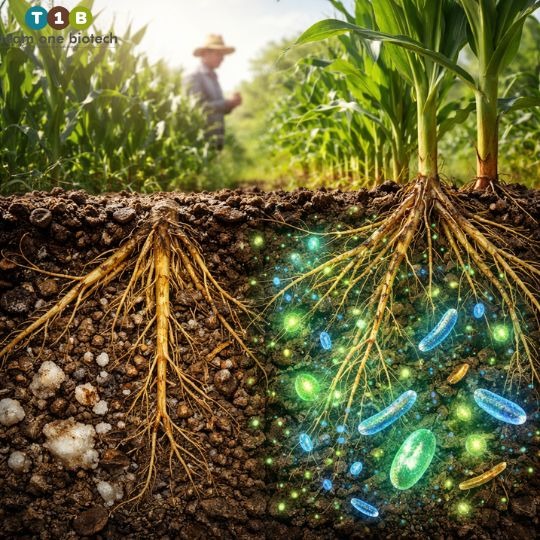
The paradox of modern Indian agriculture is this: we apply more fertilizer than ever, yet nutrient use efficiency declines yearly. The average nitrogen use efficiency in Indian agriculture is barely 30-35%. That means for every 100 kg of urea applied, the crop utilizes only 30-35 kg. The remainder volatilizes into the atmosphere, leaches into groundwater, or remains locked in soil complexes.
Continuous chemical application also disrupts soil pH. Overuse of urea acidifies soil, while excess DAP increases soil alkalinity in certain conditions. Both extremes reduce microbial activity and nutrient availability. Soil salinity, already affecting 6.73 million hectares of Indian land, worsens under high-intensity chemical regimes, particularly in canal-irrigated regions.
Chemical fertilizers deliver nutrients but destroy the biological infrastructure needed to cycle them. PGPR biofertilizers rebuild that infrastructure. They are not a replacement for all chemical inputs immediately, but they are the bridge back to biological competence.
Bioremediation: PGPR as Soil Detoxification Agents
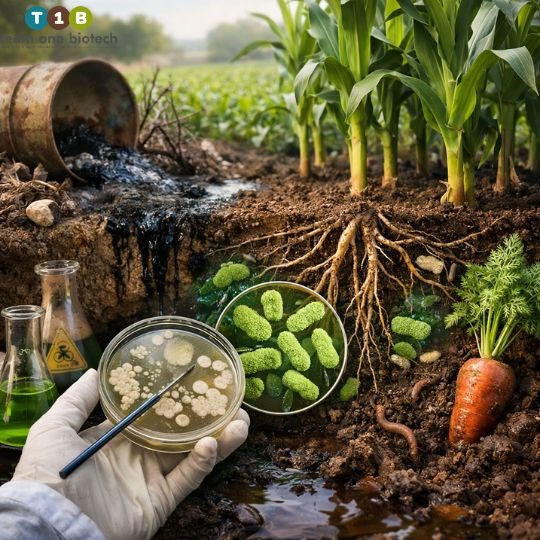
One of the least discussed yet most critical functions of PGPR is bioremediation in agriculture. Decades of pesticide application, industrial pollution, and irrigation with contaminated water have left many Indian soils laden with heavy metals (lead, cadmium, chromium) and persistent organic pollutants.
Specific PGPR strains possess remarkable bioremediation capabilities. They can:
- Immobilize heavy metals: Bacteria secrete exopolysaccharides that bind heavy metals, preventing plant uptake and groundwater contamination
- Degrade pesticide residues: Strains of Pseudomonas and Bacillus enzymatically break down organophosphates and chlorinated pesticides
- Reduce soil toxicity: By restoring microbial diversity, PGPR create competitive environments that suppress toxin-producing organisms
Team One Biotech’s expertise in bioremediation positions us uniquely in this space. We do not simply sell bio-fertilizers. We engineer microbial consortiums tested for efficacy in contaminated soils, validated through third-party field trials across diverse Indian agro-climatic zones.
Application Guide: Practical Deployment for Indian Farmers
Seed Treatment Method
For crops like wheat, rice, pulses, and millets:
- Mix 10 ml of liquid PGPR formulation per kg of seed
- Add a sticking agent (jaggery solution or gum arabica)
- Dry seeds in shade for 30 minutes
- Sow within 24 hours for maximum bacterial viability
Soil Drenching Method
For transplanted crops (tomato, chili, brinjal, paddy):
- Dilute 2-3 liters of PGPR liquid formulation in 200 liters of water
- Drench soil near root zone immediately after transplanting
- Repeat application at 30-day intervals during vegetative growth
Application Timing
- Apply during cooler parts of the day (early morning or late evening)
- Ensure adequate soil moisture for bacterial establishment
- Avoid application immediately after chemical pesticide use (wait 7-10 days)
Storage Protocols
PGPR formulations are living products. Store in cool, shaded conditions. Do not expose to direct sunlight or temperatures above 35°C. Check expiry dates and viable bacterial counts before purchase.
Traditional Chemical Fertilizers vs. PGPR-Enhanced Bio-fertilizers
| Parameter | Traditional Chemical Fertilizers | PGPR-Enhanced Bio-fertilizers |
| Yield Stability | High initial yield spike followed by plateau or decline over 3-5 years | Gradual yield improvement with sustained stability over long term |
| Soil Health Impact | Depletes Soil Organic Carbon, reduces microbial diversity, increases salinity risk | Rebuilds soil microbiome, improves soil structure, enhances organic carbon sequestration |
| Long-term Cost | Escalating input costs due to nutrient lock-in and increasing application rates | Reduced input dependency, 30-40% cost savings after 3 seasons, improved nutrient use efficiency |
| Environmental Footprint | High greenhouse gas emissions, groundwater nitrate contamination, eutrophication of water bodies | Minimal environmental impact, carbon negative, promotes ecosystem services |
| Drought/Stress Resilience | No inherent stress mitigation | Enhanced drought, salinity, and temperature stress tolerance through phytohormone regulation |
The Team One Biotech Edge: Scaling Soil Health Restoration for the Modern Indian Farm
Team One Biotech does not approach bioremediation and bio-fertilizer development as a laboratory curiosity. We bring decades of environmental remediation experience, from treating industrial effluents to restoring mining-affected lands, into agricultural applications.
Our PGPR formulations are:
- Region-specific: Isolated from Indian soils, adapted to Indian climatic stresses
- Multi-strain consortiums: Not single-strain products, but synergistic combinations that address nitrogen fixation, phosphate solubilization, and stress resistance simultaneously
- Quality-assured: Minimum viable bacterial counts of 10^8 CFU/ml, validated shelf life, contamination-free production
- Field-tested: Demonstrated efficacy across rice, wheat, cotton, pulses, and horticultural crops in over 15 states
We understand that Indian farmers need solutions that work within their economic realities and cropping calendars. Our technical support extends beyond product sales to soil testing, application training, and season-long agronomic guidance.
Restoration, Not Just Production
The future of Indian farming will not be written by those who extract maximum yield from minimum biology. It will be authored by farmers who understand that soil is not a substrate, but a living system. PGPR biofertilizers in India represent more than a product category. They are a recognition that the biology we removed in the pursuit of yield must be consciously restored if agriculture is to remain viable.
The transition to sustainable farming solutions is not romantic idealism. It is survival economics. As input costs rise, groundwater depletes, and climate volatility intensifies, the farms that endure will be those that rebuild biological resilience.
Healthy soils rich in beneficial microorganisms are better equipped to withstand drought, nutrient stress, and changing environmental conditions. Plant Growth-Promoting Rhizobacteria (PGPR) help restore the natural balance of the rhizosphere, improving nutrient availability, root development, and overall crop vigor. By reducing dependence on excessive chemical fertilizers, farmers can lower input costs while maintaining productivity and soil health over the long term.
The adoption of biological farming practices also contributes to improved soil structure, enhanced water retention, and increased microbial diversity. These benefits extend beyond a single growing season, creating a foundation for sustainable agricultural productivity for years to come. As consumers, policymakers, and global markets increasingly demand environmentally responsible farming practices, the role of biofertilizers and microbial technologies will continue to expand.
The future belongs to agriculture that works with nature rather than against it. By investing in soil biology today, farmers are securing stronger harvests, healthier ecosystems, and greater economic stability for future generations. Sustainable farming is not merely an alternative approach—it is rapidly becoming a necessity for resilient and profitable agriculture.
Your soil is not dead. It is waiting to be reawakened. Beneath every field lies an invisible workforce of beneficial microorganisms ready to rebuild fertility, unlock nutrients, and restore the natural productivity that modern agriculture depends upon.
Is your soil ready for the future?
Contact Team One Biotech for a comprehensive soil health assessment and customized PGPR application plan tailored to your crops, region, and soil conditions.
Let us partner in restoring not just your yields, but the biological legacy of your land. The soil remembers. It is time we helped it heal.
Looking to improve your ETP/STP efficiency with the right bioculture?
Talk to our experts at Team One Biotech for customised microbial solutions.
Contact: +91 8855050575
Email: sales@teamonebiotech.com
Visit: www.teamonebiotech.com
Discover More on YouTube – Watch our latest insights & innovations!-
Connect with Us on LinkedIn – Stay updated with expert content & trends!