
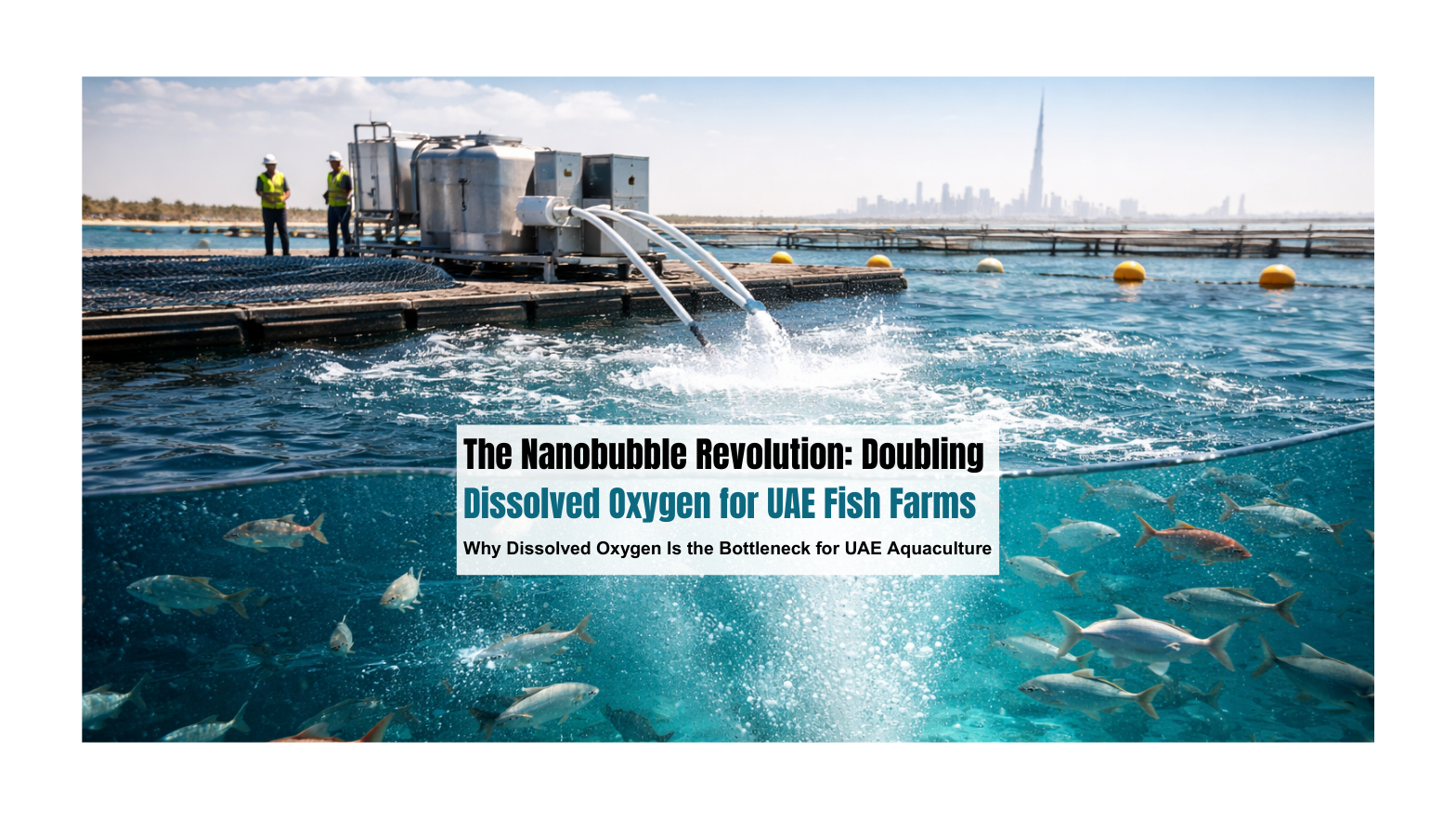
The Nanobubble Revolution: Doubling Dissolved Oxygen for UAE Fish Farms
The United Arab Emirates is racing against time. With over 90% of food currently imported and summer water temperatures routinely exceeding 32°C in recirculating aquaculture systems, the nation’s ambitious Vision 2031 and National Food Security Strategy 2051 face a fundamental biological constraint: oxygen.
In the hyperarid Gulf climate, where evaporation rates soar and salinity concentrations climb, maintaining adequate dissolved oxygen (DO) levels in fish and shrimp farms isn’t just a technical challenge, it’s the difference between commercial viability and catastrophic stock losses. Traditional aeration methods struggle in these extreme conditions, achieving oxygen transfer efficiencies below 15% while consuming enormous amounts of energy.
Enter nanobubble technology: a precision oxygenation solution delivering over 90% transfer efficiency, fundamentally reshaping what’s possible for aquaculture operations from Jebel Ali to the Northern Emirates.
Why Dissolved Oxygen Is the Bottleneck for UAE Aquaculture
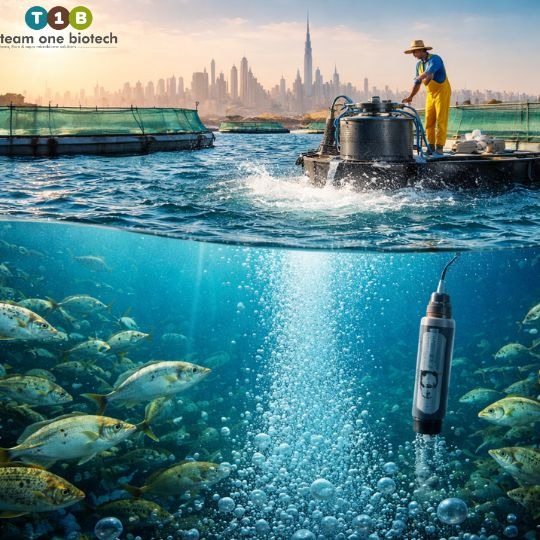
Dissolved oxygen drives every biological process in aquaculture systems. Fish and shrimp require consistent DO levels above 5 mg/L for optimal growth, feed conversion, and disease resistance. Drop below this threshold, and you’re looking at stress-induced mortality, suppressed immune function, and feed waste that compounds water quality problems.
The UAE’s environmental conditions create a perfect storm for oxygen depletion:
- Elevated water temperatures reduce oxygen solubility, water at 32°C holds 40% less dissolved oxygen than water at 20°C
- High salinity from desalination sources further decreases oxygen-holding capacity by approximately 20% compared to freshwater
- Intensive stocking densities required for commercial profitability create massive biological oxygen demand
- Limited water exchange in recirculating systems means oxygen must be actively injected rather than naturally replenished
A 2023 study of UAE aquaculture facilities found that conventional aeration systems consumed up to 35% of total operational energy while still experiencing critical DO crashes during peak afternoon temperatures. This represents both an economic drain and a fundamental limitation on production capacity.
The result? UAE fish farms are forced to operate at 40-60% of their theoretical stocking capacity simply to avoid oxygen-related die-offs.
The Science Behind Nanobubble Technology
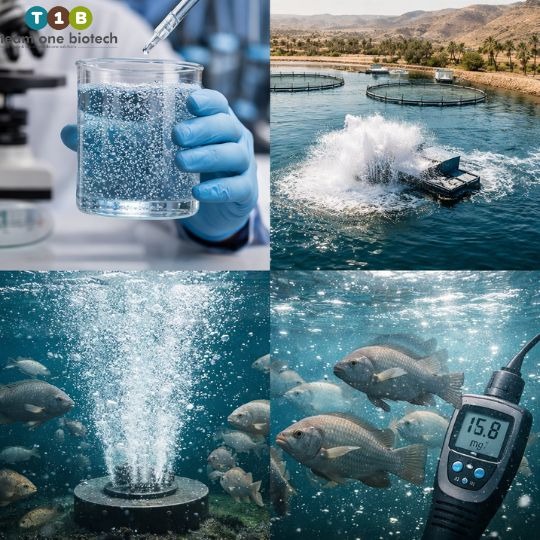
Nanobubbles are not simply smaller versions of the bubbles generated by conventional aerators. They represent a fundamentally different physical phenomenon with unique properties that make them ideal for aquaculture oxygenation.
What Makes Nanobubbles Different
Standard aeration bubbles measure 2,000-5,000 microns in diameter. They rise rapidly to the surface, bursting within seconds and transferring only 10-15% of their oxygen content to the water. This is why traditional aerators create surface turbulence, most of the oxygen escapes to the atmosphere unused.
Nanobubbles, by contrast, measure less than 200 nanometers (0.2 microns), approximately 10,000 times smaller than conventional bubbles. At this scale, surface tension and Brownian motion fundamentally alter bubble behavior:
- Near-neutral buoyancy: Nanobubbles rise at less than 0.1 mm per second, remaining suspended in the water column for weeks or months rather than seconds
- Massive surface area: One cubic centimeter of nanobubbles provides over 60 square meters of gas-liquid interface for oxygen transfer
- Internal pressurization: The high internal pressure (over 20 atmospheres in a 100-nanometer bubble) drives oxygen into solution even in already-saturated water
- Extended contact time: With residence times measured in days rather than seconds, oxygen transfer approaches 90-95% efficiency
Practical Implications for UAE Operations
For a commercial fish farm in Abu Dhabi operating a 1,000-cubic-meter raceway system, the mathematics are compelling:
Traditional fine-bubble aeration:
- Oxygen transfer efficiency: 12-15%
- Required airflow: 2,500 L/min to maintain 6 mg/L DO
- Energy consumption: 18-22 kW continuous
- Monthly energy cost (AED 0.30/kWh): AED 3,960-4,752
Nanobubble technology for aquaculture UAE:
- Oxygen transfer efficiency: 90-95%
- Required oxygen injection: 350 L/min equivalent
- Energy consumption: 3-4 kW continuous
- Monthly energy cost: AED 648-864
- Energy savings: 82-84%
Beyond energy economics, nanobubble systems enable consistent DO levels above 7 mg/L even during thermal peaks, eliminating the afternoon DO crashes that plague conventional systems. This translates directly to improved feed conversion ratios (FCR), faster growth rates, and dramatically reduced mortality during critical production phases.
Addressing UAE-Specific Aquaculture Challenges

The UAE’s unique position, combining desert climate extremes with aggressive food security targets, creates challenges that demand precision-engineered solutions.
Challenge 1: Water Scarcity and Desalination Dependency
The UAE has no natural freshwater resources adequate for large-scale aquaculture. Nearly all operations rely on desalinated seawater or brackish groundwater, both of which come with inherent oxygen limitations and costs approaching AED 4-7 per cubic meter.
Nanobubble technology enables ultra-intensive recirculating systems with water exchange rates below 3% daily, less than one-tenth of conventional flow-through requirements. For a 500-ton annual production shrimp farm, this represents water savings of over 45,000 cubic meters annually, equivalent to AED 180,000-315,000 in avoided desalination costs.
Challenge 2: Salinity Variation and Hypersaline Conditions
Shrimp farms in the Northern Emirates frequently operate at salinities of 40-45 ppt due to evaporative concentration. At these salinity levels, oxygen solubility drops to just 6.5 mg/L at 28°C, barely above the threshold for healthy shrimp.
Conventional aeration cannot overcome this physical limitation. Nanobubble systems, however, can achieve supersaturation levels of 120-150%, maintaining DO above 8 mg/L even in hypersaline conditions. This capability is particularly valuable for high-value species like white leg shrimp (Litopenaeus vannamei) where consistent oxygenation directly impacts final harvest size and marketability.
Challenge 3: Summer Temperature Extremes
June through September brings catastrophic risk to UAE aquaculture. Water temperatures in outdoor systems regularly exceed 34°C in Jebel Ali and industrial zones, while indoor RAS facilities struggle with cooling costs.
Dissolved oxygen optimization through nanobubbles provides a critical buffer. By maintaining DO at 8-9 mg/L rather than the bare minimum 5 mg/L, fish experience substantially reduced thermal stress. Research from UAE University’s Marine Science Department documented 35% lower cortisol levels and 28% improved survival rates in barramundi (Lates calcarifer) held at 33°C when DO was maintained above 8 mg/L via nanobubble supplementation.
Real-World Performance: UAE Case Applications
Case Study: Dubai Shrimp Farm Yield Improvement
A 12-hectare intensive shrimp operation near Jebel Ali implemented nanobubble technology across six production ponds in 2023. The facility previously struggled with afternoon DO drops to 3.5-4.0 mg/L during peak season, forcing harvest weights below 16 grams despite 120-day production cycles.
Following nanobubble installation:
- Minimum daily DO increased from 3.8 mg/L to 7.2 mg/L
- Average harvest weight improved from 15.3g to 21.7g (+42%)
- Feed conversion ratio improved from 1.68 to 1.42 (-15%)
- Survival rate increased from 68% to 81% (+19%)
- Overall yield per hectare increased by 73%
The operation achieved ROI on the nanobubble system within 1.3 production cycles.
Case Study: Abu Dhabi Tilapia RAS Efficiency
A 200-ton capacity indoor recirculating system producing Nile tilapia for the local market replaced its aging blower-based aeration with a staged nanobubble injection system. The primary objective was reducing electrical consumption while improving biosecurity through water conservation.
Results after six months:
- Daily water makeup reduced from 8% to 2.5% of system volume
- Aeration energy consumption decreased 79%
- Consistent DO levels eliminated need for emergency oxygen supplementation
- Reduced water exchange improved biofilter stability and reduced nitrate accumulation
- Total operating cost per kilogram decreased by AED 1.85
Integration with UAE Food Security Objectives

The UAE National Food Security Strategy 2051 explicitly targets domestic production of 60% of consumed food by mid-century. Aquaculture represents one of the most space-efficient and water-efficient protein production pathways available in a desert environment.
However, achieving the strategy’s targets requires production intensification, growing more fish in the same water volume. Traditional aquaculture operates at roughly 20-40 kg/m³ in flow-through systems. With optimized DO management via nanobubble technology, intensive RAS operations in the UAE are achieving sustained production densities of 80-120 kg/m³.
This intensity multiplication is precisely what Vision 2031 demands: leveraging advanced technology to overcome natural resource constraints. Nanobubble systems also align with the “Made in the UAE” initiative by reducing dependence on imported frozen seafood while providing fresh, traceable protein to hotels, restaurants, and consumers.
Supporting Local and Global Sustainability Goals
Beyond national strategy alignment, nanobubble technology contributes to broader environmental objectives:
- Reduced carbon footprint: 80%+ energy savings directly translate to lower emissions per kilogram of fish produced
- Minimized water extraction: Critical in a region where groundwater depletion is accelerating
- Improved biosecurity: Reduced water exchange limits disease vector introduction
- Enhanced product quality: Fish grown in optimal oxygen conditions demonstrate superior flesh quality, color, and shelf life
Implementation Considerations for UAE Operators
System Sizing and Design
Proper nanobubble system specification requires understanding your facility’s oxygen demand profile. Key factors include:
- Species-specific requirements: Shrimp demand different DO profiles than finfish; larval stages require higher and more stable DO than adults
- Stocking density targets: Higher biomass per cubic meter requires proportionally greater oxygenation capacity
- Temperature management: Summer peak temperatures require 40-50% additional capacity for thermal safety margins
- Water source salinity: Hypersaline systems need higher injection rates to achieve equivalent DO concentrations
Professional system design typically involves computational fluid dynamics (CFD) modeling to optimize injection point placement and circulation patterns within your specific tank or pond geometry.
Maintenance and Operational Requirements
One advantage of nanobubble technology is minimal ongoing maintenance. Unlike mechanical aerators with motors, bearings, and impellers operating in corrosive saltwater, nanobubble generators function through controlled cavitation or pressure dissolution, no moving parts in contact with production water.
Typical maintenance consists of:
- Quarterly inspection of gas injection ports for mineral scaling (minor in desalinated water systems)
- Annual service of oxygen concentrator units if using atmospheric oxygen extraction
- Routine monitoring of DO sensors and control system calibration
Most UAE installations operate continuously for 18-24 months between service intervals.
Integration with Existing Infrastructure
Nanobubble systems retrofit easily into existing facilities. Whether you’re operating traditional earthen ponds, concrete raceways, or sophisticated RAS, nanobubble injection can supplement or replace conventional aeration without major structural modifications.
For new facilities, designing around nanobubble technology from the outset enables even greater optimization, including:
- Reduced emergency backup aeration requirements
- Smaller biofilter sizing (due to lower water exchange and improved nitrification efficiency)
- Simplified tank geometry (elimination of dead zones since nanobubbles distribute uniformly)
Planning a new facility or expansion? Our engineering team provides complimentary preliminary design review for projects above 50-ton annual capacity. Schedule your consultation.
Economic Analysis: Investment and Returns
The business case for nanobubble technology rests on three value pillars:
1. Direct Energy Savings With electricity representing 15-25% of operating costs in intensive aquaculture, an 80% reduction in aeration energy delivers immediate bottom-line impact. For a 100-ton annual production facility, this typically translates to AED 45,000-75,000 in annual savings.
2. Production Intensification The ability to safely stock at higher densities without oxygen limitation means greater output from the same physical infrastructure. This is particularly valuable in the UAE where land costs are high and suitable locations are scarce.
3. Quality and Survival Improvements Reduced stress, improved FCR, and higher survival rates compound across production cycles. Industry data suggests that optimized DO management contributes 12-18% improvement in overall profitability even before considering energy savings.
Typical UAE installations see full payback within 18-28 months, with system lifespans exceeding 10 years.
Global Quality, Local Support
Team One Biotech stands at the intersection of global innovation and regional expertise. As a certified solutions provider specializing in Middle Eastern aquaculture technology, we deliver proven nanobubble systems backed by comprehensive local support across the Emirates.
Our approach combines:
- World-class technology: Partnerships with leading nanobubble equipment manufacturers ensuring access to the most advanced systems available
- Regional customization: Solutions engineered specifically for Gulf climate conditions, water chemistry, and species profiles
- Full-spectrum support: From initial feasibility studies through installation, commissioning, training, and ongoing optimization
- Bilingual technical team: Arabic and English-speaking engineers based in the UAE for rapid response and consultation
For international clients and partners seeking detailed product specifications, technical documentation, and procurement options, we invite you to explore our official T1B Alibaba Store, your primary portal for accessing our complete product catalog, verified certifications, and streamlined international ordering.
Whether you’re operating a small-scale demonstration facility or planning a multi-hectare commercial installation, Team One Biotech provides the expertise and technology to transform your dissolved oxygen management from a limitation into a competitive advantage.
Looking to improve your ETP/STP efficiency with the right bioculture?
Talk to our experts at Team One Biotech for customised microbial solutions.
Contact: +91 8855050575
Email: sales@teamonebiotech.com
Visit: www.teamonebiotech.com
Discover More on YouTube – Watch our latest insights & innovations!-
Connect with Us on LinkedIn – Stay updated with expert content & trends!
