


Washroom Odor Control in Public Toilets: Using Bacterial Cultures for Long-Term Results
A freshly renovated corporate headquarters in Gurugram or Bengaluru. Polished granite floors, motion-sensor faucets, premium sanitary ware. The facilities team has spent weeks ensuring everything is spotless before the doors open. And then, within three months, the same complaint arrives from every corner of the building, the washrooms smell.
Not faintly. Aggressively.
For a facility manager, few operational failures carry the reputational weight of a malodorous restroom. It does not matter how sophisticated the air-conditioning system is, or how regularly the housekeeping team mops the floors. The odor is still there, embedded deep beneath the surface, reactivated by every flush and every degree of rising temperature. In a hospital corridor, it triggers patient anxiety. In a school, it discourages children from using the facilities at all, with downstream consequences on health. In a shopping mall, it shortens dwell time and quietly damages the brand promise.
Facility managers across sectors know this trap intimately. The standard response, deploying heavy aerosol masking fragrances, pouring acid-based urinal cleaners, and scheduling more frequent mopping cycles, provides relief for a few hours at most. By the afternoon peak, the complaints are back.
This is not a housekeeping failure. It is a chemistry problem, and no amount of fragrance can solve a chemistry problem.
What actually solves it is biology.
This is where a purpose-engineered washroom odor control solution built on live bacterial cultures changes the entire equation. Team One Biotech has spent years developing industrial-grade biological formulations for organic waste conditions found in Indian institutional and commercial washrooms. Understanding why these solutions work requires first understanding why everything else does not.
The Root Cause: What Your Chemical Cleaner Is Missing
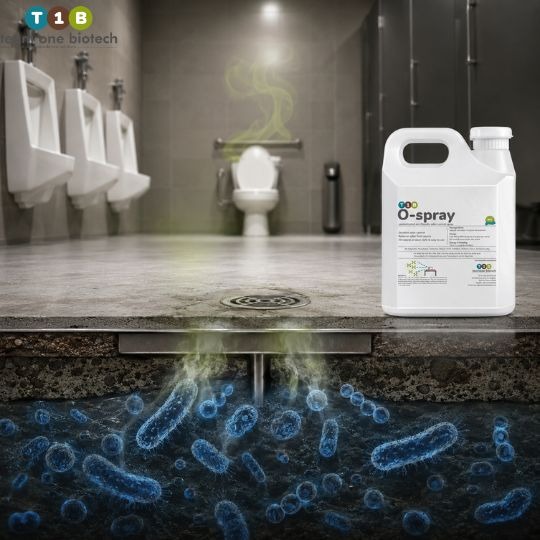
The odor you detect in a heavily used public toilet is not surface dirt. By the time it registers in the air, the source is already microscopic, layered into porous surfaces, and largely invisible to standard cleaning protocols.
Here is the mechanism:
When urine contacts a tile floor or the grout between tiles, uric acid crystals begin forming immediately. Uric acid is notoriously insoluble in water. Standard mopping, even with disinfectant solutions, breaks up the surface residue but leaves the crystallized uric acid deposits intact within grout lines, cracks in flooring screed, and the micro-pores of older or lower-grade ceramic tiles.
Over time, ambient moisture reactivates these crystals, and the bacteria already present in the environment begin breaking them down through their own metabolic processes, releasing ammonia and mercaptans, the sulfuric, sharp, eye-watering compounds that define institutional restroom odor at its worst.
The core failure of chemical cleaners in commercial restroom odor removal is structural, not operational. Acid-based cleaners dissolve surface buildup but cannot penetrate deep enough into grout to address established uric acid deposits. Masking fragrances introduce a pleasant olfactory distraction for a brief window but do nothing to interrupt the decomposition cycle underneath. Heavy disinfectants kill surface bacteria but also damage the grout and sealant over time, increasing porosity, which actually accelerates future odor buildup.
In the Indian climate, this problem is not just more frequent. It is orders of magnitude more intense. Ambient temperatures across most of the subcontinent, routinely between 32°C and 42°C during peak seasons, accelerate organic waste degradation and microbial proliferation dramatically. High relative humidity compounds the effect. The result is that a washroom that might sustain a chemical cleaning cycle for 24 hours in a temperate climate may revert to baseline odor conditions in as little as 4 to 8 hours during an Indian summer. No fragrance budget survives that math.
The Science of Bioremediation: How Team One Biotech’s Bacterial Cultures Work
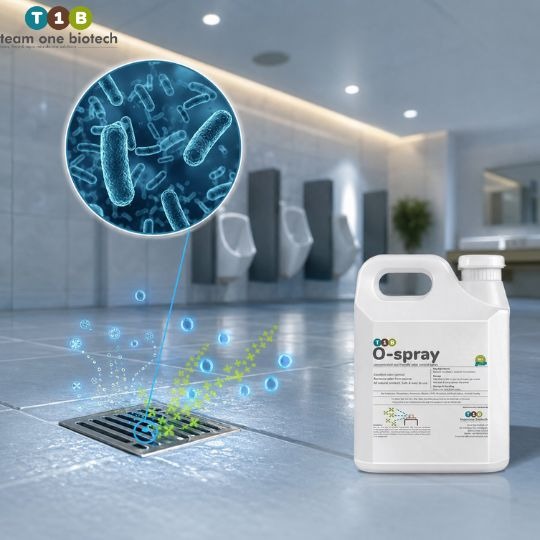
The biological approach to commercial restroom odor removal does not operate on the same logic as a cleaning product. It operates on the logic of an ecosystem.
Bacterial culture for cleaning in this context refers to carefully selected, concentrated formulations of non-pathogenic, beneficial microorganisms, primarily spore-forming bacilli and enzyme-producing strains, that target specific organic compounds as their food source.
When Team One Biotech’s bacterial formulations are introduced into a washroom environment through regular application protocols, the following sequence occurs:
- The bacteria secrete enzymes, proteases, ureases, and lipases, that break down uric acid, urea, proteins, and fats at the molecular level. This is not surface action. Enzymes penetrate into porous grout and reach deposits that no liquid chemical can access.
- Organic matter is consumed, not masked. The bacteria metabolize the odor source directly. Ammonia is not covered up; it is eliminated as a byproduct of the bacteria’s own metabolic cycle.
- A self-sustaining biofilm establishes itself on treated surfaces over an initial period of approximately 2 to 4 weeks. This beneficial biofilm competes actively with and displaces odor-causing bacterial communities, maintaining a biologically suppressed environment between cleaning cycles.
Note: These are general values and operational outcomes will vary based on the specific design, microbial load, and unique parameters of individual Effluent Treatment Plants (ETPs).
The practical implication for a facility manager is profound: rather than a cleaning product that needs to be reapplied constantly to compensate for its own short effectiveness window, a biological treatment builds compounding results over time. The longer it is in place, the more stable and self-maintaining the odor control becomes.
This is institutional hygiene solutions design at its most efficient, biology doing the work that chemistry fundamentally cannot.
Sector Impact Analysis: Why the Stakes Are Different Depending on Who Uses Your Washrooms
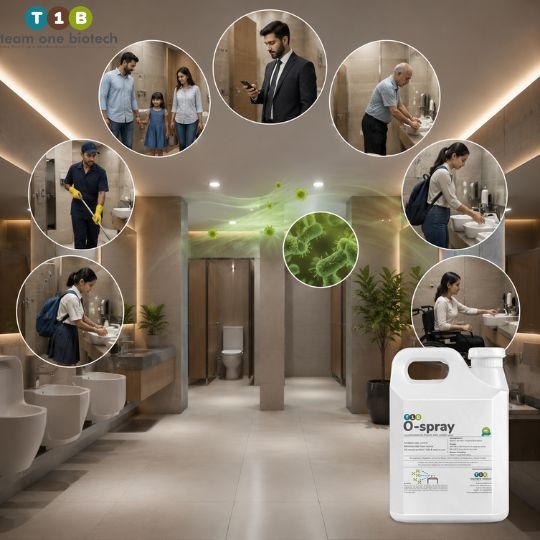
Hospitals
In a healthcare setting, the public toilet maintenance standard is not just about comfort, it is a clinical and regulatory matter. Persistent ammonia odors in patient washrooms or ward toilet facilities directly correlate with patient-reported dissatisfaction and, in certain ward environments, can indicate inadequate sanitation protocols to visiting inspectors.
The critical constraint here is that many chemical approaches introduce their own problems. Harsh acid cleaners and heavy disinfectants release volatile organic compounds (VOCs) that are a documented irritant for patients with respiratory conditions, post-surgical sensitivities, and compromised immune responses. In a neonatal unit or oncology ward, this is not a theoretical risk, it is an operational one.
Team One Biotech’s bacterial cultures are non-toxic, non-fuming, and non-corrosive. They produce no VOCs. They do not require evacuation of the area during or after application. For hospitals managing an uninterrupted schedule of patient movement, this matters enormously. The biological formulation continues working passively after application, requiring no extended dwell time that would take a washroom out of service.
Schools
A school environment presents a uniquely demanding set of washroom conditions. The combination of high-frequency usage across a tight time window, the brief intervals between classes, chaotic usage patterns from younger students, and inconsistent adherence to basic hygiene by children creates an organic load that can overwhelm standard cleaning schedules within hours.
More critically, any cleaning chemistry used in a school environment must meet a non-negotiable standard: it cannot pose a risk to children. Several institutional disinfectants and acid-based urinal cleaners carry cautionary labeling that makes their use around school populations at minimum uncomfortable and at maximum a compliance concern.
Bacterial cultures for cleaning in school washrooms are inherently safe. The microorganisms used are the same category of non-pathogenic bacteria present in healthy soil and in probiotic-grade food products. There is no caustic reaction risk, no fume hazard, and no risk from incidental contact. For school administrators who manage both the operational reality and the duty-of-care obligation, this matters as much as the odor control outcome itself.
Additionally, the organic waste degradation capacity of the bacterial formulation handles the specific waste profile of school washrooms, including the higher incidence of paper waste, food residue, and surface contamination, more comprehensively than standard mopping with a disinfectant.
Shopping Malls and Corporate Office Complexes
In premium commercial real estate, the washroom is an underappreciated brand touchpoint. A luxury mall that invests heavily in retail fit-out and shopper experience cannot afford to send a customer from a flagship boutique into a malodorous restroom. The sensory jarring is immediate and the associative brand damage is real. The same principle applies to a corporate office complex hosting clients.
There is a secondary and less frequently discussed consequence of heavy chemical use in these environments: structural degradation. Acid-based cleaners, applied repeatedly over months and years, erode grout, pit tile glazing, and compromise the sealant integrity of flooring systems. In facilities where the original tile and stone work represent a significant capital investment, the accelerated replacement cycle driven by chemical damage is a genuine cost center.
Bacterial culture applications, by contrast, are pH-neutral and non-corrosive. They extend the life of washroom surfaces rather than compromising them. For a mall or corporate facility running on an asset protection mandate, this is a measurable operational benefit beyond the odor control outcome.
Head-to-Head: Chemical Cleaners vs. Bacterial Cultures
| Parameter | Chemical Cleaners / Masking Agents | Team One Biotech Bacterial Cultures |
| Odor Elimination | Temporary masking; source remains active | Eliminates the organic source at molecular level |
| Depth of Action | Surface and near-surface only | Penetrates grout, pores, and subsurface deposits |
| Duration of Effect | 4 to 12 hours typically | Builds toward sustained control over 2 to 4 weeks |
| Surface Impact | Acid-based formulas degrade grout and tile over time | pH-neutral; protects and preserves surface integrity |
| VOC / Fume Emission | Present in many industrial-grade formulations | None; non-fuming and non-toxic |
| Safety Profile | Requires precautions, PPE in some applications | Safe for occupied spaces including schools and hospitals |
| Environmental Load | High chemical oxygen demand in wastewater discharge | Low; biodegradable; reduces ETP shock load |
| Long-Term Cost Trend | Recurring and escalating as resistance and porosity increase | Reduces over time as biofilm self-maintains |
Note: These are general values and operational outcomes will vary based on the specific design, microbial load, and unique parameters of individual Effluent Treatment Plants (ETPs).
If your current washroom protocol is delivering the same complaints on a weekly cycle, it is time to request a biological audit. Contact Team One Biotech to assess your facility’s specific organic load profile and design a targeted bacterial culture program.
The Indian Compliance and ETP Synergy: A Factor That Most Facility Managers Have Not Considered
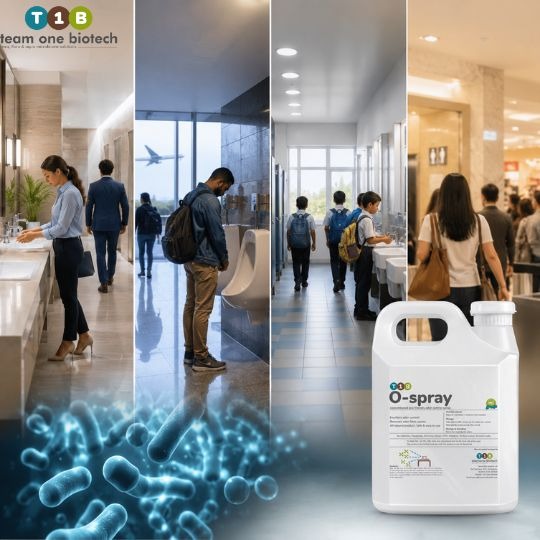
There is a dimension to this conversation that rarely appears in discussions about public toilet maintenance in India but has significant operational and regulatory relevance: what happens to your washroom wastewater after it leaves the drain.
Commercial and institutional facilities above a certain footprint are required to manage their wastewater through on-site or shared Effluent Treatment Plants (ETPs). The performance of these ETPs is directly affected by what flows into them.
Heavy chemical cleaners, particularly acid-based products and quaternary ammonium disinfectants used in high volumes across large facilities, introduce a chemical shock load into the wastewater stream. This disrupts the biological treatment processes within the ETP, which rely on their own microbial communities to break down organic matter. When those microbial communities are suppressed by incoming chemical load, ETP performance degrades, effluent quality declines, and the facility moves closer to a compliance threshold.
Switching to bacterial-culture-based institutional hygiene solutions has a directly measurable effect on this dynamic. Bioenzyme-based cleaning products do not introduce disruptive chemicals into the wastewater stream. In fact, the active bacterial content in the wastewater actually supplements the biological processes within the ETP, improving organic load digestion by approximately 30% to 60% in well-managed systems.
Note: These are general values and operational outcomes will vary based on the specific design, microbial load, and unique parameters of individual Effluent Treatment Plants (ETPs).
This alignment with Indian sustainability standards, particularly as regulatory scrutiny of commercial wastewater compliance intensifies under frameworks like the Environment Protection Act and CPCB discharge norms, makes the biological transition not just operationally sensible but strategically sound. Facility managers who are ahead of this curve will have a significantly simpler compliance conversation than those who are not.
Moving from Reactive Odor Masking to Proactive Biological Control
The operational reality for most facility managers today is that washroom odor management is a firefighting exercise. A complaint arrives, a cleaning crew responds, a fragrance is deployed, and the cycle repeats. The budget is consumed not in prevention but in constant response.
Biological treatment reframes this entirely. The investment is front-loaded in the establishment phase, the 2-to-4-week period during which the bacterial biofilm colonizes treated surfaces and begins outcompeting odor-causing microbial communities. After that window, the maintenance requirement decreases, the complaint frequency drops, and the operational cost of managing washroom hygiene begins to normalize at a lower level.
Note: These are general values and operational outcomes will vary based on the specific design, microbial load, and unique parameters of individual Effluent Treatment Plants (ETPs).
For hospitals managing patient perception and clinical compliance simultaneously. For schools managing a duty of care alongside a tight maintenance budget. For malls and corporate complexes managing brand equity through every square foot of the facility, this is not a marginal improvement. It is a structural change in how washroom hygiene works.
The question is not whether bacterial cultures deliver better long-term results than chemical cleaners. The science, the field data, and the environmental chemistry are unambiguous on that point.
The question is when your facility makes the transition.
Partner with Team One Biotech for a Site-Specific Washroom Bioremediation Audit
Team One Biotech works directly with facility managers, operations directors, and administration heads to design bioremediation programs that are built around the specific organic load, footfall patterns, surface conditions, and wastewater management requirements of your individual facility, not a generic off-the-shelf protocol.
Our washroom bioremediation audits cover:
- Surface and grout assessment for existing uric acid and organic waste penetration depth
- Microbial load profiling to identify dominant odor-causing bacterial communities
- Custom bacterial culture selection matched to your facility’s waste chemistry
- ETP compatibility review to ensure your biological transition supports, not disrupts, your wastewater management system
- Implementation protocol design with measurable performance checkpoints
If your facility is a hospital, a school campus, a shopping mall, or a corporate complex with a persistent washroom odor problem that conventional cleaning has failed to resolve, the answer has been biological from the beginning. You now know exactly why.
Reach out to Team One Biotech today. Let us conduct a washroom bioremediation audit at your facility and build you a biological odor control program that actually lasts.
Looking to improve your ETP/STP efficiency with the right bioculture?
Talk to our experts at Team One Biotech for customised microbial solutions.
Contact: +91 8855050575
Email: sales@teamonebiotech.com
Visit: www.teamonebiotech.com
Discover More on YouTube – Watch our latest insights & innovations!-
Connect with Us on LinkedIn – Stay updated with expert content & trends!