
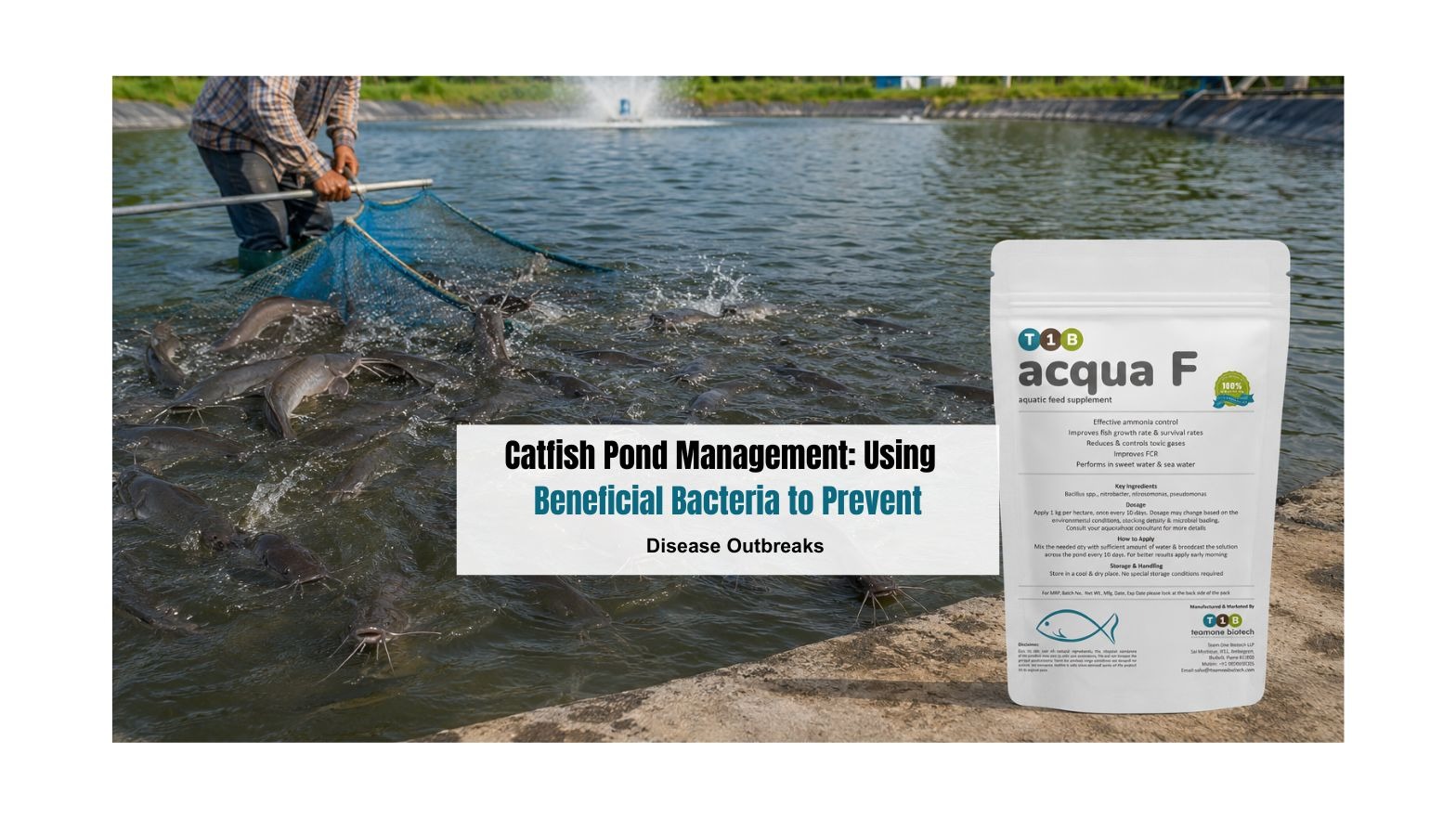
Catfish Pond Management: Using Beneficial Bacteria to Prevent Disease Outbreaks
Your Pangasius batch is looking dense and healthy. Feed conversion has been steady, and you have mentally already calculated the margins. Then, at five in the morning, your pond manager calls. There is a kill. Not a few fish floating at the edges, a mass mortality event, hundreds of kilograms of market-ready fish belly-up, the water turned gray-brown overnight.
The culprit is rarely a single dramatic event. It is almost always the result of a slow, invisible accumulation: organic sludge building silently on the pond floor, ammonia climbing past the threshold of tolerance, dissolved oxygen crashing under the weight of a bacterial bloom. By the time the fish are visibly stressed, the window for intervention has already closed.
This is the economic reality of catfish pond management when it is treated reactively rather than proactively.
Traditional interventions, lime treatments, emergency aeration, broad-spectrum antibiotics, are the aquaculture equivalent of a fire extinguisher. They can contain immediate damage, but they do nothing to address the underlying microbial ecology that made your pond a disease incubator in the first place. Worse, repeated antibiotic use disrupts the very biological balance that keeps pathogen populations in check, leaving you with resistant bacterial strains and a weakened natural defense system.
Aquaculture probiotics for fish farming represent a fundamental shift in how commercial pond systems are managed. These are concentrated consortia of beneficial microorganisms, primarily spore-forming Bacillus species and nitrifying bacteria, introduced directly into pond water and sediment to establish a stable, competitive microbial environment.
In fish farming, probiotics function on multiple levels simultaneously: they suppress pathogenic bacteria through competitive exclusion, accelerate the breakdown of toxic ammonia and nitrite through biological nitrification, and digest accumulated organic sludge that would otherwise drive water quality degradation.
For catfish species like Pangasius and Clarias, which are farmed at high densities with significant organic waste loads, a well-designed probiotic program is not an additive to pond management. It is the biological architecture that makes sustained, healthy production possible.
The conversation in modern commercial aquaculture has shifted decisively. Beneficial bacteria for aquaculture are not a supplementary luxury, they are the foundation of a sustainable, disease-resistant pond system.
The Anatomy of a Catfish Disease Outbreak
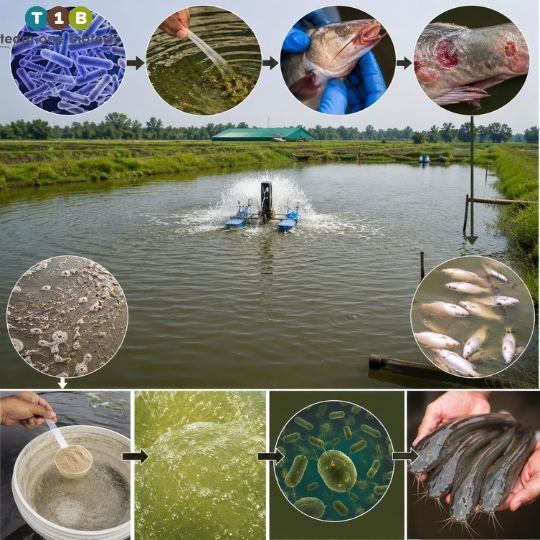
To understand the solution, you need to understand the cascade.
The Organic Loading Problem
Every gram of uneaten feed, every gram of fish waste, every algal cell that dies and sinks, all of it accumulates in the benthic layer of your pond. In high-density catfish systems, particularly those cultivating Clarias gariepinus (African catfish) or Pangasius hypophthalmus, this organic loading is aggressive. The bottom of a productive catfish pond can accumulate a layer of decomposing matter within a single production cycle that would take years to build in a natural lake ecosystem.
This sludge layer is not inert. It is a microbial battleground. When oxygen penetrates it, aerobic decomposition proceeds efficiently. When it does not, which happens during thermal stratification, during calm pre-dawn hours, or after overfeeding events, anaerobic fermentation takes over. This produces hydrogen sulfide, methane, and drives ammonia concentrations upward.
The Ammonia-Pathogen Connection
Elevated total ammonia nitrogen (TAN) and rising nitrite levels are not just toxic to fish in isolation. They create physiological stress that compromises the mucosal immune barriers of catfish, the gill tissue, the skin, the intestinal lining. Aeromonas hydrophila, one of the most destructive opportunistic pathogens in freshwater catfish culture, essentially waits for this window. In a well-oxygenated, low-ammonia pond, its population remains suppressed by competitive microbiota. Once water quality degrades, it multiplies rapidly and penetrates the compromised tissue of stressed fish.
Flavobacterium columnare, responsible for Columnaris disease, follows a similar pattern, thriving in warm, organically loaded water and targeting fish already weakened by suboptimal water chemistry.
The disease outbreak you wake up to is rarely sudden. It is the final chapter of a story that started weeks earlier at the bottom of the pond.
The Bioremediation Solution: How Beneficial Bacteria Actually Work
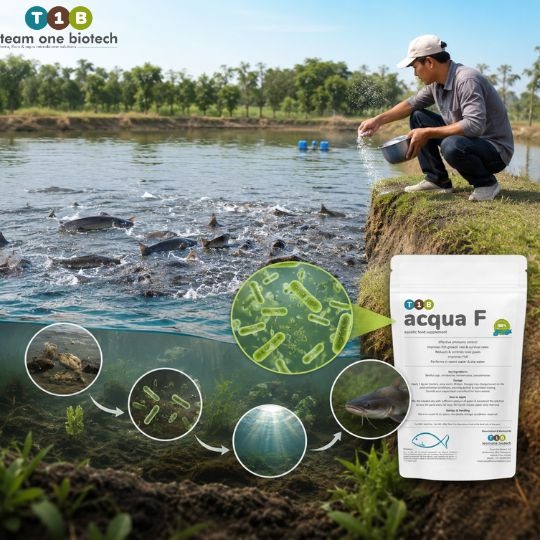
Aquaculture bioremediation through bacterial inoculants is not a new concept, but the precision with which modern formulations work has made it genuinely transformative for commercial operations.
Competitive Exclusion of Pathogens
Bacillus strains, particularly Bacillus subtilis, Bacillus licheniformis, and Bacillus amyloliquefaciens, colonize the water column and pond substrate by secreting antimicrobial compounds including bacteriocins, lipopeptides, and biosurfactants. These compounds directly inhibit the growth of Aeromonas and Flavobacterium by disrupting their cell membranes and competing for the attachment sites and nutrient resources that pathogenic bacteria depend on.
This is not selective pressure, it is ecological displacement. When beneficial bacteria occupy the available biological space, pathogenic populations are structurally prevented from reaching disease-causing concentrations.
Nitrogen Cycle Stabilization
Nitrifying bacteria, primarily Nitrosomonas and Nitrobacter species, are the biological engines of ammonia detoxification. Nitrosomonas converts toxic ammonia to nitrite; Nitrobacter then converts nitrite to comparatively benign nitrate. In a newly stocked or disturbed pond, these populations are insufficient and slow to establish. Seeding your pond with concentrated, shelf-stable nitrifying inoculants dramatically accelerates this process, compressing the nitrogen cycle stabilization period from several weeks to a window of approximately 1 to 3 weeks depending on initial conditions.
Note: These are general baseline values. Specific operational outcomes, water parameter stabilization timelines, and biological performance will vary based on regional water quality, stocking densities, feed management, and the unique environmental dynamics of individual aquaculture ponds or Effluent Treatment Plants (ETPs).
Organic Sludge Digestion
Heterotrophic Bacillus strains produce extracellular enzymes, proteases, lipases, amylases, cellulases, that break down the complex organic molecules in pond sludge into simpler compounds that can be assimilated or safely off-gassed. A consistent probiotic dosing program can meaningfully reduce accumulated benthic sludge over a production cycle, often showing measurable improvement in sediment depth and color within a 4 to 8 week period of regular application.
Note: These are general baseline values. Specific operational outcomes, water parameter stabilization timelines, and biological performance will vary based on regional water quality, stocking densities, feed management, and the unique environmental dynamics of individual aquaculture ponds or Effluent Treatment Plants (ETPs).
The Economic Reality of Disease: A Number You Cannot Afford to Ignore
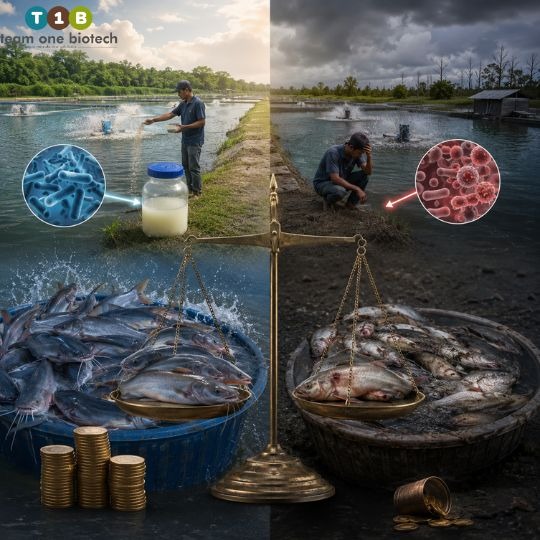
When a disease outbreak hits a commercial catfish operation at 60% to 80% of the production cycle, the financial damage is not limited to fish mortality. Factor in emergency inputs, labor, compromised growth rates in surviving stock, the potential loss of buyer contracts if delivery timelines are missed, and the reputational cost with buyers who track your quality metrics, and a single outbreak can set a farm back by one to three full production cycles in economic terms.
This is the moment to make a decision about how you manage your ponds going forward.
Team One Biotech works directly with commercial catfish farmers and hatchery operators across India to develop site-specific bioremediation programs using high-CFU bacterial consortia precisely formulated for tropical freshwater aquaculture conditions. If you are currently managing water quality reactively, our technical team can help you build a proactive system that protects your harvest, your margins, and your pond’s long-term productivity.
Connect with Team One Biotech’s aquaculture specialists today to request a tailored pond water management assessment.
Species and Phase Specifics: Pangasius, Magur, and Hatchery Systems
High-density Pangasius cultivation in earthen ponds operates at stocking densities that push the biological limits of self-regulating pond ecosystems. The feeding aggression of this species, combined with its rapid growth requirements and high protein feed inputs, generates organic waste loads that require structured microbial management from day one of stocking.
For Clarias (Magur) systems, which are often operated in smaller, intensively managed ponds across eastern and northeastern India, the challenge is slightly different. These systems tend to have higher sediment disturbance due to the bottom-feeding behavior of the fish, which constantly resuspends organic matter and keeps ammonia flux unpredictable.
Fish hatchery management in India presents a distinct but equally critical application for beneficial bacteria. In hatchery systems, the tolerance thresholds for ammonia and pathogen loading are dramatically lower, larvae and fry are orders of magnitude more sensitive than grow-out stock. A probiotic program in hatchery water delivers a dual benefit: it suppresses Aeromonas and Pseudomonas populations that would otherwise devastate larval batches, and it stabilizes the nitrogen cycle in recirculating or flow-through systems where biological filtration is still establishing.
The Indian Context: Summer, Monsoon, and the Realities of Tropical Aquaculture

Pond water quality management in India cannot be designed around temperate assumptions. The operational calendar here is defined by two critical stress periods.
Peak Summer (March to June): Water temperatures in many aquaculture zones across Andhra Pradesh, West Bengal, Odisha, and the Northeast can sustain elevated temperatures for weeks on end. At these temperatures, microbial metabolism accelerates sharply, organic decomposition speeds up, oxygen demand rises, and the reproduction rate of opportunistic pathogens like Aeromonas can reach dangerous levels within days. Beneficial bacterial dosing frequency typically needs to increase during this window to maintain competitive populations.
Monsoon Onset (June to September): The first heavy monsoon rains introduce a massive dilution effect, rapid pH shifts, and freshwater influx that destabilizes established microbial communities. Ponds that have been running with a stable biological balance can experience sudden parameter swings that open disease windows. A structured pre-monsoon probiotic loading protocol, building up beneficial bacterial populations two to three weeks before anticipated rain, provides a buffer against this disruption.
Indian aquaculture operations targeting export markets are also increasingly aligned with MPEDA guidelines, which emphasize antibiotic reduction, traceability, and water quality compliance as conditions of market access. A documented probiotic-based water management program supports this compliance narrative and positions farms competitively in international buyer conversations.
Proactive Probiotics vs. Reactive Antibiotics: A Direct Comparison
| Parameter | Proactive Probiotic Management | Reactive Antibiotic Treatment |
| Approach | Preventive, ecological | Emergency, chemical |
| Cost Profile | Distributed, manageable over production cycle | Concentrated, high cost at crisis point |
| Pathogen Resistance Risk | Negligible | Significant with repeated use |
| Water Quality Impact | Actively improves DO, ammonia, nitrite balance | Disrupts beneficial microbial communities |
| Long-term Efficacy | Builds and improves with consistent application | Diminishes with repeated cycles |
| Export Compliance | Supports antibiotic-free certification | Creates residue and documentation risk |
| Soil/Sediment Health | Reduces sludge accumulation progressively | No impact on organic loading |
| Disease Recurrence Rate | Significantly reduced over successive cycles | High without structural water management change |
The math here is not complicated. Antibiotic treatments address symptoms in the final hours of a crisis. Probiotic water management eliminates the conditions that create the crisis.
Turning Catfish Farming Into a Predictable Science
The most successful commercial catfish operations in India share a defining characteristic: they have stopped treating pond management as crisis response and started treating it as biological engineering.
The pond is not a passive container for fish, it is a living system with its own microbial ecology, nutrient cycling dynamics, and cascade failure points. Managing that system with the right bacterial inputs, at the right concentrations, at the right intervals across a production cycle, is the difference between a farm that survives outbreaks and one that prevents them.
Every disease event you prevent is a harvest you protect. Every stable water column is a margin point you keep. And every production cycle that runs without antibiotic intervention is a step toward the kind of documented, traceable aquaculture operation that commands premium pricing in both domestic and export markets.
The tools exist. The microbiology is proven. The only variable is whether you implement it before or after the next kill.
Ready to move from reactive pond management to a proactive, science-driven bioremediation strategy?
Team One Biotech’s technical specialists work with commercial catfish farmers, hatchery operators, and aquaculture consultants across India to build customized beneficial bacteria programs, formulated for your species, your stocking density, your regional water chemistry, and your production calendar.
Contact Team One Biotech today. Protect your pond, protect your harvest, protect your margins.
Looking to improve your ETP/STP efficiency with the right bioculture?
Talk to our experts at Team One Biotech for customised microbial solutions.
Contact: +91 8855050575
Email: sales@teamonebiotech.com
Visit: www.teamonebiotech.com
Discover More on YouTube – Watch our latest insights & innovations!-
Connect with Us on LinkedIn – Stay updated with expert content & trends!